Inside Ithra’s ‘Horizon in Their Hands’ exhibition  

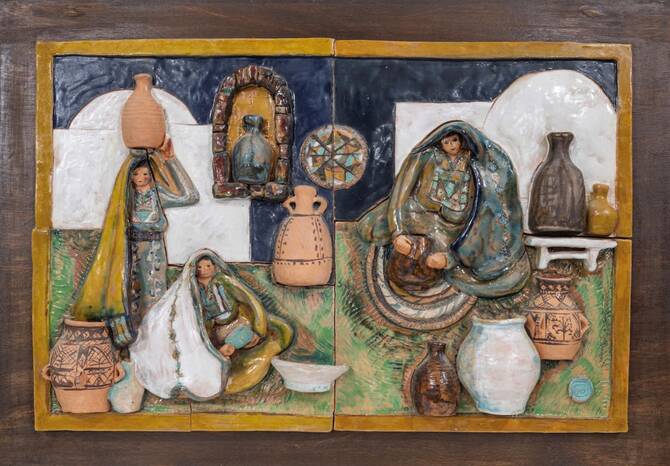
Vera Tamari, ‘Palestinian Women at Work,’ 1979, Ceramic relief. (Courtesy of Barjeel Art Foundation Collection, Sharjah)
Short Url
Updated 05 October 2025
Follow

Inside Ithra’s ‘Horizon in Their Hands’ exhibition  

  • Overlooked stories of pioneering Arab women come to light in new show 

DHAHRAN: There’s a new exhibition in town. Some of the artists you know, and some you don’t — which is exactly the point. 

The works of more than four dozen pioneering women from across the Arab world are on display — some for the first time ever — in “Horizon in Their Hands: Women Artists from the Arab World (’60s–’80s),” which opened Sept. 18 at the King Abdulaziz Center for World Culture (Ithra) in Dhahran and runs until Feb. 14. The show contains 70 works by artists from 13 countries. 


Fatima Hassan Assiri, ‘Untitled.’ (Courtesy of Jameelah Assiri)

“The idea behind the title was to give back agency to a generation of women who have been overlooked,” the show’s curator, Rémi Homs, tells Arab News. “We also wanted to see this relationship between arts and craft as a horizon for further research. And we wanted to have this idea of hands — something handmade.” 

The exhibition is a collaboration between Ithra and Barjeel, a UAE-based foundation established by Sultan Sooud Al-Qassemi in 2010. Of the 50 artists featured, four are from Saudi Arabia: Mona Al-Munajjed, Fatima Hassan Assiri, Mounirah Mosly, and Safeya Binzagr, regarded as the mother of Saudi modern art. Both Al-Munajjed and Binzagr are the subjects of an “In Focus” section of the show, along with the late Tunisian artist Safia Farhat, and the Wissa Wassef Art Center in Egypt, which preserves hand-weaving traditions. 


 Mona Al-Munajjed, ‘Dreams Come True in Saudi,’ 2022 - Batik on silk. (Courtesy of the artist)

Al-Munajjed’s works, including “Traditional Saudi Door” and “Minaret of Mosque” — both from the mid-Eighties — weave together personal memory and collective history, capturing intimate domestic scenes and broader social narratives of Jeddah. Using the fiery batik dyeing technique, she blends vibrant colors and subtle textures, creating visual stories that feel both deeply personal and historically resonant. 

Assiri, the mother of renowned artists Ahmed and Jamila Mater, showcases an untitled acrylic-on-wood panel piece — a complex composition that intertwines colors and motifs, employing the feminist-centric traditional Saudi art form, Al-Qatt Al-Asiri — which women historically used to decorate their homes with specific shapes, colors, and markings, and is listed on UNESCO’s Intangible Cultural Heritage of Humanity. 


Nadia Mohamed, ‘Palms and Fields,’ 2021 - Tapestry. (Courtesy of Barjeel Art Foundation Collection, Sharjah)

“The Young Woman,” by Mosly, exemplifies the late artist’s ability to blend portraiture with broader social and cultural themes, while Binzagr’s lithography etchings, intimate and bold, captured the spirit of Saudi life, blending figurative storytelling with a modernist sensibility that continues to resonate. Her 1980 work “Desert Ship,” depicting camels in front of a tent, is particularly striking. 

The show is split into thematic sections, including “Depicting a Rapid Modernization,” “Alternative Pathways: Self-Taught Artists,” “Revisiting Islamic Art Legacies,” “New Media Experimentation,” “Reclaiming Local Craft Practices,” and “Al-Qatt Al-Asiri.” 

Many of the works carry partial or unknown histories. Homs cites a brass piece by Egyptian artist Atyat El-Ahwal (1989), initially listed only by name and date.  

“We basically had no information about her,” he says. “We included her work because we wanted to focus not just on the more well-known names,” he said. Further research — and input from visitors and experts — helped uncover her full name, dates of birth and death (1919–2012), and even a video likely recorded in the 1970s found on YouTube, all allowing her work to be contextualized in a broader history.  

Everyday materials appear in surprising ways — transformed into abstract compositions, for example — and embroidery is reimagined as narrative painting. Henna recurs across many works; Homs highlighted Emirati pioneer Najat Makki, saying: “Henna was an accessible part of everyday life.”  

He praises the artists’ innovative and creative use of available materials. “Something that you cannot see in history books from the West, but it’s something very important and, in my opinion, very groundbreaking,” he says. 

And Homs is hopeful that the exhibition will lead to further revelations of artworks by women in the Arab world. 

“Yes, we are seeing 70 different works by 50 different artists—22 of whom are still alive,” he says. “But it’s the tip of the iceberg. I’d say that we are seeing maybe the first 5 percent of artists we need to discover.” 


SAMoCA’s collaboration with BIENALSUR takes playful approach to art  

Updated 14 November 2025
Follow

SAMoCA’s collaboration with BIENALSUR takes playful approach to art  

  •  ‘Let’s Play: A Labyrinth of Options’ presents work by 26 local and international artists 

RIYADH: The Saudi Museums Commission inaugurated the fourth Saudi edition of the International Biennial of Contemporary Art of South America (BIENALSUR) in October at the Saudi Arabia Museum of Contemporary Art, bringing a refreshing new perspective on what art can inspire: fun.  

Held under the theme “Let’s Play: A Labyrinth of Options,” the colorful and immersive show, which runs until Dec. 31, brings 26 local and international artists together under the curatorial direction of BIENALSUR’s artistic director Diana Wechsler.  

Saudi artist Arwa Alneami's 'Art Not a Race.' (Supplied)

BIENALSUR’s general director Aníbal Jozami told Arab News: “For us it's very important to be in Saudi Arabia because it’s a very important country and related to our country because we have an important percentage of our population with Arab origins — I’m an example myself. The goal of BIENALSUR is to bring culture to where the people are. It’s not an exhibition or a project for the upper classes; it’s a project for all. We’re in different museums in different countries around the world. 

“This is an exhibition with many different artists from different countries, where each artist had the freedom to say or do what they think,” he added.  

The museum has been transformed by light, sound and movement, with many works inviting direct participation. Audience-activated pieces, interactive sculptures and walkable installations set the tone for a dynamic experience, inspiring families, students and art enthusiasts alike.  

Carlos Amorales’ 'We’ll See How Everything Reverberates.' (Supplied)

From Mexican artist Carlos Amorales’ “We’ll See How Everything Reverberates” — an interactive sound piece that invites guests to strike cymbals — to Saudi artist Arwa Alneami’s “Art Not a Race,” which is both a workout and reminder that art is a natural progression, there’s something for everyone to contemplate.  

CEO of the Museums Commission, Ibrahim Al-Sanousi, told Arab News: “It's a unique theme, but it's a part of our lives. It's a part of our Saudi culture, where people enjoy playing in all forms. And this unites us as human beings all around the world as well. Playing may be one of the few traits that you see across all civilizations and across centuries among all human beings.  

“The theme of play is also a very important part of any creative industry,” he continued. “So through this theme, we, of course, invite all visitors to come and to enjoy. We are showing that artworks are meant to be open, are meant to be engaging, are meant to be interactive, and not just static things that you look at.” 

Visitors to the exhibition at SAMoCA. (Supplied)

The three-month exhibition is enhanced by two additional programs: SAFAR and MUNTADA SAMoCA, both presented by the museum.  

SAFAR is an outdoor concert series that bridges diverse disciplines and nurtures a growing community around the museum. It began on Oct. 28 with the first Riyadh performance by the French electro-chill collective Bon Entedeur, who blend disco, funk, and hip-hop.  

On Nov. 12, Nigerian “Blufunk” pioneer Keziah Jones took the stage to showcase his percussive guitar style in a blend of blues, funk, soul, and Yoruba heritage. The legendary Egyptian singer Umm Kulthum will also be revived by the duo Love and Revenge, who reimagine her legacy through electronic music and cinematic visuals. They’ll be playing Agmal Layali on Dec. 8, while artist Wael Kodeih will be giving a masterclass on Dec. 7.  

MUNTADA SAMoCA, ran from Nov. 2-8, offering masterclasses, workshops, panel discussions, and film screenings that explore how images are made, read, and shared in the modern day, held under the theme “Focus on Image: Tools, Language and its Power.” 

“Let’s Play” is an edition curated in part to celebrate BIENALSUR’s 10th anniversary. Originating at the Universidad Nacional de Tres de Febrero (UNTREF) in Buenos Aires and supported by UNESCO, the biennial now spans more than 70 cities and 140 institutions worldwide.  

The idea is to create spaces that are accessible for all, in both notable museums around the world and smaller neighborhood galleries, showcasing all types of art without any commercial compromises.  

“Saudi Arabia has been our partner since 2019, and to be here is very important for us, and we have different projects that we think we could improve with Saudi Arabia,” Jozami said.