

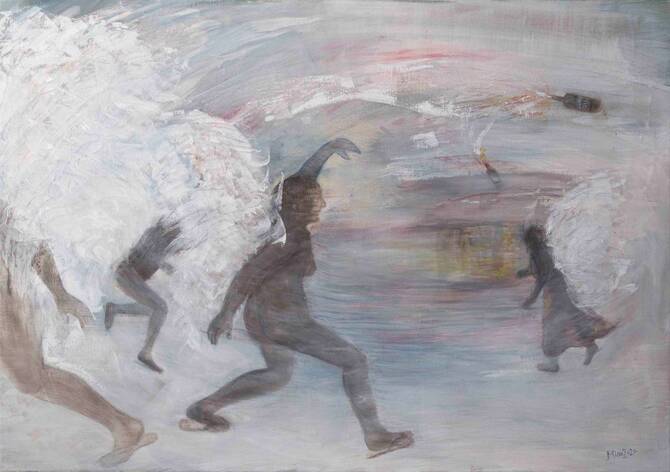

Sager Al-Qatil

‘Untitled’
This year’s Ramallah Art Fair is titled “Narratives Under Occupation.” It brings together 42 artists from Palestine and the Golan Heights who explore “contemporary themes of displacement, loss, identity, memory, and the daily realities under oppression, while also presenting artworks that envision a future without occupation,” according to the show catalogue. The fair is divided into two sections: Contemporary and Rare. This piece is from the latter section. Its self-taught creator, who died in 2004 aged 45, was one of the first members of the League of Palestinian Artists. His surrealist work, the catalogue states, “is often described as uncanny, depicting trauma and adverse experiences, relying on fantasy and freedom from the constraints of content and form.” It adds that Al-Qatil, who was born in Al-Amari Refugee Camp in Ramallah and was raised in another camp in Gaza, “spent much of his life seeking to break away from the burden of dispossession and trauma experienced by his family and community.”
Inass Yassin

‘100 Oranges in Yafa’
“Questioning, confrontation, rotation, and joy. These are my driving notions,” the artist says on her website. “Yet, in the Here, there is so much to play with, and that is just perfect.” The fair’s catalogue states that Yassin’s work “examines social shifts within Palestinian culture since the late 1980s” and “reveals the politics and aesthetics of transformation at both private and collective levels” by, among other things, “tracing incidents in the transforming cityscape.”
Noor Elshaer

‘Folds No. 3’
This is one of a series of works by the Golan Heights native featured in the fair that are based on the theme “Tayyat” (folds). “Her works feature internal conflicting emotions that accompany the experience of motherhood and daily rituals, such as folding scarves, which symbolizes closeness, contentment, and the memories they carry,” the fair catalogue states. Elshaer’s practice “centers on themes of absence, homeland, and longing, exploring emotional and psychological states.” Becoming a mother, it later adds, marked a “turning point” in Elshaer’s practice, “introducing new layers of vulnerability, anxiety, and reflection. The maternal figures in her work function as symbolic embodiments of care, fear, responsibility, and transformation.”
Mira Shihadeh

‘Molotov Flipflops’
“Resistance and resilience are central subjects in the artistic production of the fifth edition” of the Ramallah Art Fair, according to the show catalogue. This piece by Mira Shihadeh certainly fits the bill. The Cairo-based artist and qualified yoga instructor (the latter “informs the figurative art that is my primary interest,” she notes on her website) first gained recognition when her street art focusing on sexual harassment gained traction in the wake of the #MeToo movement. In an interview with the website Artist Close-Up, Shihadeh said that she wanted her art “to comment on humanity, conflict and resolution, truth and lies, love, community, joy and emotion. I strive to create compositions that will deliver those messages.” She added that she is currently “trying to make art that inspires joy, fun and humor. It’s not easy, and my main challenge is to bring enthusiasm into what I do. I think many artists are striving in that direction.”
Rahaf Haj Ali

‘Choking No. 5’
This work — a diptych — is part of the Nablus-born artist’s graduation project — she recently graduated in contemporary visual art from Birzeit University — which, the catalogue says, “combines sculpture and painting using sand and clay on wooden boards” and “critically examines pollution, health risks, and the drastic transformation of the natural landscape caused by industry.” All of which fits in the focus of her wider work, which “explores the environmental and human impact of excavation and mining in her hometown of Jama’in, a village known for its stone quarries.”
Alaziz Atef

‘My Grandmother, Fatimah’
Atef was born in Al-Aroub refugee camp north of Hebron in the mid-Nineties and is currently completing a “research-based artistic graduate project in Critical Studies” at Birzeit University, focusing on the role of art in contexts of war. According to the fair catalogue, Atef’s artistic practice “engages with concepts of visual fragility, Palestinization, and endurance as structures shaped by life under political occupation.” This is one of several of the artist’s works created using oil and gauze on canvas that share the title “My Grandmother.” The catalogue continues: “Material in Atef’s work operates as an archaeological register, where the surface becomes a site of tension between trace, absence, repair and care.”


