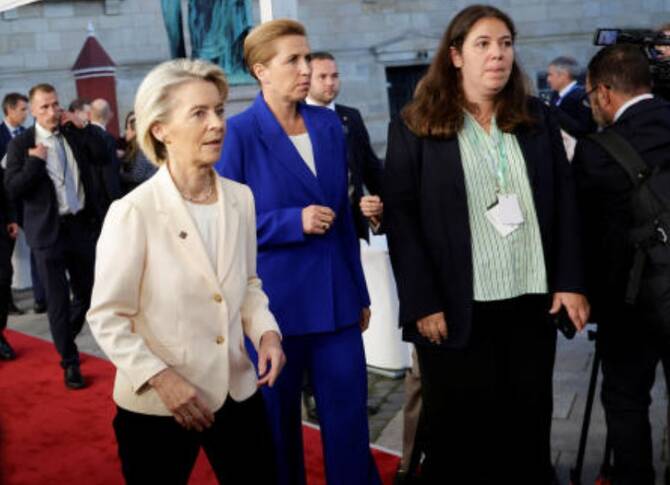
COPENHAGEN: Europe is in the middle of a hybrid war waged by Russia and the continent must arm itself, Danish Prime Minister Mette Frederiksen warned on Wednesday as she hosted a summit of European Union leaders in Copenhagen.
“I hope that everybody recognizes now that there is a hybrid war and one day it’s Poland, the other day it’s Denmark, and next week it will probably be somewhere else that we see sabotage or we see drones flying,” Frederiksen told reporters.
The summit comes after a spate of troubling drone incidents at Danish airports and military bases over the last week. Ahead of the meeting, a special radar system was set up at Copenhagen airport to help keep watch. Unidentified drones forced the closure of the airfield a week ago, causing major disruptions.
France, Germany, the Netherlands, Sweden and the UK also sent aircraft, ships and air defense systems to Denmark ahead of the talks. Ukraine’s armed forces have dispatched a mission to the Nordic country for joint exercises, sharing its expertise on combating Russian drones.
While the Danish authorities have not identified those believed to be responsible, Frederiksen said, “There is only one country that is willing to threaten us and it is Russia and therefore we need a very strong answer back.”
“I want us to rearm. I want us to buy more capabilities. I want us to innovate more, for example on drones,” she said. “When I look at Europe today, I think we are in the most difficult and dangerous situation since the end of the Second World War.”
Russia was the focus of Wednesday’s summit, where discussions centered on how to prepare Europe to fend off Russian aggression by 2030, especially as the United States turns its focus on security concerns in Asia and elsewhere.
Ukraine was also high on the agenda, and Ukrainian President Volodymyr Zelensky addressed the EU leaders by videolink.
Leaders and intelligence services believe that Russia could mount an assault elsewhere in Europe in 3 to 5 years, and that President Vladimir Putin is intent on testing NATO as doubts swirl about US President Donald Trump’s commitment to the organization.
On Sept. 10, when several Russian drones breached Poland’s airspace, NATO aircraft were scrambled to intercept and shoot down some of the devices. It was the first direct encounter between NATO and Moscow since Russia launched its war on Ukraine on Feb. 24, 2022.
The incident jolted leaders across Europe, raising questions about how prepared the alliance is against Russia. Days later, NATO jets escorted three Russian warplanes out of Estonia’s airspace.
French President Emmanuel Macron said Wednesday that an oil tanker off the French coast had committed “very serious wrongdoings” and linked it to Russia’s shadow fleet, which is avoiding Western sanctions over Moscow’s war in Ukraine.
The tanker was sailing off the coast of Denmark last week and was cited by European naval experts as possibly being involved in drone flights over the Nordic country.
After Wednesday’s meeting began, officials in Germany said that authorities there are also investigating claims that unidentified drones may have spied on a power plant, a hospital and a shipyard in the northern state of Schleswig-Holstein last week.
Turning to Ukraine, the EU leaders discussed ways to maintain military and financial support as the conflict-ravaged country’s funds, weapons and ammunition slowly dry up.
A new proposal to use frozen Russian assets to help Ukraine was considered, as well as its prospects of joining the EU. Trump has ruled out NATO membership for the country, the best security guarantee available.
Asked whether he would respect Trump’s demand that NATO stop buying Russian oil, Hungarian Prime Minister Viktor Orbán said: “We don’t have any options.”
“We need a primary pipeline, and the only primary pipeline is Russia. Because Hungary is a land-locked country. We don’t have any sea,” Orbán said, adding that in any case “the American president respects the sovereignty of other countries.”
UK Prime Minister Keir Starmer and other leaders from across Europe will join their EU partners for talks on Thursday in the European Political Community (EPC) forum. Around 40 heads of state or government are due to take part.
Those talks will focus on security, trafficking and migration. Critics say the EPC forum — which draws together EU members, aspiring partners in the Balkans and Eastern Europe, as well as Britain and Turkiye — is a political “talking shop” that produces few tangible results.


![]()
![]()

Denmark warns that Russia is waging a hybrid war on Europe, as EU leaders hold security talks
Short Url
https://arab.news/p6ap3
Denmark warns that Russia is waging a hybrid war on Europe, as EU leaders hold security talks
- “I hope that everybody recognizes now that there is a hybrid war and one day it’s Poland, the other day it’s Denmark, and next week it will probably be somewhere else,” Frederiksen told reporters
- “There is only one country that is willing to threaten us and it is Russia and therefore we need a very strong answer back“


Latest updates




© 2026 SAUDI RESEARCH & PUBLISHING COMPANY, All Rights Reserved And subject to Terms of Use Agreement.