Jeddah Historic District partners with Google to launch AI-powered cultural tours

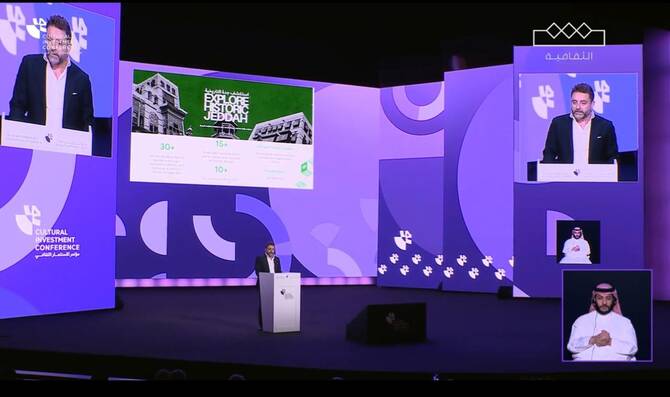
The partnership was announced during the Cultural Investment Conference in Riyadh. Screenshot
Short Url
Updated 30 September 2025
Follow

Jeddah Historic District partners with Google to launch AI-powered cultural tours

RIYADH: Jeddah Historic District has partnered with Google Arts & Culture to launch Saudi Arabia’s first AI-powered digital tours, offering immersive virtual experiences of the city’s cultural heritage. 

Announced during the Cultural Investment Conference in Riyadh, the initiative aims to digitally map and showcase Jeddah’s historical landmarks using artificial intelligence, providing virtual experiences accessible to audiences worldwide. 

The project supports the Kingdom’s Vision 2030 goals to use advanced technologies in cultural preservation and tourism, while highlighting Google’s role in Saudi Arabia’s digital transformation. 

Charbel Sarkis, country director at Google Saudi Arabia, said: “Google Arts & Culture provides the digital infrastructure and the distribution network, in addition to the technological innovation that the cultural sector needs to remain vibrant and relevant as we move forward.”   

He added: “Google has been a proud partner of Saudi Arabia’s bold digital transformation. All our efforts and investments have been geared towards empowering individuals, businesses and communities.”  

As part of the collaboration, the Explore Historic Jeddah platform will offer an immersive digital experience that brings the city's cultural legacy to life. 

The initiative will feature more than 30 stories detailing Jeddah’s historical significance, restoration projects, and its designation as a UNESCO World Heritage site. 

Users can explore over 15 Street View captures of key landmarks — including traditional houses, mosques, and pathways — and access more than 10 AI-powered walking tours. 

The platform will also include a Virtual Pocket Gallery showcasing archival photos and regeneration efforts, along with interactive features such as “Puzzle Party” to engage broader audiences. 

Through the Google Arts & Culture platform — a nonprofit initiative partnering with over 3,000 cultural institutions globally — the collaboration will provide free digital infrastructure and advanced digitization tools to preserve and showcase Jeddah’s cultural assets. 

“Being part of this incredible transformation of Saudi Arabia under Vision 2030 is just so inspiring,” Sarkis said.  

He emphasized that Google’s support for Saudi Arabia’s economic and digital ecosystem spans more than a decade, including local initiatives like the 2011 Google Forum in Saudi Arabia and the launch of the Google Cloud region in Dammam in 2023.   

“Since 2018, Google has trained more than 590,000 individuals on digital skills,” Sarkis added, highlighting the company’s ongoing investment in human capital development and local partnerships.   

He also pointed to the broader economic impact of Google’s operations in the Kingdom. “Last year, a report by Public First assessed Google’s economic contribution to the Kingdom north of SR30 billion,” Sarkis said. “The power of marrying technology and local partnership is just magical.” 


Saudi POS transactions see 20% surge to hit $4bn: SAMA

Updated 05 December 2025
Follow

Saudi POS transactions see 20% surge to hit $4bn: SAMA

RIYADH: Saudi Arabia’s total point-of-sale transactions surged by 20.4 percent in the week ending Nov. 29, to reach SR15.1 billion ($4 billion).

According to the latest data from the Saudi Central Bank, the number of POS transactions represented a 9.1 percent week-on-week increase to 240.25 million compared to 220.15 million the week before.

Most categories saw positive change across the period, with spending on laundry services registering the biggest uptick at 36 percent to SR65.1 million. Recreation followed, with a 35.3 percent increase to SR255.99 million. 

Expenditure on apparel and clothing saw an increase of 34.6 percent, followed by a 27.8 percent increase in spending on telecommunication. Jewelry outlays rose 5.6 percent to SR354.45 million.

Data revealed decreases across only three sectors, led by education, which saw the largest dip at 40.4 percent to reach SR62.26 million. 

Spending on airlines in Saudi Arabia fell by 25.2 percent, coinciding with major global flight disruptions. This followed an urgent Airbus recall of 6,000 A320-family aircraft after solar radiation was linked to potential flight-control data corruption. Saudi carriers moved swiftly to implement the mandatory fixes.

Flyadeal completed all updates and rebooked affected passengers, while flynas updated 20 aircraft with no schedule impact. Their rapid response contained the disruption, allowing operations to return to normal quickly.

Expenditure on food and beverages saw a 28.4 percent increase to SR2.31 billion, claiming the largest share of the POS. Spending on restaurants and cafes followed with an uptick of 22.3 percent to SR1.90 billion.

The Kingdom’s key urban centers mirrored the national decline. Riyadh, which accounted for the largest share of total POS spending, saw a 14.1 percent surge to SR5.08 billion, up from SR4.46 billion the previous week. The number of transactions in the capital reached 75.2 million, up 4.4 percent week-on-week.

In Jeddah, transaction values increased by 18.1 percent to SR2.03 billion, while Dammam reported a 14 percent surge to SR708.08 million.

POS data, tracked weekly by SAMA, provides an indicator of consumer spending trends and the ongoing growth of digital payments in Saudi Arabia. 

The data also highlights the expanding reach of POS infrastructure, extending beyond major retail hubs to smaller cities and service sectors, supporting broader digital inclusion initiatives. 

The growth of digital payment technologies aligns with the Kingdom’s Vision 2030 objectives, promoting electronic transactions and contributing to the nation’s broader digital economy.