

Pakistan’s average inflation to rise to 6% in FY26 due to flood impacts, gas tariffs

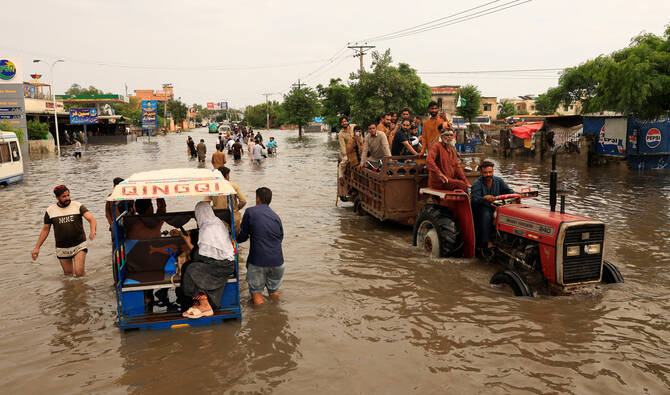
Residents sit on a tractor trolley as they cross a flooded road following monsoon rains and rising water levels in Sialkot, Punjab province, Pakistan on August 27, 2025. (REUTERS/File)
Short Url
Updated 30 September 2025
Follow

Pakistan’s average inflation to rise to 6% in FY26 due to flood impacts, gas tariffs

  • ADB says supply chain disruptions due to recent floods, increase in gas tariffs to hike inflation in FY26
  • Says policy consistency, climate resilience remain vital for Pakistan to maintain growth momentum

ISLAMABAD: The Asian Development Bank (ADB) said in its latest report on Tuesday that Pakistan’s average inflation is expected to rise to 6 percent during fiscal year 2026, reflecting the impact of flood-related supply chain disruptions and recent increase in gas tariffs on prices.

Heavy monsoon rains and excess water released from dams in India triggered floods in Pakistan’s eastern Punjab province, also known as its breadbasket province, since late August. Over 2.5 million people were evacuated to safer locations as thousands of acres of farmland were inundated with floodwaters. Experts warned of looming food shortages and price hikes due to the deluges.

In July, Pakistan’s government revised gas prices for the fiscal year 2025-26 and okayed a 50 percent increase in fixed charges for domestic consumers. The move was in line with Pakistan’s structural benchmarks agreed with the International Monetary Fund (IMF), including rationalization of captive power tariffs and a shift from subsidies to direct, targeted support for low-income consumers.

“Average inflation is projected to increase to 6.0 percent in FY2026, reflecting the impact of flood-related supply chain disruptions on food prices and the increase in gas tariffs,” the ABD said in a report. “In response, the central bank is expected to adopt a cautious approach to easing monetary policy to stabilize inflation within its medium-term target range of 5 percent–7 percent.”

The bank said Pakistan’s economic activity is expected to strengthen in FY2026, supported by improved external buffers and renewed business confidence following the US-Pakistan trade agreement.

“However, the damage caused to infrastructure and farmland by the recent floods may weigh on growth,” it warned. “Recovery and rehabilitation efforts, bolstered by fiscal incentives for the construction sector announced in the FY2026 budget, are expected to partially offset the adverse impact.”

Citing the ‘Asian Development Outlook for September 2025,’ the ADB’s annual flagship economic publication, the bank said Pakistan’s growth is projected to continue in the medium term, with real gross domestic product (GDP) growth forecast at 3.0 percent in FY2026, as macroeconomic stability deepens through sustained reforms addressing structural vulnerabilities.

It noted that Pakistan’s economic reform has progressed “considerably” under the IMF’s $7 billion Extended Fund Facility arrangement which began in October last year.

“Policy consistency and climate resilience remain vital to maintaining the growth momentum. Downside risks to the outlook remain high,” the ADB stressed.


Pakistan urges revival of long-paralyzed SAARC as bloc marks 40th charter anniversary

Updated 4 sec ago
Follow

Pakistan urges revival of long-paralyzed SAARC as bloc marks 40th charter anniversary

  • PM Sharif says political rifts have stalled regional collaboration, calls for economic and digital connectivity
  • He mentions regional challenges requiring collective responses based on mutual trust, spirit of cooperation

ISLAMABAD: Prime Minister Shehbaz Sharif on Monday called for reviving the long-paralyzed South Asian Association for Regional Cooperation (SAARC), saying deeper economic collaboration and collective responses to shared challenges were essential as the bloc marked the 40th anniversary of its founding charter.

SAARC has been effectively dysfunctional since 2016, when its planned Islamabad summit collapsed after India withdrew following a militant attack it blamed on Pakistan. Islamabad denied involvement, but New Delhi’s decision prompted Afghanistan, Bangladesh and Bhutan to pull out, leading to the indefinite postponement of the summit.

Beyond the immediate rupture, SAARC was widely believed to have already become stagnant because of structural issues, including the India-Pakistan rivalry and New Delhi’s pivot toward alternative regional groupings.
Sharif extended his greetings to the peoples and the governments of “all SAARC member states” in a statement circulated by his office.

“When SAARC was established, over four decades ago, it was meant to provide an essential platform, to promote dialogue, foster cooperation and strengthen the bonds that bring our nations together,” he said.

“While these goals have, regrettably, remained elusive due to political considerations within the region, I commend the SAARC Secretariat for striving hard to provide its dedicated assistance as well as for its efforts to advance the organization’s goals and create opportunities for meaningful collaboration among the member states,” he added.

The prime minister noted his administration remained committed to the principles and objectives of the SAARC Charter.

“We believe that genuine cooperation, guided by sovereign equality, mutual respect and constructive engagement, can unlock South Asia’s vast potential and ensure a better tomorrow for all,” he said.

Sharif maintained the region needed stronger economic, digital and people-to-people connectivity to expand trade, investment, innovation and cultural exchange, adding that South Asian states faced shared pressures from poverty, climate-induced natural disasters, food and energy insecurity and public-health vulnerabilities.

These, he continued, required “collective responses based on mutual trust, goodwill and a spirit of cooperation.”

His statement did not directly mention India, though last week, his deputy, Ishaq Dar, urged a “reimagining” of South Asia’s fractured regional architecture, saying an 11-year freeze in dialogue with New Delhi had eroded prospects for long-term stability in one of the world’s most volatile regions.

Dar criticized the paralysis of SAARC, saying “artificial obstacles” needed to be removed for it to resume its role as a platform for economic cooperation, and argued the region would only achieve its political and economic potential if countries committed to cooperation and a future “where connectivity replaces divisions.”