

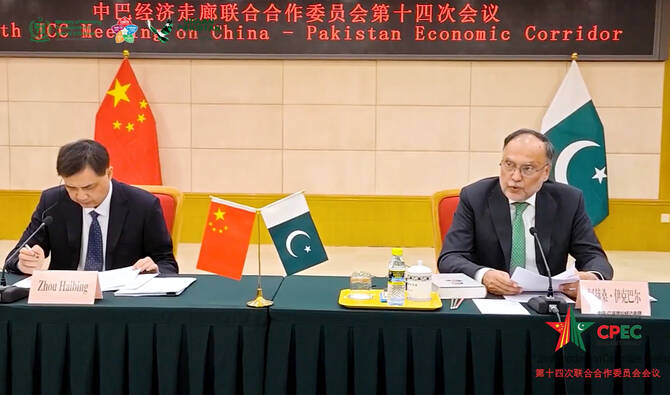

ISLAMABAD: Pakistan’s planning minister Ahsan Iqbal on Friday urged China to grant Islamabad the same market access enjoyed by Southeast Asian nations, as he called for an export-driven expansion of the China-Pakistan Economic Corridor (CPEC).
Iqbal was speaking at the 14th session in Beijing of the Joint Coordination Committee (JCC), the top decision-making body steering the CPEC program. Launched in 2015 as part of China’s Belt and Road Initiative, CPEC is a network of infrastructure, energy and industrial projects worth around $62 billion.
The first phase of CPEC focused on tackling Pakistan’s crippling energy shortages and improving connectivity through new power plants, highways and the development of the deep-sea port of Gwadar. The second phase is expected to shift the focus to industrial cooperation, agriculture, technology and human capital development.
CPEC projects have stalled in recent years due to persistent security threats to Chinese workers and bureaucratic delays, and Islamabad is now seeking to revive momentum under the program's second phase.
“Despite China’s $2 trillion import annually, Pakistan’s exports to China demand barely $3 billion,” Iqbal said. “We seek under CPEC that Pakistan may be given the same market access as ASEAN countries so that we have the same tariff for Pakistani products.”
Such a concession would mean giving Pakistani goods the same preferential tariff treatment that China extends to members of the Association of Southeast Asian Nations under their free trade agreement, which has eliminated or sharply reduced tariffs on more than 90 percent of products traded between them. Islamabad argues that similar terms would help narrow its trade gap with China and significantly boost exports from its textile, agricultural and engineering sectors.
Iqbal said CPEC should now pivot “from government-to-government to business-to-business cooperation” to unlock Pakistan’s export potential, adding that a recent Pakistan-China Investment Conference saw 800 companies sign memoranda of understanding worth $8.5 billion, underscoring the appetite for private-sector partnerships.
Iqbal also proposed two government-to-government special economic zones in Karachi and Islamabad, alongside a Pakistan-China industrial relocation fund to attract investment in textiles, engineering, electronics, pharmaceuticals and electric vehicles. Chinese industries should be encouraged to move production to Pakistan to benefit from lower costs, he said.
Iqbal also called for a “Pakistan-China Digital Silk Road” with investment in 5G networks, fiber optics and data centres, and the creation of joint laboratories in artificial intelligence and quantum computing.
A “future skills program” in IT, robotics, fintech and biotech, as well as a space centre in Pakistan, would prepare the country’s youth for a technology-driven economy, he added.
On climate and sustainability, Iqbal proposed a joint working group on water and climate resilience and expanded cooperation on renewable energy to help Pakistan reach 60 percent clean energy by 2030. Pilot projects in climate-smart agriculture and electric mobility should also be launched, he said.
Other priorities include modernizing agriculture with hybrid seeds, drip irrigation and agro-processing zones, building cold-chain logistics and storage facilities to reduce post-harvest losses, expanding cross-border fiber-optic networks and border markets, and constructing new transport links, including a mining corridor connecting mineral-rich regions to the southwestern Gwadar port that China is developing under CPEC.
Reaffirming Pakistan’s commitment to the safety of Chinese personnel and projects, Iqbal said:
“Peace and stability remain the bedrock of our partnership, and Prime Minister Shehbaz Sharif is personally committed to overseeing the security of Chinese personnel.”
“With youth as innovators, people as stakeholders, and exports as the driver of growth, CPEC will help transform Pakistan’s economy and realize our shared dream of connectivity, prosperity, and a community of shared future for mankind,” he added.


