GENEVA: The World Health Organization said on Wednesday there is currently no conclusive scientific evidence confirming a possible link between autism and use of paracetamol during pregnancy.
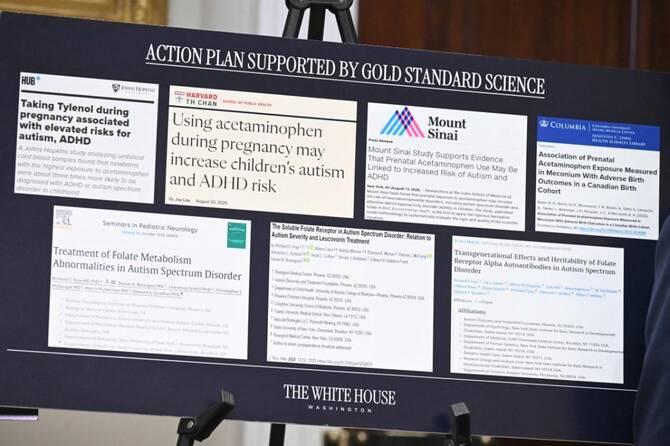
US President Donald Trump on Monday linked autism to childhood vaccine use and the taking of popular pain medication Tylenol by women when pregnant, elevating claims not backed by scientific evidence to the forefront of US health policy.
“The evidence remains inconsistent,” WHO spokesperson Tarik Jašarević told a Geneva press briefing when asked about a possible link between paracetemol use in pregnancy and autism.
“We know that vaccines do not cause autism. Vaccines, as I said, save countless lives. So this is something that science has proven, and these things should not be really questioned,” he added.

WHO says there is no link between autism and paracetamol use during pregnancy
https://arab.news/99npu
WHO says there is no link between autism and paracetamol use during pregnancy
- US President Trump linked autism to childhood vaccine use and the taking of popular pain medication Tylenol by women when pregnant
US judge orders lifting of Trump-backed limits on pro-Palestinian Tufts student
- Ozturk’s arrest on a street in the Boston suburb of Somerville, Massachusetts, was captured in a viral video that shocked many and drew criticism from civil rights groups
BOSTON: A federal judge on Monday cleared the way for a Tufts University PhD student and pro-Palestinian activist Rumeysa Ozturk to work on campus after ordering the Trump administration to restore her status in a key database used to track foreign students.
Chief US District Judge Denise Casper in Boston issued an injunction after concluding Ozturk was likely to succeed in proving US Immigration and Customs Enforcement unlawfully terminated her record in the database the same day that masked, plainclothes agents took her into custody in March.
That ICE-maintained database is called the Student and Exchange Visitor Information System and is used to track foreign students who enter on visas. The termination of a student’s record from that database prevents that person from being employed.
Ozturk in a statement said she was grateful for the ruling and that she hopes “that no one else experiences the injustices I have suffered.”
The US Department of Homeland Security, which oversees ICE, did not immediately respond to a request for comment.
Ozturk’s arrest on a street in the Boston suburb of Somerville, Massachusetts, was captured in a viral video that shocked many and drew criticism from civil rights groups.
She was detained after the US Department of State revoked her student visa as the Trump administration moved to crack down on non-citizens who engaged in pro-Palestinian activism on campuses.
The sole basis authorities provided for revoking her visa was an editorial she co-authored in Tufts’ student newspaper a year earlier criticizing her school’s response to Israel’s war in Gaza.
The former Fulbright scholar was held for 45 days in a detention facility in Louisiana until a federal judge in Vermont, where she had briefly been held, ordered her immediately released after finding she raised a substantial claim that her detention constituted unlawful retaliation in violation of her free speech rights under the US Constitution’s First Amendment.
Following her release, Ozturk, a child development researcher, resumed her studies at Massachusetts-based Tufts.
But the administration’s refusal to restore her SEVIS record has prevented her from teaching or working as a research assistant, leading her lawyers to ask Casper to order its reinstatement so her academic and career development would not be further jeopardized in the final months before she graduates.
Casper, who was appointed by Democratic President Barack Obama, said the administration had provided “shifting justifications” for terminating Ozturk’s SEVIS record, at times wrongly claiming she had failed to maintain her lawful, foreign student status.
To the extent it now acknowledges she complied with rules governing foreign students like herself, “it is all the more irrational that the government has imposed negative consequences on her that are inconsistent with that status,” Casper wrote.


