Closing Bell: Saudi main market climbs 1.25% as Aramco shares rise

Saudi Aramco recorded its sharpest increase in two years. Shutterstock
Short Url
Updated 17 September 2025
Follow

Closing Bell: Saudi main market climbs 1.25% as Aramco shares rise

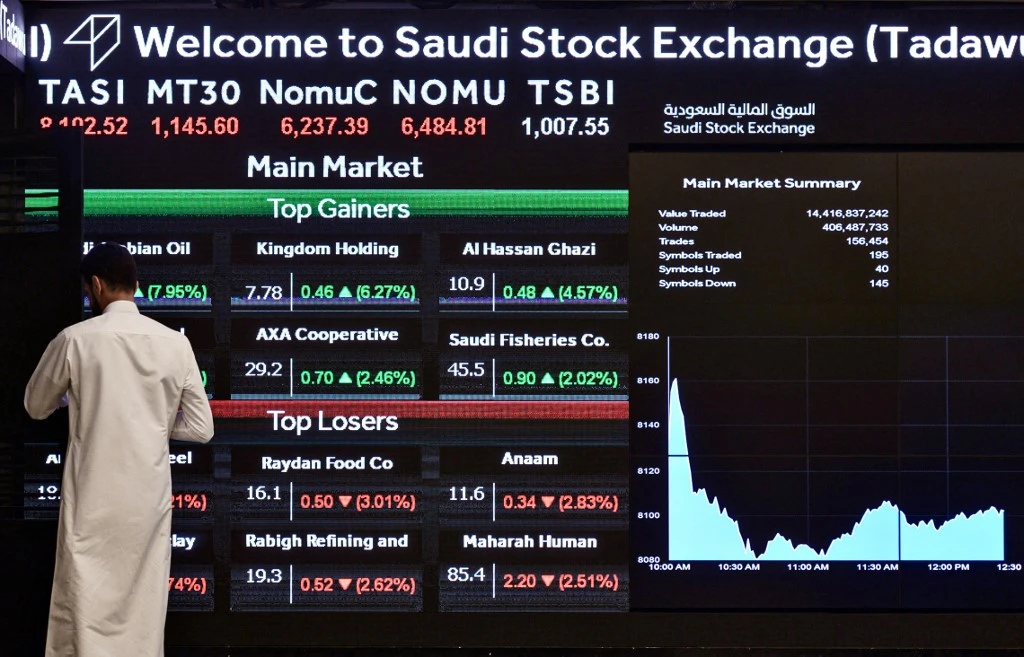
RIYADH: Saudi Arabia’s Tadawul All Share Index ended higher on Wednesday, increasing 131.66 points, or 1.25 percent, to close at 10,650.39. 

Total trading turnover reached SR4.64 billion ($1.23 billion). A total of 205 stocks advanced, while 43 declined.

The MSCI Tadawul 30 Index gained 14.30 points, or 1.04 percent, to finish at 1,383.42

The Kingdom’s parallel market, Nomu, however gained 100.63 points, or 0.4 percent, to settle at 25,123.21, with 41 gainers against 44 fallers.

Shares of Saudi Aramco recorded their sharpest increase in two years, rising by 3.21 percent to close at SR24.10 and lifting the Tadawul All Share Index above the 10,600-point mark.

Among the top performers, National Gypsum Co. surged 9.97 percent to SR20.29, while National Metal Manufacturing and Casting Co. climbed 8.86 percent to SR17.7. 

Arabian Internet and Communications Services Co. rose 5.44 percent to SR248.20, Derayah Financial Co. gained 4.66 percent to SR26.48, and BinDawood Holding Co. advanced 4.49 percent to SR5.59.

Among those to see decreases, Saudi Cable Co. dropped 2.47 percent to SR138.20, while Leejam Sports Co. fell 1.29 percent to SR138.20.


Oman trade surplus drops to 42% to $10bn amid weaker oil exports 

Updated 5 sec ago
Follow

Oman trade surplus drops to 42% to $10bn amid weaker oil exports 

JEDDAH: Oman’s trade surplus fell 42 percent to more than 3.88 billion Omani rials ($10 billion) by the end of September, down from over 6.74 billion rials in the same period of 2024, according to official data. 

Preliminary figures from the National Centre for Statistics and Information showed the decline was largely driven by a drop in oil and gas exports, the Oman News Agency reported. 

Oman’s trade profile remains anchored in hydrocarbons, with mineral fuels, oils and related products consistently the largest export category, even as non-oil segments such as plastics, iron and steel contribute to diversification. 

The data highlights Oman’s ongoing efforts to diversify its economy, with non-oil exports continuing to grow despite declines in the hydrocarbon sector. 

“This decrease is mainly attributed to the decline in Oman’s oil and gas exports by 16.5 percent to reach 10.92 billion rials by the end of September 2025, compared to 13.07 billion rials during the same period in 2024,” the ONA report stated. 

It added: “In contrast, non-oil merchandise exports to the Sultanate of Oman grew by 10.3 percent to reach a value of 5 billion rials by the end of September 2025, compared to 4.53 billion rials during the same period in 2024.” 

Overall merchandise exports declined 9.1 percent to 17.18 billion rials, while re-exports fell 2.6 percent to 1.27 billion rials. 

Registered imports increased 9.3 percent to 13.30 billion rials, up from 12.16 billion rials a year earlier. 

Among trading partners, the UAE led non-oil exports at 945 million rials, up 28.3 percent, and remained the top re-export destination at 484 million rials. 

The UAE was also Oman’s largest source of imports at 3.07 billion rials, followed by China with 1.35 billion rials and Kuwait with 1.15 billion rials. 

Saudi Arabia and India were the next-largest recipients of non-oil exports, while Iran and the Kingdom followed in re-exports. 

Financial strength 

Oman’s financial activity remained robust, with total credit extended by local banks rising 9 percent to 34.7 billion rials by the end of October. 

Lending to the private sector increased 5.8 percent to 28.3 billion rials, according to the Central Bank of Oman. Non-financial corporates accounted for 46.8 percent of total credit, while individuals held 44.7 percent. Financial corporates and other sectors made up the remaining 8.5 percent. 

Bank deposits rose 3.5 percent to 33 billion rials, while private sector deposits increased 9.4 percent to 22.3 billion rials. Individuals accounted for the largest share at 50.4 percent, followed by non-financial corporates at 30.3 percent and financial corporates at 17.2 percent.