The UN refugee agency said Wednesday that governments around the world, especially that of the United States and countries in Europe, are increasingly undermining the global convention on refugees and asylum seekers — even threatening its very existence.
The stark warning by the UNHCR came on the 75th anniversary of the UN Refugee Convention, a 1951 document that defines who refugees are and outlines the responsibilities of countries hosting them.
Many have moved to suspend applications for asylum — requests for international protection by those who say they face war or persecution for their religion, race, nationality, sexuality or for their political beliefs if they were to return home.
“I am not exaggerating when I say that the institution of the asylum worldwide is under more threat now than it has ever been,” Ruvendrini Menikdiwela, assistant high commissioner for protection at UNHCR in Geneva, told reporters during an online briefing from the Swiss city.
A piece of paper that saves lives
The US under the Trump administration, and some European nations have increasingly restricted asylum and sought bilateral deals with third countries, especially in Africa, to deport migrants and, in some cases, transfer asylum responsibilities altogether.
Others, like Greece, which has seen a surge in Sudanese refugees arriving to the island of Crete, have temporarily suspended asylum processing.
“Those two pieces of paper have saved millions of lives in the past and will save millions of lives in the future,” she added, referring to the 1951 Convention relating to the Status of Refugees adopted in the wake of World War II and the ensuing 1967 Protocol, which expanded protections to refugees worldwide.
A cash crisis world over
A global funding crisis in the humanitarian sector has impacted more than 122 million people displaced from their homes, fleeing conflict or persecution. A growing anti-asylum and anti-migration sentiment has added to their woes.
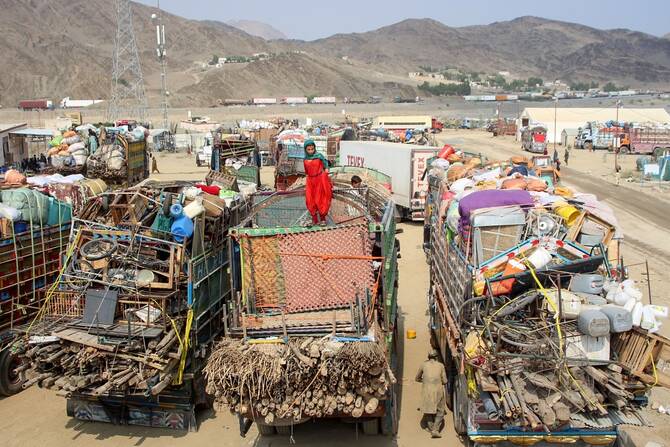
And though the arrivals of refugees in the global north “dominate the headlines,” Menikdiwela said, some “75 percent of the world’s 43 million plus refugees are actually being hosted in low-income and middle-income countries.”
She cited the example of Chad, an East African nation that currently hosts 1.5 million refugees, the vast majority of them Sudanese who fled the brutal and ongoing civil war.
Menikdiwela, who recently visited a refugee camp in Chad, said the agency’s programs there are vastly underfunded and unable to support urgent needs of the arriving refugees.
“There are people, men, women and children, wandering around with bullet wounds and shrapnel wounds,” she said. Women and girls in particular have been subjected to unprecedented levels of sexual violence, Menikdiwela said, highlighting the case of an 80-year-old woman who reported being raped multiple times.
And yet, despite their dire situation, she insisted the refugees she met would not be alive if Chad hadn’t respected the refugee convention and allowed them across its borders.
Without support, refugees will keep moving
Menikdiwela urged leaders to step up donations and support, saying that many of the refugees in Chad would continue to move north through Libya and eventually Europe if their needs weren’t met in the East African nation.
She did, however, acknowledge abuse in asylum applications by migrants who have moved for economic or other reasons, not because they were fleeing war or persecution. The UN refugee agency has supported the concept of return hubs, a euphemism for deportation centers, which is increasingly gaining support in the US and Europe.


UNHCR says that US and European governments increasingly undermine the global refugee convention
https://arab.news/4cgqm
UNHCR says that US and European governments increasingly undermine the global refugee convention

- The US under the Trump administration, and some European nations have increasingly restricted asylum and sought bilateral deals with third countries, especially in Africa, to deport migrants and, in some cases, transfer asylum responsibilities altogether


US, Ukraine officials say they’ll meet for 3rd day after progress on creating a security framework
- Witkoff and Kushner’s talks in Florida with Umerov, Ukraine’s lead negotiator, and Hnatov follow discussions between President Vladimir Putin and the US envoys at the Kremlin on Tuesday
WASHINGTON: President Donald Trump’s advisers and Ukrainian officials say they’ll meet for a third day of talks on Saturday after making progress on finding agreement on a security framework for postwar Ukraine.
The two sides also offered the sober assessment that any “real progress toward any agreement” ultimately will depend “on Russia’s readiness to show serious commitment to long-term peace.”
The statement from US special envoy Steve Witkoff, Trump’s son-in-law Jared Kushner as well as Ukrainian negotiators Rustem Umerov and Andriy Hnatov came after they met for a second day in Florida on Friday. They offered only broad brushstrokes about the progress they say has been made as Trump pushes Kyiv and Moscow to agree to a US-mediated proposal to end nearly four years of war.
“Both parties agreed that real progress toward any agreement depends on Russia’s readiness to show serious commitment to long-term peace, including steps toward de-escalation and cessation of killings,” the statement said. “Parties also separately reviewed the future prosperity agenda which aims to support Ukraine’s post-war reconstruction, joint US–Ukraine economic initiatives, and long-term recovery projects.”
The US and Ukrainian officials also discussed “deterrence capabilities” that Ukraine will need “to sustain a lasting peace.”
Witkoff and Kushner’s talks in Florida with Umerov, Ukraine’s lead negotiator, and Hnatov follow discussions between President Vladimir Putin and the US envoys at the Kremlin on Tuesday.
Friday’s session took place at the the Shell Bay Club in Hallandale Beach, a high-end private golf and lifestyle destination owned by Witkoff’s real estate development company.
Previous diplomatic attempts to break the deadlock have come to nothing and the war has continued unabated. Officials largely have kept a lid on how the latest talks are going, though Trump’s initial 28-point plan was leaked.
Ukrainian President Volodymyr Zelensky said his country’s delegation in Florida wanted to hear from the US side about the talks at the Kremlin.
Zelensky, as well as European leaders backing him, have repeatedly accused Putin of stalling in peace talks while the Russian army tries to press forward with its invasion. Zelensky said in a video address late Thursday that officials wanted to know “what other pretexts Putin has come up with to drag out the war and to pressure Ukraine.”
Speaking to Russian journalist Pavel Zarubin on Friday, Kremlin foreign affairs adviser Yuri Ushakov praised Kushner as potentially playing an important role in ending Russia’s invasion of Ukraine. Ushakov also took part in Tuesday’s talks at the Kremlin.
“If any plan leading to a settlement is put on paper, it will be the pen of Mr. Kushner that will lead the way,” Ushakov said.
The flattering comments about Kushner by the senior Russian official come as Putin has sought to sow division between Trump and Ukraine and Europe at a moment when Trump’s impatience with the conflict is mounting. Putin said his five-hour talks this week with Witkoff and Kushner were “necessary” and “useful,” but some proposals were unacceptable.
Kushner, who is married to Trump’s daughter Ivanka, was a senior adviser to Trump during his first term and was the president’s point person on developing the Abraham Accords, which formalized commercial and diplomatic ties between Israel and a trio of Arab nations.
Kushner has played a more informal role in Trump’s second go-around, but he helped Witkoff close out ceasefire and hostage negotiations between Israel and Hamas this fall. Trump tapped Kushner again to pair up with Witkoff to try to find an endgame to Russia’s invasion of Ukraine.
The European take on the peace talks
Ushakov, who accompanied Putin on a visit to India on Friday, repeated the Russian president’s recent criticism of Europe’s stance on the peace talks. Kyiv’s European allies are concerned about possible Russian aggression beyond Ukraine and want a prospective peace deal to include strong security guarantees.
Kyiv’s allies in Europe are “constantly putting forward demands that are unacceptable to Moscow,” Ushakov told Russia’s state-owned Zvezda TV. “Putting it mildly, the Europeans don’t help Washington and Moscow reach a settlement on the Ukrainian issues.”
French President Emmanuel Macron said Friday that he made progress during a visit to Beijing on getting Chinese leader Xi Jinping’s support for peace efforts.
“We exchanged deeply and truthfully on all points, and I saw a willingness from the (Chinese) president to contribute to stability and peace,” Macron said.
The French president said he stressed that Ukraine needs guarantees that Russia won’t attack it again if a settlement is reached and that Europe must have a voice in negotiations.
“The unity between Americans and Europeans on the Ukrainian issue is essential. And I say it, repeat it, emphasize it. We need to work together,” Macron said.
The latest drone attacks
Russian drones struck a house in central Ukraine, killing a 12-year-old boy, officials said, while long-range Ukrainian strikes reportedly targeted a Russian port and an oil refinery.
The Russian attack on Thursday night in Ukraine’s central Dnipropetrovsk region destroyed the house where the boy was killed and also two women were injured, according to the head of the regional military administration, Vladyslav Haivanenko.
The Ukrainian air force said Russia fired 137 drones of various types during the night.
Ukrainian drones attacked a port and an oil refinery inside Russia overnight as part of Kyiv’s campaign to disrupt Russian logistics, Ukraine’s general staff said.
The drones struck Temriuk sea port in Russia’s Krasnodar region and the Syzran oil refinery in the Samara region, starting blazes, a statement said. Syzran is about 800 kilometers (500 miles) east of the border with Ukraine.
The Russian Defense Ministry said only that its air defenses intercepted 85 Ukrainian drones over Russian regions and Crimea, which Russia illegally annexed in 2014.


