LONDON: Britain said on Monday it would suspend applications from registered refugees to bring family members into the country in order to give the government time to toughen the rules, its latest attempt to cut the number of arrivals.
Prime Minister Keir Starmer’s Labour government is under mounting pressure to reduce the number of asylum seekers reaching Britain from France in small boats, after hotels housing migrants became a focal point for weeks of sometimes violent demonstrations.
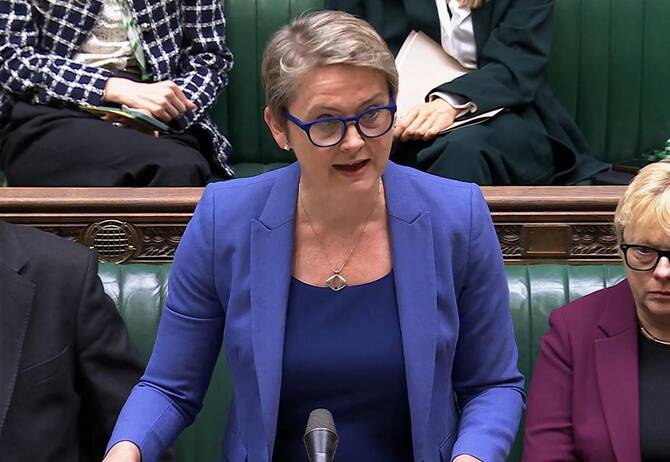
Interior minister Yvette Cooper told parliament that more and more refugees had applied to bring in family members, placing pressure on housing across the country.
Many were applying to bring over families within about a month whereas, as recently as 2019, they were waiting one or two years or more.
Cooper said she would suspend the system while the government looked to toughen the rules.
“The system has to be controlled and managed based on fair and properly enforced rules, not chaos and exploitation driven by criminal smuggler gangs,” she said.
Accused of moving too slowly, the government says it is tackling a problem left by previous Conservative-led administrations by trying to speed up the processing of asylum claims and brokering return deals with other nations.
But the public discontent has handed Brexit campaigner Nigel Farage’s populist Reform UK party a consistent lead in opinion polls, prompting the government to go further.
Under the current system, an asylum seeker granted indefinite leave to remain can bring their partner if they can prove they have been in a relationship for at least two years, and children under the age of 18.
Just over 29,000 people have come to Britain unofficially on small boats so far this year, up 38 percent on the comparable period in 2024.

Britain suspends refugees’ family reunion applications to toughen rules
https://arab.news/wubxp
Britain suspends refugees’ family reunion applications to toughen rules
- Interior minister Yvette Cooper told parliament that more and more refugees had applied to bring in family members
- Public discontent has handed Brexit campaigner Nigel Farage’s populist Reform UK party a consistent lead in opinion polls
Tarique Rahman takes oath as Bangladesh’s PM after landslide election win
- 49 members of new cabinet, including ministers and state ministers, have also been sworn in
- Experts say restoring law and order will be the new government’s main immediate task
DHAKA: Bangladesh Nationalist Party Chairman Tarique Rahman took the oath as prime minister on Tuesday, days after his party secured more than a two-thirds majority in the first vote since a student-led uprising expelled former Premier Sheikh Hasina.
The son of former Prime Minister Khaleda Zia and former President Ziaur Rahman — the BNP’s founder — Rahman returned to Bangladesh in late December after nearly two decades of self-imposed exile.
He led his party to a landslide victory last week, winning an absolute majority with 209 seats in the 300-seat parliament, followed by the Jamaat-e-Islami party, which won 68 seats.
The swearing-in ceremony was held publicly for the first time, under the open sky at the south plaza of the national parliament building.
Rahman’s administration takes over from an interim government led by Nobel laureate Muhammad Yunus who during the 18 months after Hasina’s ouster in August 2024, prepared the country for reform and the next election.
One of the most immediate tasks expected of the new leadership of the country of 170 million is the restoration of law and order — an area in which the caretaker cabinet faced widespread criticism.
A crisis that swept through the police force, which was implicated in the deadly crackdown on the July to August 2024 protests, has left law enforcement significantly weakened and some of its tasks were taken over by the military.
“The law-and-order situation during the interim’s period became very volatile ... The government will have to immediately step in to stop mobocracy,” said Dr. Zahed Ur Rahman, a Dhaka-based political commentator.
“The government must think about withdrawing the military from the streets because they’ve been there for one and a half years, and the military chief repeatedly said that it is having some impact on their professionalism. The regular police should take charge fully.”
In the long-term, the new government will have to focus on reviving the economy.
Under the interim administration the country has recorded little foreign or domestic investment — a situation expected as an elected government will mean more stability to potential investors, Rahman said, warning that the process will also require better energy security.
“We do not have good energy security. Supplying energy at a cheap or affordable price will be tough because this sector suffered rampant corruption during Sheikh Hasina’s regime.
“When investment increases, energy consumption or demand increases. So, it will be a severe problem to manage the power supply,” he told Arab News.
As the BNP leader took the oath of office, he appointed 24 ministers and 25 state ministers, with former commerce minister Amir Khasru Mahmud Chowdhury taking the finance and planning portfolio, former attorney general Md. Asaduzzaman as law minister, and former state minister of power, Ikbal Hasan Mahmud Tuku, at the helm of the Ministry of Power, Energy and Mineral Resources.
The appointment of the foreign minister is still pending.
The new government’s foreign policy will have to address the influence of key players — the US, China, and India, a neighbor that was Bangladesh’s main partner during the 15-year rule of Hasina’s Awami League and with whom Dhaka has been at loggerheads since the former leader fled to New Delhi following her ouster.
Since 2024, India has suspended key transshipment access that allowed Bangladeshi exports to go via Indian ports and airports. It also put on hold most normal visa services for Bangladeshis, who were among its largest groups of medical tourists.
Bangladesh needs to revive the relationship as the “next priority” after restoring law and order, according to Mohiuddin Ahmad, a political historiographer.
“The revival of a good relationship with India will increase people-to-people contact, bilateral trade and commerce, and so on,” he said.
“The next priority should be the normalization of the relationship with India. We need such a relationship with India, which will promote all the elements of a good neighborhood.”


