WARSAW: A swarm of Russian drones flies into Poland in what officials there regard as a deliberate provocation.
NATO responds by bolstering the alliance’s air defenses on its eastern flank.
Moscow showcases its conventional and nuclear military might in long-planned exercises with Belarus, as it warns the West against sending foreign troops into Ukraine.
These events — all taking place in the month since the US-Russia summit meeting in Alaska failed to bring peace to Ukraine — have only heightened tensions in eastern Europe.
When Russian President Vladimir Putin launched the full-scale invasion of Ukraine in February 2022, it came days after joint maneuvers with Belarus. The latest sweeping drills, dubbed “Zapad 2025” — or “West 2025” — have worried NATO members Poland, Latvia and Lithuania that border Belarus to the west.
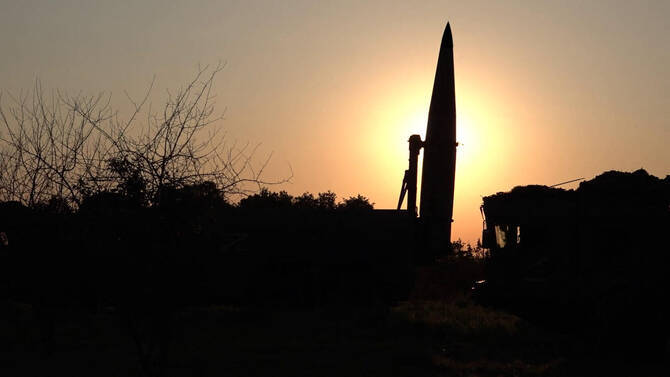
The maneuvers, which wrap up Tuesday, have included nuclear-capable bomber and warships, thousands of troops and hundreds of combat vehicles simulating a joint response to an enemy attack -– including what officials said was planning for nuclear weapons use and options involving Russia’s new intermediate range ballistic missile, the Oreshnik.
NATO Secretary-General Mark Rutte referenced Moscow’s hypersonic missiles, noting that they shatter the notion that Spain or Britain are any safer than Russia’s neighbors of Estonia or Lithuania.
“Let’s agree that within this alliance of 32 countries, we all live on the eastern flank,” he said in Brussels.
The anniversary of Russia’s nuclear weapons policy
One year ago this month, Putin outlined a revision of Moscow’s nuclear doctrine, noting that any nation’s conventional attack on Russia that is supported by a nuclear power will be considered a joint attack on his country. That threat was clearly aimed at discouraging the West from allowing Ukraine to strike Russia with longer-range weapons and appears to significantly lower the threshold for the possible use of Russia’s nuclear arsenal.
That doctrine also places Belarus under the Russian nuclear umbrella. Russia, which says it has deployed battlefield nuclear weapons to Belarus, plans to station Oreshnik missiles there as well later this year.
The Zapad 2025 exercise comes as Russia’s 3½-year-old war in Ukraine has dragged on despite President Donald Trump’s push for a peace deal and his Aug. 15 meeting with Putin in Alaska.
On Sept. 10, two days before the maneuvers started, about 20 Russian drones flew into Poland’s airspace. While Moscow denied targeting Poland and officials in Belarus alleged that the drones veered off course after being jammed by Ukraine, Polish Prime Minister Donald Tusk said it was a “provocation” that “brings us all closer to open conflict, closer than ever since World War II.”
Rutte branded Moscow’s action as “reckless” as he announced a new “Eastern Sentry” initiative to bolster the alliance’s air defenses in the area. He also noted that in addition to Poland, “drones violate our airspace in Romania, Estonia, Latvia and Lithuania.”
Putin’s Oreshnik threat
When Russia first used the Oreshnik against Ukraine in November 2024, Putin warned the West it could use it next against allies of Kyiv that allowed it to strike inside Russia with their longer-range missiles.
Putin has bragged that Oreshnik’s multiple warheads plunge at speeds of up to Mach 10 and can’t be intercepted, and that several of them used in a conventional strike could be as devastating as a nuclear attack. Russian state media boasted that it would take the missile only 11 minutes to reach an air base in Poland and 17 minutes to reach NATO headquarters in Brussels. There’s no way to know whether it’s carrying a nuclear or a conventional warhead before it hits the target.
Russia has begun Oreshnik production, Putin said last month, reaffirming plans to deploy it to Belarus later this year.
Belarus’ deputy defense minister, Pavel Muraveiko, said Tuesday that the drills involved planning for the use of tactical nuclear weapons and the deployment of the Oreshnik. He didn’t give any further details.
Unlike nuclear-tipped intercontinental ballistic missiles that can obliterate entire cities, less-powerful tactical weapons have a short range for use against troops on the battlefield.
Russia’s Defense Ministry released videos of nuclear-capable bombers on training missions as part of the drills that spread from Belarus — which borders NATO members Poland, Latvia and Lithuania — to the Arctic, where its naval assets practiced launches of nuclear-capable missiles, including the hypersonic Zircon missile.
Rebuilding the Soviet-era ‘nuclear fortress’
Belarus President Alexander Lukashenko said in December that his country has several dozen Russian tactical nuclear weapons.
The revamped Russian nuclear doctrine says Moscow could use nuclear weapons “in the event of aggression” against Russia and Belarus with conventional weapons that threaten “their sovereignty and/or territorial integrity.”
Russian and Belarusian officials have made contradictory statements about who controls the weapons. When their deployment was first announced, Lukashenko said Belarus will be in charge, but the Russian military emphasized that it will retain control.
While signing a security pact with Lukashenko in December, Putin said that even with Russia controlling the Oreshniks, Moscow would allow Minsk to select the targets. He noted that if the missiles are used against targets closer to Belarus, they could carry a significantly heavier payload.
Deploying tactical nuclear weapons to Belarus would allow Russian aircraft and missiles to reach potential targets in Ukraine more easily and quickly if Moscow decides to use them. It also extends Russia’s capability to target several NATO allies in eastern and central Europe.
“The weapons’ deployment closer to the borders with the West sends a signal even if there are no plans to use it,” said Andrey Baklitskiy, senior researcher at the United Nations Institute for Disarmament Research.
Alexander Alesin, a Minsk-based military analyst, said the deployment of Russian tactical nuclear weapons to Belarus has turned it into a “balcony looming over the West” that threatens the Baltics and Poland, as well as Ukraine.
The planned Oreshnik deployment will threaten all of Europe in a return to a Cold War-era scenario when Belarus was a forward base for Soviet nuclear weapons aimed at Europe, he said.
In the Cold War, Belarus hosted more than a half of the Soviet arsenal of intermediate-range missiles under the cover of its deep forests. Such land-based weapons that can reach between 500 to 5,500 kilometers (310 to 3,400 miles) were banned under the 1987 Intermediate-range Nuclear Forces Treaty that was terminated in 2019.
“Belarus served as a nuclear fortress during the Soviet times,” Alesin said.
The USSR built about 100 heavily reinforced storage sites for nuclear weapons in Belarus, some of which have been revamped for holding Russian nuclear weapons, he said.
“If they restored several dozen storage sites and are actually keeping nuclear warheads in just two or three, the potential enemy will have to guess where they are,” Alesin added.


![]()

Russia shows off conventional and nuclear military might in drills — and raises tensions with NATO
Short Url
https://arab.news/m62fp
Russia shows off conventional and nuclear military might in drills — and raises tensions with NATO
- Rutte referenced Moscow’s hypersonic missiles, noting that they shatter the notion that Spain or Britain are any safer than Russia’s neighbors of Estonia or Lithuania
- The Zapad 2025 exercise comes as Russia’s 3½-year-old war in Ukraine has dragged on despite President Donald Trump’s push for a peace deal and his Aug. 15 meeting with Putin in Alaska


Latest updates


© 2026 SAUDI RESEARCH & PUBLISHING COMPANY, All Rights Reserved And subject to Terms of Use Agreement.