Pakistan kills four militants in Balochistan raid, accuses India of backing them

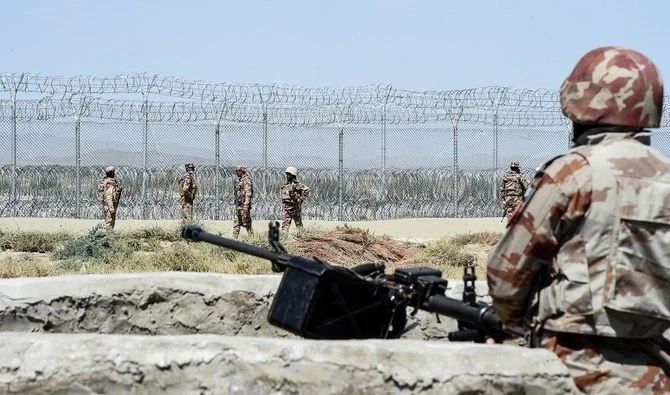
Security personnel of Pakistan's Frontier Corps patrol near the newly inaugurated Badini Trade Terminal Gateway, a border crossing point between Pakistan and Afghanistan at the Pakistan's border town of Qila Saifullah in the southwestern province of Balochistan on September 16, 2020. (AFP/File)
Short Url
Updated 12 September 2025
Follow

Pakistan kills four militants in Balochistan raid, accuses India of backing them

  • The intelligence-based operation was launched in Mastung district, says the military
  • Security forces also recovered weapons, ammunition and explosives from the militants

ISLAMABAD: Pakistani security forces killed four militants in an intelligence-based operation in the country’s restive southwestern Balochistan province on Friday, the military said, accusing them of having Indian backing.

Balochistan, which borders Afghanistan and Iran, is strategically important due to its mineral wealth and its role as a transit hub for the China-Pakistan Economic Corridor (CPEC). However, the province has long been gripped by a separatist insurgency, with groups such as the Balochistan Liberation Army (BLA) ramping up attacks in recent years.

Islamabad calls these outfits proxies of Indian intelligence, branding them “Fitna-e-Hindustan,” India’s mischief, though the charge is denied by New Delhi.

“On 12 Sep 2025, security forces conducted an intelligence based operation in Mastung District of Balochistan, on reported presence of terrorists belonging to Indian proxy, Fitna al Hindustan,” the military’s media wing, Inter-Services Public Relations (ISPR), said in a statement.

“During the conduct of operation, own forces effectively engaged the terrorists’ location, and after an intense fire exchange, four Indian sponsored terrorists were sent to hell,” it continued.

The statement said weapons, ammunition and explosives were recovered from the militants, who “remained actively involved in numerous terrorist activities in the area.”

It added that a “sanitization operation” was continuing to eliminate any other militants in the district, reaffirming what it called the nation’s resolve to “wipe out the menace of Indian sponsored terrorism” and bring those responsible to justice.

Balochistan has seen a string of high-profile militant attacks this year. In March, the BLA hijacked a passenger train, and in May, a suicide bombing in Khuzdar killed several children after targeting their school bus.

Security forces, civilians and non-local workers are frequently targeted in coordinated attacks across the province. Despite the violence, the government has refrained from launching a full-scale military response, preferring intelligence-based operations instead.


Pakistan to launch AI screening in January to target fake visas, agent networks

Updated 05 December 2025
Follow

Pakistan to launch AI screening in January to target fake visas, agent networks

  • New system to flag forged-document travelers before boarding and pre-verify eligibility
  • Move comes amid increasing concern over fake visas, fraudulent agents, forged papers

ISLAMABAD: Pakistan will roll out an AI-based immigration screening system in Islamabad from January to detect forged documents and prevent illegal overseas travel, the government said on Thursday. 

The move comes amid increasing concern over fake visas, fraudulent agents and forged papers, with officials warning that such activity has contributed to deportations, human smuggling and reputational damage abroad. Pakistan has also faced scrutiny over irregular migration flows and labor-market vulnerability, particularly in the Gulf region, prompting calls for more reliable pre-departure checks and digital verification.

The reforms include plans to make the protector-stamp system — the clearance required for Pakistani citizens seeking overseas employment — “foolproof”, tighten labor-visa documentation, and cancel the passports of deportees to prevent them from securing visas again. The government has sought final recommendations within seven days, signalling a rapid enforcement timeline.

“To stop illegal immigration, an AI-based app pilot project is being launched in Islamabad from January,” Interior Minister Mohsin Naqvi said following a high-level meeting chaired by him and Minister for Overseas Pakistanis Chaudhry Salik Hussain.

Naqvi said the new screening technology is intended to determine travelers’ eligibility in advance, reducing airport off-loads and closing loopholes exploited by traffickers and unregistered agents.

The interior minister added that Pakistan remains in contact with foreign governments to improve the global perception and ranking of the green passport, while a uniform international driving license will be issued through the National Police Bureau.

The meeting also approved zero-tolerance measures against fraudulent visa brokers, while the Overseas Pakistanis Ministry pledged full cooperation to streamline the emigration workflow. Minister Hussain said transparency in the protector process has become a “basic requirement,” particularly for labor-migration cases.

Pakistan’s current immigration system has long struggled with document fraud, with repeated cases of passengers grounded at airports due to forged papers or agent-facilitated travel. The launch of an AI screening layer, if implemented effectively, could shift the burden from manual counters to pre-flight verification, allowing authorities to identify risk profiles before departure rather than after arrival abroad.

The reforms also come at a moment when labor mobility is tightening globally. Gulf states have begun demanding greater documentation assurance for imported labor, while European and Asian destinations have increased scrutiny following trafficking arrests and irregular-entry routes from South Asia. For Pakistan, preventing fraudulent departures is increasingly linked to protecting genuine workers, reducing deportation cycles and stabilizing the country’s overseas employment footprint.