

Pakistani, Iraqi air forces resolve to enhance joint exercises, training initiatives

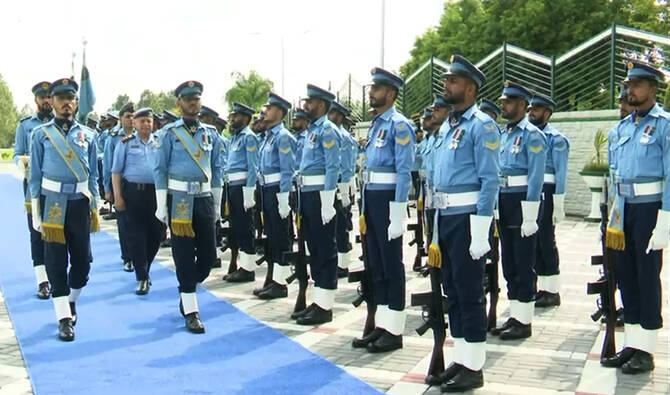
Iraqi Air Force Commander Lt. Gen. Staff Pilot Mohanad Ghalib Mohammed Radi Al-Asadi reviews guard of honor during visit at the Air Headquarters in Islamabad on September 11, 2025. (Handout/PAF)
Short Url
Updated 11 September 2025
Follow

Pakistani, Iraqi air forces resolve to enhance joint exercises, training initiatives

  • Iraqi Air Force commander calls on PAF chief in Islamabad to discuss mutual cooperation
  • Iraqi commander seeks PAF’s help in building modernized training paradigm, says Pakistan military

ISLAMABAD: The Pakistan Air Force (PAF) chief and a senior commander of the Iraqi Air Force (IAF) resolved to enhance training initiatives and joint exercises between the two countries to improve interoperability, the Pakistani military’s media wing said on Thursday.

A high-level delegation led by Iraqi Air Force Commander Lt. Gen. Staff Pilot Mohanad Ghalib Mohammed Radi Al-Asadi met Air Chief Marshal Zaheer Ahmed Baber Sidhu at the Air Headquarters in Islamabad, the Inter-Services Public Relations (ISPR) said in a statement.

Both officials discussed various prospects for mutual cooperation between their air forces, placing special emphasis on joint training, capacity building and advancements in the aviation industry, the ISPR said.

“Both commanders concurred on conducting joint exercises and training initiatives aimed at bolstering interoperability and forging stronger operational synergy between the two air forces,” the military’s media wing said.

Al-Asadi conveyed the Iraqi Air Force’s desire to restructure its entire training system, spanning from basic to advanced operational and tactical levels, the ISPR said. He sought PAF’s support in building a modernized training paradigm of the IAF.

“The Iraqi commander also highlighted the aspiration of his force to benefit from exchange postings of PAF pilots, underscoring the immense value Iraqi aviators attach to learning directly from PAF’s combat-proven professionals,” the ISPR said.

The statement said the IAF chief wanted to establish a similar ecosystem in Iraq to the National Aerospace Science & Technology Park, bringing academia, industry and military needs under one umbrella.

Pakistan has sought closer defense and military cooperation with several countries, especially in the air force domain, since its brief military skirmish with India in May.

Pakistan’s government claimed PAF pilots shot down six Indian fighter jets. While Indian officials acknowledged its jets were shot down, they denied that six of them were downed by Pakistan.


Pakistani, Uzbek leaders urge business community to help achieve $2 billion trade target

Updated 06 February 2026
Follow

Pakistani, Uzbek leaders urge business community to help achieve $2 billion trade target

  • Pakistan and Uzbekistan have steadily increased economic ties in recent years, with bilateral trade volume reaching nearly $500 million
  • President Shavkat Mirziyoyev says business community is ‘most important bridge’ linking both nations, promising favorable business climate

ISLAMABAD: Pakistan Prime Minister Shehbaz Sharif and Uzbekistan President Shavkat Mirziyoyev on Friday urged businesspersons from both countries to help the two countries achieve a bilateral trade target of $2 billion within the next five years.

The two leaders made the call while addressing traders, industrialists from both countries at the Pakistan Uzbekistan Business Forum in Islamabad during President Mirziyoyev’s visit to the South Asian country.

Pakistan and Uzbekistan have steadily increased economic ties in recent years as Pakistan offers landlocked Central Asian states greater access to global markets, aiming to position itself as a regional transit hub.

Pakistan was the first Central Asian partner with which Uzbekistan signed a bilateral Transit Trade Agreement, along with a Preferential Trade Agreement in March 2022, covering 17 items, which became operational in 2023.

“We agreed that political goodwill must be matched by economic actions and words must be converted into implementation,” Sharif said, citing his visit to Tashkent last year which had helped brought annual bilateral trade to nearly $450 million.

“Today, ladies and gentlemen, we will strengthen last night’s protocol by signing another document today, which will give you vistas of opportunities to sit down together, B2B (business to business), have wonderful discussions with your counterparts and come to arrangements in terms of joint ventures, investments in Uzbekistan and Pakistan.”

Sharif was referring to the protocol signed between the two countries on Thursday to establish a joint working group to formulate a five-year action plan to take bilateral trade to $2 billion. Both sides also signed 28 agreements focused on areas such as defense cooperation, climate change, disaster risk reduction, disaster management, agriculture, exports of fruits, and mining and geosciences.

President Mirziyoyev said the increase in bilateral trade to half-a-billion dollars was an outcome of their talks held in Tashkent in Feb. last year.

“Over the course of very comprehensive and detailed discussions yesterday, we together decided that this is far [from] being enough,” he told businessperson from both countries.

The Uzbek president said business community is the “most important bridge” in linking the two nations and it was their job as heads of the state to ensure favorable conditions for them.

“Success of this agreement is in your hands,” he told the attendees, assuring them of eliminating any obstacles and bottlenecks in the process.

Later, Pakistan President Asif Ali Zardari conferred the Nishan-e-Pakistan, the highest civilian award of the country, on President Mirziyoyev at a televised ceremony.

The Nishan-e-Pakistan is awarded to individuals who have rendered services of highest distinction to the national interest of Pakistan and has often been conferred on visiting Heads of State as a mark of respect and friendship.