



ISLAMABAD: Pakistan and the United States (US) have signed an agreement on critical minerals, the US embassy and the government in Islamabad said on Monday, amid deepening cooperation between the two countries.
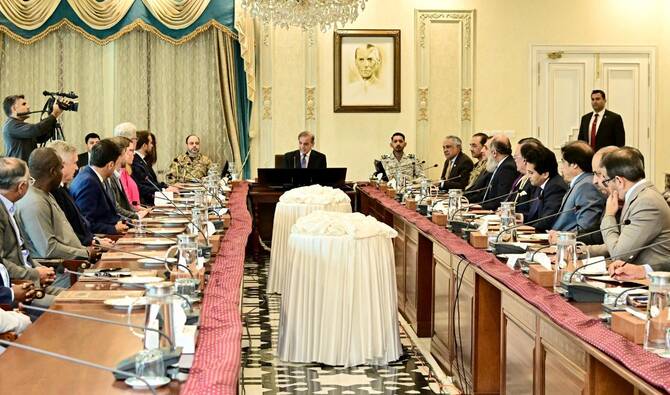
The agreement was signed between American firm US Strategic Metals (USSM) and Pakistan’s Frontier Works Organization (FWO) at the Prime Minister's House in Islamabad, according to the US embassy in Islamabad.
Missouri-based USSM produces and recycles critical minerals, which Washington says are essential in a variety of technologies related to advanced manufacturing and energy production.
Prime Minister Shehbaz Sharif’s office said the agreement establishes a framework for collaboration across a range of critical minerals essential for the defense, aerospace and technology industries.
“The partnership will begin immediately with the export of readily available minerals from Pakistan, including antimony, copper, gold, tungsten, and rare earth elements. This cooperation lays the foundation for scaling up towards the establishment of a USSM proprietary, highly flexible poly-metallic refinery in Pakistan,” it said.
“The refinery will produce intermediate and finished products dedicated to meeting the rapidly growing demand of the U.S. market. The first phase of this deal is envisaged at approximately $500 million of investments into Pakistan’s critical minerals sector.”
The US delegation, including representatives of USSM and Mota-Engil, another renowned global infrastructure firm, is visiting Pakistan to explore opportunities for expansion of mining operations in Pakistan and to assess potential for value addition in mineral resources and development of supporting infrastructure, according to PM Sharif's office.
The delegates were briefed on Pakistan’s vast mineral reserves, including copper, gold and rare earth elements, at a meeting with PM Sharif, attended by federal ministers and Chief of the Army Staff Field Marshal Asim Munir.
"The visiting companies expressed readiness to invest in establishing value-addition facilities within the country, enhancing mineral processing capacity, and developing large-scale infrastructure projects linked to the mining sector," Sharif's office said.
"In this context, two Memoranda of Understanding (MoUs) focusing on development and processing of critical minerals, including rare earth elements (REEs), and logistics services were signed between the two governments."
US Chargé d’Affaires (CDA) Natalie Baker called the signing of the agreement on critical minerals yet another example of the strength of the US-Pakistan bilateral relationship that will "benefit both countries."
“The Trump administration has made the forging of such deals a key priority given the importance of critical mineral resources to American security and prosperity,” Baker said in a statement issued by the US embassy.
"We look forward to seeing future agreements between U.S. companies and their counterparts in the critical minerals and mining sector in Pakistan."
The next steps for the MoU include forming dedicated teams to explore the full potential of Pakistan’s vast resource base, identifying critical minerals for immediate export, and building an anchor position for a long-term partnership in exploration, extraction, and processing. Importantly, the cooperation will prioritize sustainability, profitability, and environmental responsibility to ensure benefits for the people of both nations, according to Sharif’s office.
In addition, both parties will also explore innovative financing and digital solutions such as tokenization of critical minerals, enabling global investors to participate in Pakistan’s mineral wealth and further accelerating transparency, liquidity, and value creation across the sector.
Critical minerals are a select group of non-fuel minerals and metals essential for modern manufacturing, technological advancements, and the transition to clean energy technologies like solar panels and electric vehicles, but are subject to supply chain vulnerabilities.
While Pakistan is rich in gold, copper and lithium reserves as well as other minerals, its mineral sector contributes only 3.2 percent to the country's GDP and 0.1 percent to global exports, according to official figures.
Last month, Pakistani and the US officials discussed ways to strengthen Pakistan's railways and infrastructure to support mineral extraction and transportation, according to the US embassy. US Secretary of State Marco Rubio said the same month Washington looked forward to exploring cooperation with Pakistan in critical minerals and hydrocarbons.
In July, Pakistan also signed a trade deal with the US after which Washington slashed its tariff on Pakistani goods from 29 percent to 19 percent, while Trump imposed double tariffs on Islamabad's arch-rival India.
Islamabad is currently aiming to tap into its underutilized mineral potential by attracting investment from global mining companies.
In April this year, Pakistan hosted an international minerals summit in Islamabad where top companies and government officials from the US, Saudi Arabia, China, Turkiye, the UK, Azerbaijan, and other nations attended. The summit aimed to attract foreign investment in the country’s mining sector.


