Archbishop criticizes Reform’s Farage over ‘knee-jerk’ UK asylum plans

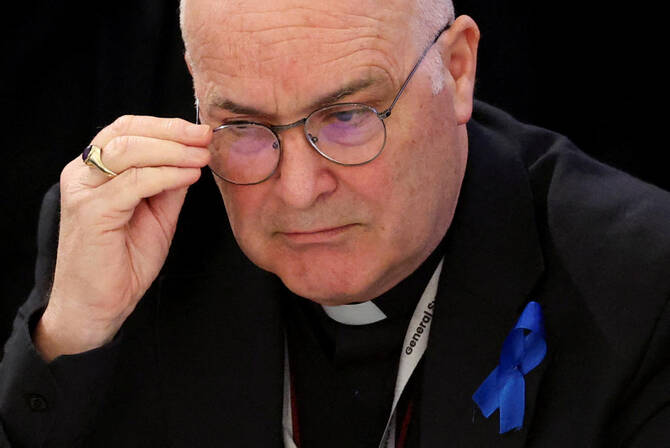
Archbishop of York Stephen Cottrell has criticized the leader of Britain’s populist Reform UK party, Nigel Farage. (Reuters)
Short Url
Updated 31 August 2025
Follow

Archbishop criticizes Reform’s Farage over ‘knee-jerk’ UK asylum plans

  • Stephen Cottrell’s criticism is the latest in a growing row in Britain over how to deal with the large numbers of asylum seekers

LONDON: The Archbishop of York, Stephen Cottrell, has criticized the leader of Britain’s populist Reform UK party, Nigel Farage, describing his plans for mass deportations of asylum seekers as an “isolationist, short-term, knee-jerk” response.
Cottrell, the Church of England’s second most senior clergyman who is performing some functions of the Archbishop of Canterbury while a new head of the Church is selected, told Sky News that Brexit veteran Farage was “not offering any long-term solution to the big issues which are convulsing our world.”
He said in an pre-recorded interview aired on Sunday that people should “actively resist the kind of isolationist, short-term, knee-jerk ... send them home” policies.
In response, Reform UK’s deputy leader, Richard Tice, said “the role of the Archbishop is not actually to interfere with international migration policy that is determined by the government.”
Cottrell’s criticism is the latest in a growing row in Britain over how to deal with the large numbers of asylum seekers arriving in boats, an issue which has seen weeks of summer protests outside hotels where some of them are housed.
The Labour government says it is tackling a problem left by earlier, Conservative administrations by trying to process asylum claims more quickly and brokering return deals with other nations, but is under growing pressure to act fast.
Reform UK, which has a commanding lead in opinion polls before an election expected to take place in 2029, took the initiative to lead on the issue last week when Farage unveiled his party’s plans to remove asylum seekers by repealing or disapplying treaties used to block forced deportations.
Cottrell said those plans did little to address the main issue of why asylum seekers wanted to travel to Britain, and “so if you think that’s the answer you will discover, in due course, that all you have done is made the problem worse.”


Portugal heads for presidential vote, fretting over storms and far-right

Updated 4 sec ago
Follow

Portugal heads for presidential vote, fretting over storms and far-right

LISBON: Portugal ended campaigning on Friday for a presidential election this weekend amidst a battering by storms and fretting about the political whirlwind created by outspoken far-right leader Andre Ventura.
Ventura is almost certain to be beaten by Socialist candidate Antonio José Seguro in Sunday’s election but the far-right score will be watched almost as much as the latest of a series of fierce gales that have swept in off the Atlantic since the start of the year.
Voting has been delayed by a week in some municipalities because of the storms, which have killed at least five people, triggered flooding and caused widespread damage.
A new storm is forecast for Saturday.
But Ventura’s call to postpone the whole vote was rejected.
Prime Minister Luis Montenegro said the storms had caused a “devastating crisis” but that the threats to voting could be overcome. The electoral law only allows for a postponement in individual localities.
- Government attacks -

Seguro and Ventura have drastically rewritten their election scripts and appearances to focus on the towns and villages worst hit by floods, where the storm has torn down buildings and pylons.
Ventura, whose Chega (Enough) party was only created in 2019 but is now the biggest single opposition party in parliament, has attacked the response to the storm given by Montenegro’s center-right minority government.
Seguro has cast off his stance as a unifying candidate and also criticized the government.
The 63-year-old former Socialist party leader said he was “shocked” by the state’s efforts to get the country back on its feet.
Seguro has the advantage in the divisions caused by the rise of Chega in recent years.
An opinion poll published by the Publico daily on Wednesday gave Seguro 67 percent of voter support and Ventura 33 percent.
Seguro led the first round of the presidential election in January with 31 percent of votes and he is now backed by a host of political figures from the far left to the mainstream right.
Montenegro, whose government relies on the goodwill of the Socialists and Chega to survive, has not publicly backed any candidate, however.
His own party’s candidate obtained only 11 percent in the first round and dropped out.
Ventura, 43, took 23 percent of the vote in the first round.
The Portuguese establishment and analysts will be closely watching Ventura’s final score on Sunday to see whether his support is “stagnating” or whether he is “conquerering a new public,” said Joao Cancela, political science professor at Lisbon’s Nova University.
But the weather could have the final word in the debate as the storms and Seguro’s predicted win may lower voter turnout.