

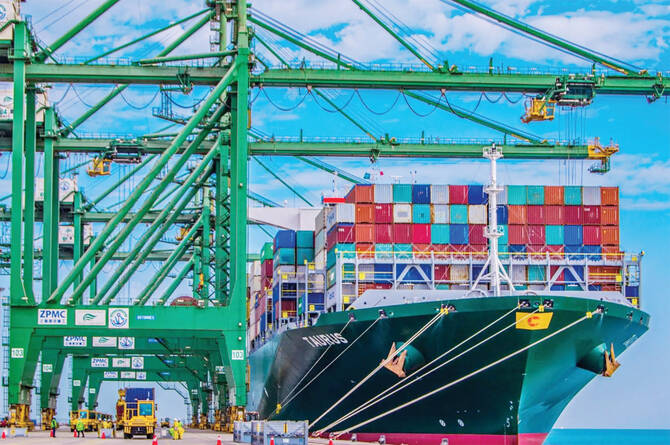

RIYADH: Saudi Arabia’s non-oil exports, including re-exports, reached SR27.45 billion ($7.31 billion) in June, marking an annual rise of 22.1 percent, official data showed.
Preliminary figures released by the General Authority for Statistics showed that the UAE remained the top destination for the Kingdom’s non-oil products, with exports to the Emirates amounting to SR7.85 billion in the sixth month of the year.
India was the second-largest non-oil trade partner, importing goods worth SR2.6 billion, followed by China at SR2.14 billion, Turkiye at SR946.2 million, and Egypt at SR871.2 million.
The rise in non-oil exports supports the goals of Vision 2030, which aims to diversify Saudi economy and reduce its reliance on oil revenues.
In its latest report, GASTAT stated: “Non-oil exports, including re-exports, recorded an increase of 22.1 percent compared to June 2024, while national non-oil exports, excluding re-exports, increased by 8.4 percent.”
It added: “The value of re-exported goods increased by 60.2 percent during the same period.”
In a separate release, GASTAT noted that Saudi non-oil exports jumped 17.8 percent in the second quarter of 2025, offsetting weaker oil sales and highlighting the Kingdom’s accelerating diversification drive, official data showed.
FASTFACTS
• Figures showed that the UAE remained the top destination for the Kingdom’s non-oil products.
• India was the second-largest non-oil trade partner, importing goods worth SR2.6 billion.
• This is followed by China at SR2.14 billion, Turkiye at SR946.2 million, and Egypt at SR871.2 million.
• Other major destinations for Saudi non-oil shipments in June included Belgium.
The increase included a 46.2 percent rise in re-exports, while national non-oil exports excluding re-exports climbed 5.6 percent.
Other major destinations for Saudi non-oil shipments in June included Belgium, which received goods worth SR675.2 million, followed by Oman at SR629.4 million, and Kuwait at SR594.4 million.
Exports to the US stood at SR446 million, while shipments to Singapore and the UK totaled SR394.3 million and SR322.3 million, respectively.
Departure locations
Among seaports, the King Fahad Industrial Port in Jubail handled the highest volume of outbound non-oil goods, valued at SR3.55 billion, followed closely by the Jeddah Islamic Sea Port at SR3.17 billion.
Jubail Sea Ports and Ras Al Khair facilitated non-oil exports worth SR2.19 billion and SR1.98 billion, respectively.
On land, the Al-Batha Port processed non-oil exports worth SR1.77 billion. Al-Hadithah and Al-Wadiah ports recorded outbound shipments of SR693.6 million and SR398.9 million, respectively.
King Abdulaziz International Airport led all air terminals, handling SR4.25 billion in non-oil exports in June — a 366.3 percent increase compared to the same month last year.
Machinery and chemicals lead the way
“Among the most important non-oil exports are chemical products, which constituted 24.5 percent of the total non-oil exports, recording an 8.5 percent increase compared to June 2024,” GASTAT noted.
Machinery, electrical equipment, and parts came in second, accounting for 23.3 percent of total non-oil exports and growing 168 percent year on year. The strength of Saudi non-oil private sector was further affirmed by Riyad Bank’s Purchasing Managers’ Index, compiled by S&P Global, which showed that the Kingdom’s headline PMI rose to 57.2 in June, up from 55.8 in May. This reading indicates a strong improvement in business conditions, exceeding the long-run average of 56.9.
A PMI score above 50 signals expansion, while a figure below that mark indicates contraction. Saudi Arabia’s June PMI also outpaced that of its regional peers, with the UAE and Kuwait recording 53.5 and 53.1, respectively.

Machinery, electrical equipment, and parts accounted for 23.3 percent of total non-oil exports and growing 168 percent year on year. (AN file photo)
Merchandise exports
According to GASTAT, the Kingdom’s total merchandise exports in June increased by 3.7 percent year on year, although there was a 2.5 percent decrease in oil exports. Consequently, the percentage of oil exports out of total exports decreased from 74.7 percent in June 2024 to 70.2 percent a year later.
China was the top destination for Saudi Arabia’s overall merchandise exports, with shipments valued at SR14.32 billion. The UAE followed at SR8.4 billion — a 43.5 percent jump compared to the previous year — while exports to India reached SR8.33 billion. South Korea and Japan imported SR8.22 billion and SR6.65 billion worth of goods, respectively, while Egypt accounted for SR4.48 billion.
Imports climb
Saudi imports in June reached SR70.03 billion, up 1.7 percent year on year, GASTAT reported.
Machinery, mechanical and electrical equipment topped the import list at SR21.42 billion, followed by transport equipment at SR8.75 billion and chemical products at SR6.38 billion.
Base metal imports stood at SR5.68 billion, while mineral products totaled SR3.95 billion.
By region, Asia remained the Kingdom’s largest trade partner, contributing SR39.68 billion in imports — a 9.2 percent rise from a year ago.
Imports from Europe and the Americas amounted to SR18.6 billion and SR8.23 billion, respectively. Africa supplied SR2.79 billion worth of goods, while imports from Oceania totaled SR719.7 million.
China led all countries as the top source of imports, with SR19.54 billion worth of shipments in June, a 27.7 percent year-on-year increase. The US followed with SR5.79 billion, ahead of the UAE at SR4.31 billion, India at SR3.19 billion, and Germany at SR2.94 billion. Sea routes were the dominant entry channel for imports, accounting for SR41.47 billion — a 4.3 percent decrease year on year. Air and land routes handled SR21.2 billion and SR7.35 billion worth of inbound goods, respectively.
King Abdulaziz Sea Port in Dammam led all seaports with SR17.7 billion in imports, followed by Jeddah Islamic Sea Port at SR16.18 billion and Ras Tanura Port at SR1.28 billion.
Among land entry points, Al-Batha Port managed SR3.07 billion worth of goods, while Riyadh Dry Port and King Fahad Bridge processed SR2.14 billion and SR691.7 million, respectively.
A mixed picture
While non-oil exports strengthened, Saudi Arabia’s overall trade performance showed mixed signals across the second quarter of the year.
During this period, a 15.8 percent drop in oil exports dragged total merchandise exports down by 7.3 percent year on year. Combined with a 13.1 percent rise in imports, this pushed the merchandise trade balance surplus down by 56.2 percent compared to the same period in 2024. Oil’s share of the Kingdom’s total exports slipped from 74.7 percent to 67.9 percent in the quarter, reflecting a gradual rebalancing of the
export basket.


