UN Security Council renews Lebanon peacekeeping mission ‘for a final time’

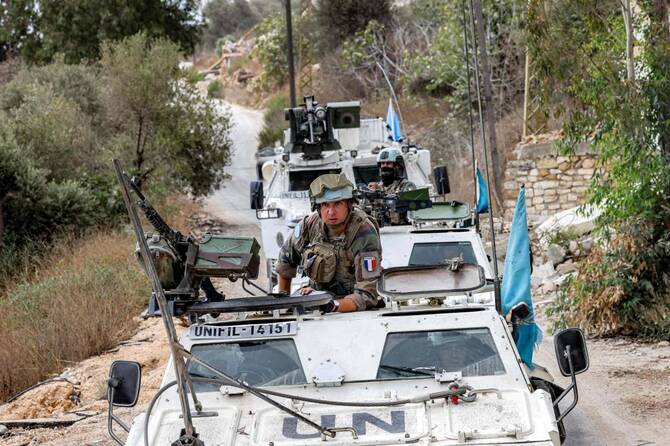
UNIFIL armored vehicles at a position formerly held by Hezbollah in the Khraibeh Valley in southern Lebanon. (AFP)
Short Url
Updated 29 August 2025
Follow

UN Security Council renews Lebanon peacekeeping mission ‘for a final time’

  • Peacekeeping operation in Lebanon extended until the end of 2026, and will then begin a year-long ‘orderly and safe drawdown and withdrawal’
  • The 15-member council unanimously adopted a French-drafted resolution after a compromise was reached with the US, a veto-wielding council member

UNITED NATIONS: The United Nations Security Council on Thursday unanimously extended “for a final time” a long-running peacekeeping mission in Lebanon until the end of 2026, when the operation will then begin a year-long “orderly and safe drawdown and withdrawal.”

The UN Interim Force in Lebanon (UNIFIL), established in 1978, patrols Lebanon’s southern border with Israel.

The 15-member council unanimously adopted a French-drafted resolution after a compromise was reached with the United States, a veto-wielding council member. The Security Council decided “to extend for a final time the mandate of UNIFIL.”

The resolution “requests UNIFIL to cease its operations on 31 December 2026 and to start from this date and within one year its orderly and safe drawdown and withdrawal of its personnel, in close consultation with the Government of Lebanon with the aim of making Lebanon Government the sole provider of security in southern Lebanon.” This will be the last time the United States will support an extension of UNIFIL, said acting US Ambassador to the UN Dorothy Shea.

“The security environment in Lebanon is radically different than just one year ago, creating the space for Lebanon to assume greater responsibility,” she told the council. UNIFIL’s mandate was expanded in 2006, following a month-long war between Israel and Hezbollah, to allow peacekeepers to help the Lebanese army keep parts of the south free of weapons or armed personnel other than those of the Lebanese state.

That has sparked friction with Hezbollah, which effectively controls southern Lebanon despite the presence of the Lebanese army. Hezbollah is a heavily armed party that is Lebanon’s most powerful political force.

“Decades since UNIFIL’s mandate was extended, it is time to dispel the illusion. UNIFIL has failed in its mission and allowed Hezbollah to become a dangerous regional threat,” Israel’s UN Ambassador Danny Danon said after the vote. The United States brokered a truce in November between Lebanon and Israel following more than a year of conflict sparked by the war in Gaza.

The US is now seeking to promote a plan for Hezbollah’s disarmament. Washington is linking the plan to a phased Israeli withdrawal from southern Lebanon, while also promoting a US- and Gulf-backed economic development zone in Lebanon’s south aimed at reducing Hezbollah’s reliance on Iranian funding.

Lebanon’s Prime Minister Nawaf Salam welcomed the extension, noting that it “reiterates the call for Israel to withdraw its forces from the five sites it continues to occupy, and affirms the necessity of extending state authority over all its territory.”


Hamas retakes control of daily life in Gaza

Updated 9 sec ago
Follow

Hamas retakes control of daily life in Gaza

  • “Everyone knows that Hamas possesses the real power in Gaza,” said Shaaban, a displaced Palestinian
  • “Currently, we operate only in areas under Hamas control,” said a merchant

GAZA CITY, Palestinian Territories: Hamas has reasserted control over large parts of Gaza from which the Israeli military withdrew under the US-sponsored ceasefire, exercising power through police and working to restart public administration.
The inaugural meeting of US President Donald Trump’s “Board of Peace” on Thursday included an announcement on the recruitment of a new transitional Palestinian police force in Gaza meant to take over security from Palestinian Islamist movement Hamas.
It also saw several countries pledge to send troops for the nascent International Stabilization Force in the Gaza Strip, without any timetable set.
Hamas still refuses to lay down its arms under the conditions set by Israel, but it has pledged to hand over power, insisting it no longer wants to administer the territory it seized by force nearly 20 years ago.
“Everyone knows that Hamas possesses the real power in Gaza,” said Jaber Shaaban, a displaced Palestinian living in a tent in Gaza City.
“Hamas is the strongest and largest organized entity and it has power, police and a government,” the 64-year-old added.
“Without Hamas, the committee cannot work,” he said, referring to the 15-member Palestinian technocratic committee formed to handle day-to-day governance of Gaza.
Since a ceasefire between Hamas and Israel began on October 10, Gaza has been divided by a so-called “Yellow Line” beyond which Israeli forces are stationed and which leaves the military in control of just over half of the territory.
“Currently, we operate only in areas under Hamas control,” said Abu Ashraf Barbah, a merchant who before the war supplied food items across the territory of more than two million Palestinians.
“The Hamas ministry is the one that deals with traders and controls the markets, while the Hamas police carry out campaigns against tax evaders,” he added.
The newly-formed Palestinian technocratic body is primarily mandated to oversee civilian services such as health, education and municipal affairs.

- In the markets, on the streets -

Phase two of Trump’s Gaza ceasefire plan, which the UN Security Council endorsed in November, stipulates that Hamas should disarm and the Strip’s day-to-day governance be handed over to the technocratic committee.
But Israeli officials say Hamas still has around 20,000 fighters in Gaza and several thousand rockets.
The return to some form of public order is one of the challenges of the second phase, which the United States launched last month.
Concrete results have been slow to materialize.
While waiting for the transitional authority to take shape, Gaza’s existing police force — which answers to Hamas authorities — has returned to the streets since the ceasefire took effect.
AFP journalists reported that uniformed, armed police have deployed at major intersections, hospital entrances and government buildings, directing traffic and regulating markets.
With many police stations destroyed during Israeli air strikes, some units have resumed operations from temporary tents, residents said.
For traders, Hamas’s influence is most visible.
“The one controlling everything in Gaza’s economy is Hamas,” said 41-year-old merchant Samir Abu Adnan.
“Hamas has started collecting taxes, the ministry of economy publishes daily price lists, and the police and ministries are still affiliated with Hamas,” he said.
Several traders confirmed to AFP that civil servants were collecting taxes in markets and shops, relying on police enforcement in cases of non-compliance.

- ‘Hamas controls the levers’ -

In rare testimony to the media, a police captain in Gaza City told AFP that the force would maintain law and order regardless of who formally governs the territory.
“We are a police force that carries out the government’s instructions,” the 44-year-old officer said, declining to be identified for security reasons.
“We do not care who will be in the political leadership of the government,” he added.
“What matters to me is that the incoming government is not affiliated with the occupation,” he said, referring to Israel.
“If the committee takes over Gaza, we will help it.”
But there is uncertainty over how the transitional technocratic committee would be deployed in the territory and what would happen to the current police force.
Amani Ashtiwi, a teacher living in a tent in central Gaza, said the committee would need “very strong support from the Palestinian Authority, Egypt and America to be able to govern Gaza.”
“The committee faces a long and difficult road because Hamas controls the levers of life in Gaza,” Ashtiwi added.
For merchant Abu Adnan, Hamas still “holds the power.”
“If the committee takes over, it will need Hamas’s approval for every decision,” he said.