


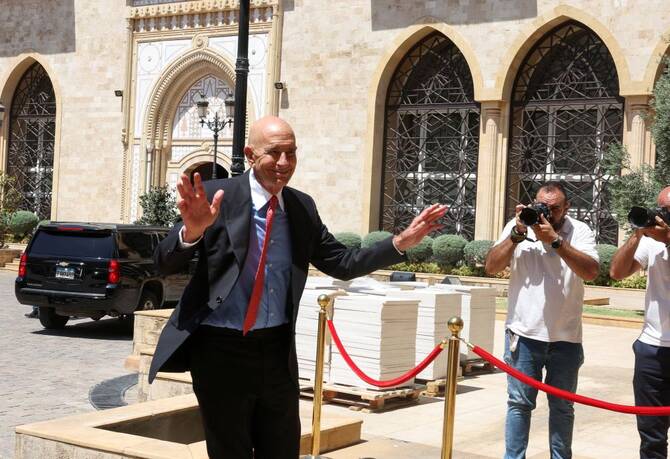
BEIRUT: US envoy Thomas Barrack on Tuesday promised Lebanese officials that the disarmament of Hezbollah would unlock economic assistance and international aid.
However, those who met Barrack and his diplomatic colleague, Morgan Ortagus, said he failed to deliver any public commitment by Israeli authorities that they would fully implement a US-backed ceasefire agreement reached in November 2024.
A government source told Arab News: “Lebanon took the first step when the cabinet adopted the clause restricting arms to state authority and approved the US proposal, with Lebanese amendments added to it.
“Meanwhile, Israel has neither adopted nor committed to the proposal, limiting itself to congratulating the Lebanese Cabinet on its decision, a move that practically means nothing to Lebanon.”
President Joseph Aoun met Barrack on Tuesday morning to discuss the envoy’s recent visit to Israel and the positions of Israeli officials.
After their meeting, the president’s office reaffirmed Lebanon’s commitment to the Nov. 27 ceasefire deal, brokered by the US and France.
“Aoun also stressed adherence to the joint US-Lebanese statement endorsed in its entirety by the Cabinet,” it added.
Prime Minister Nawaf Salam also met the envoys and told them: “The path of arms monopoly, and the extension of state authority and its monopoly over decisions of war and peace, is a path that has already begun and there is no turning back.”
He described the Cabinet’s decision to take action to disarm non-state organizations as a “firm” one, and confirmed that the Lebanese army has been tasked with developing a comprehensive plan to bring all weapons under state control by the end of the year. It is scheduled to be presented to the Cabinet next week.
“This (peace) proposal is based on the concept of synchronized steps to ensure Israel’s withdrawal from Lebanese territory and the full cessation of hostilities,” Salam said.
The Lebanese response to information from Israel conveyed by Barrack suggested that “his shuttle visits to Beirut and Tel Aviv may not yield progress in the near term, so long as Israel has not declared a commitment to the proposal and its terms,” a government source said.
Following his meeting with Aoun at the Presidential Palace, Barrack said: “The president, the prime minister and the parliament speaker performed a heroic act by responding to the proposals we submitted. Israel’s response was also historic.”
He expressed confidence that the Lebanese government would respect the timeline for the disarmament plan, after which Israel is expected to submit its own proposal for withdrawal from occupied areas of Lebanon on and near the border.
“Israel says that it doesn’t want to occupy Lebanon,” Barrack said. “I am hopeful, because the Lebanese government did an impressive job and pledged to commit to 11 specific items in the US proposal, the first of which tasks the Lebanese army with presenting a plan for Hezbollah’s disarmament.
“We are waiting for the government and army’s plan at the end of the month. This is not about the outbreak of war but, rather, about how to persuade Hezbollah to relinquish its weapons.”
Ortagus, Barrack’s colleague, said that Israeli authorities were monitoring the situation closely and would advance “step by step” alongside the actions of the Lebanese government.
“We will help the government move forward with its historic decision and we encourage Israel to take its steps as well,” she added.
Barrack, who visited Syria before arriving in Lebanon, said that the Syrian president, Ahmad Al-Sharaa, seeks cooperative rather than hostile relations with Lebanon.
“He does not see the weakness of the Shiites as an opportunity for himself but, rather, looks forward to a historic relationship and cooperation with Lebanon, and he is ready for talks on the borders,” Barrack said.
Noting that US President Donald Trump had stated “he wants to see a prosperous and stable Lebanon,” Barrack hinted at plans to establish an economic zone in southern Lebanon near the Israeli border with Israel.
“We will bring in the Gulf states to contribute to the economic zone in the south,” said Barrack. “We will also remove the Israeli fear, keeping in mind that a peace agreement with Israel is the path to achieving prosperity and peace.”
Also on Tuesday, President Aoun met members of a US congressional delegation that included senators Jeanne Shaheen and Lindsey Graham, and member of Congress Joe Wilson.
Shaheen, a Democrat from New Hampshire and ranking member of the US Senate Committee on Foreign Relations, expressed support for “the Lebanese government’s decision to disarm Hezbollah,” acknowledging that it “is a difficult but crucial step and we support the bold decisions taken by the government.”
She added that “the Lebanese army needs material and logistical support and we discussed that today.”
Graham, a Republican from South Carolina, said: “The idea of disarming Hezbollah comes from the Lebanese people.
“The party (Hezbollah) serves a foreign agenda, not the Lebanese people. It is not loyal to the people, and I believe the Lebanese want a better future. Israel will not view Lebanon differently unless Lebanon does something different. Without disarming Hezbollah, discussions about withdrawal with Israel would be futile.
“Iran, a close ally of Hezbollah, is currently in a weak position; it does not intend good, but its capabilities have diminished.”
Graham added: “Israeli Prime Minister Benjamin Netanyahu should view Lebanon differently once Hezbollah is disarmed. The United States defends religious diversity in Lebanon. If you make an effort to disarm Hezbollah, we will be here to help you. Congress views Lebanon differently, and if it continues on this path it will have opportunities.”
Meanwhile, Barrack and Ortagus also met several other Lebanese political figures, including former Progressive Socialist Party leader Walid Jumblatt. Barrack was scheduled to travel to southern Lebanon on Wednesday to visit areas devastated by Israeli attacks.
After arriving in Lebanon from Syria on Monday, the large American delegation spent several hours that evening in Beirut’s Gemmayzeh Street, known for its abundance of restaurants, cafes and bars.


