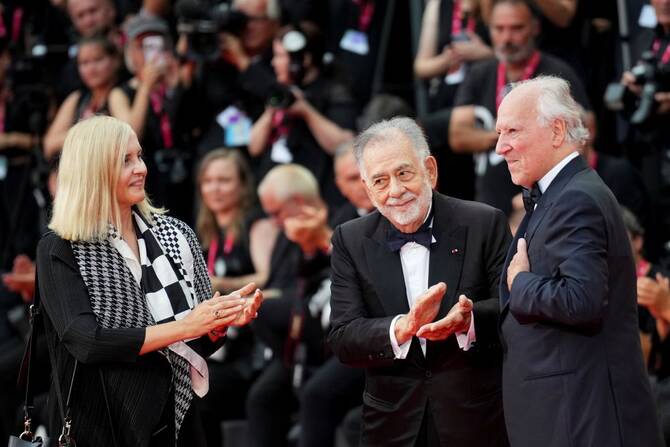
VENICE: Globetrotting filmmaker Werner Herzog, an eclectic risk-taker whose monumental works often explore humankind’s conflict with nature, was honored with a special award on Wednesday at the Venice Film Festival.
The 82-year-old arthouse giant, who helped launch New German Cinema in the 1960s, received the Golden Lion for Lifetime Achievement ahead of the debut of his latest documentary, “Ghost Elephants,” about a lost herd in Angola, on Thursday.
He was handed a special winged Golden Lion statue by “The Godfather” director and friend Francis Ford Coppola who praised the German’s “limitless creativity.”
“I have always tried to strive for something that goes deeper beyond what you normally see in movie theaters, a deep form of poetry that is possible in cinema,” Herzog told a star-studded audience in an acceptance speech.
Guided by a search “for truth in unusual ways,” he added: “I always try to do something which was sublime, or something transcendental.”
Herzog has made more than 70 movies, rising to fame in the 1970s and 80s with sweeping films about obsessive megalomaniacs and struggles with the natural world.
The German director and daredevil explorer has made a series of documentaries in recent years, many in exotic locales, while continuing to make film appearances, including cameos in “The Simpsons.”
Herzog “has never ceased from testing the limits of the film language,” said festival artistic director Alberto Barbera in announcing the award in April.
Born in Munich in 1942, Herzog began experimenting with film at age 15, going on to make his name as a writer, producer and director.
A long and contentious collaboration with German screen icon Klaus Kinski resulted in epic films like 1972’s “Aguirre, the Wrath of God,” about the search for El Dorado in the Amazon jungle, or 1982’s “Fitzcarraldo,” about a mad dreamer hellbent on building an opera house in the jungle — in which Herzog had the extras haul a huge steamship up a hill.
Other noteworthy films include 1979’s gothic horror film “Nosferatu the Vampyre,” the 2005 documentary “Grizzly Man” and “Bad Lieutenant: Port of Call New Orleans” in 2009, with Nicolas Cage.
An inveterate traveler, Herzog is known for shunning studios for the outdoors, shooting in the Amazon, the Sahara desert or Antarctica.
Often placing himself at the center of his documentaries — a genre for which Herzog is particularly noted — the director strayed dangerously close to active volcanoes in 2016’s “Into the Inferno,” while entering death row in Texas for “Into the Abyss” in 2011.
A prolific opera director — including at Bayreuth and La Scala — Herzog has also published poetry and prose, including his 2021 novel “The Twilight World,” a 1978 diary and a memoir in 2023.


![]()

Globetrotting German director Herzog honored at Venice festival
Short Url
https://arab.news/p6qps
Globetrotting German director Herzog honored at Venice festival
- Werner Herzog was handed a special winged Golden Lion statue by ‘The Godfather’ director and friend Francis Ford Coppola who praised the German’s ‘limitless creativity’
- A long and contentious collaboration with German screen icon Klaus Kinski resulted in epic films such as 1972’s ‘Aguirre, the Wrath of God’ and 1982’s ‘Fitzcarraldo’

Latest updates



© 2026 SAUDI RESEARCH & PUBLISHING COMPANY, All Rights Reserved And subject to Terms of Use Agreement.