Palestinian leader Abbas urges ‘firm’ US response to Israel’s West Bank plan

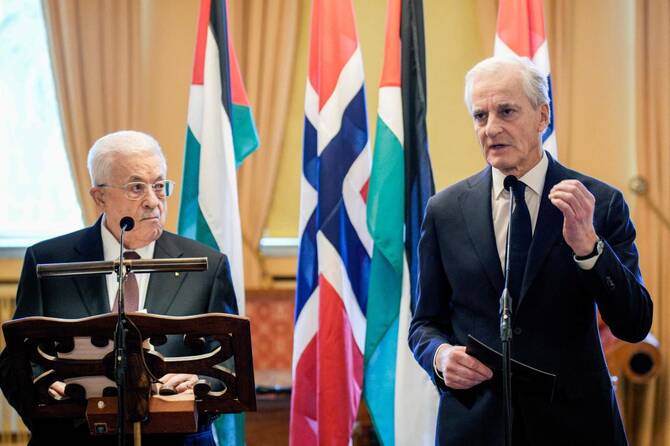
Norway's Prime Minister Jonas Gahr Store (R) and Palestinian President Mahmoud Abbas adress the press after a meeting in Oslo Wednesday. (AFP)
Short Url
Updated 11 February 2026
Follow

Palestinian leader Abbas urges ‘firm’ US response to Israel’s West Bank plan

  • During visit to Oslo, Abbas said he had discussed the issue with Norwegian Prime Minister Jonas Gahr Store
  • Israel’s security cabinet approved a series of measures that would allow Israel to expand its control in areas of the occupied territory

OSLO: Palestinian leader Mahmoud Abbas called Wednesday for a “firm response” from the United States and the international community to Israel’s plan to tighten its control of the occupied West Bank.
During a visit to Oslo, Abbas said he had discussed the issue with Norwegian Prime Minister Jonas Gahr Store, as well as those of Israeli settler violence and Israel’s freezing of “$4 billion” intended for the Palestinian people.
“These serious violations require a firm response from the US administration and the international community because they hinder (US) President (Donald) Trump’s efforts and constitute a violation of international law,” Abbas told reporters.
On Sunday, Israel’s security cabinet approved a series of measures that would allow Israel to expand its control in areas administered by the Palestinian Authority under the Oslo accords in place since the 1990s.
The plans, which have sparked international outrage, would also allow Jewish Israelis to buy West Bank land directly and allow Israeli authorities to administer certain religious sites even when they are located in areas under Palestinian Authority control.
Israel has occupied the West Bank since 1967.
Excluding Israeli-annexed east Jerusalem, more than 500,000 Israelis live in settlements and outposts across the West Bank, which are illegal under international law.
Around three million Palestinians live in the territory.


Iran says missile attacks to continue, US talks ‘not on agenda’

Updated 3 sec ago
Follow

Iran says missile attacks to continue, US talks ‘not on agenda’

  • Abbas Araghchi: ‘I don’t think talking with the Americans would be on our agenda anymore’
  • Top envoy says Tehran had a “very bitter experience” during previous negotiations with the US
TEHRAN: Iran’s foreign minister said Tuesday that talks with the United States were not on the agenda as their war entered its 11th day.
“I don’t think talking with the Americans would be on our agenda anymore,” Abbas Araghchi told PBS News, saying Tehran had a “very bitter experience” during previous negotiations with the US.
On February 28, the US and Israel launched strikes against Iran that killed its supreme leader Ayatollah Ali Khamenei and triggered a war that has spread across the Middle East.
The Israeli and US attacks took place two days before Washington and Tehran were scheduled to hold talks following three prior rounds of negotiations. Omani mediators in those discussions had said there was “significant progress” in the talks.
Iran has responded to the US-Israeli attacks with drone and missile strikes targeting Israel and US interests across the region.
Shipping traffic through the strategic Strait of Hormuz, through which nearly 20 percent of the world’s crude oil usually transits, has been severely disrupted.
Iranian forces have repeatedly targeted oil tankers passing through the strategic waterway since the war began.
In the interview with PBS News, Araghchi insisted that Iran was acting in “self-defense.”
“We are prepared, we have been prepared to continue attacking them with our missiles as long as needed and as long as it takes,” he said.
Late Monday, Iranian deputy foreign minister Kazem Gharibabadi said some countries in the region and elsewhere had reached out to Iran to push for a ceasefire.
“China, Russia and France, and even some countries in the region, are in contact with us,” he told state TV.
“Some of them are willing to do something to stop this war or establish a ceasefire.”
French President Emmanuel Macron said France and its allies are preparing a “defensive” mission to reopen the Strait of Hormuz.
Gharibabadi said Iran “did not start the aggression and the war … we are defending ourselves.”