

Pakistan, Cambodia agree to promote bilateral trade, enhance business networking

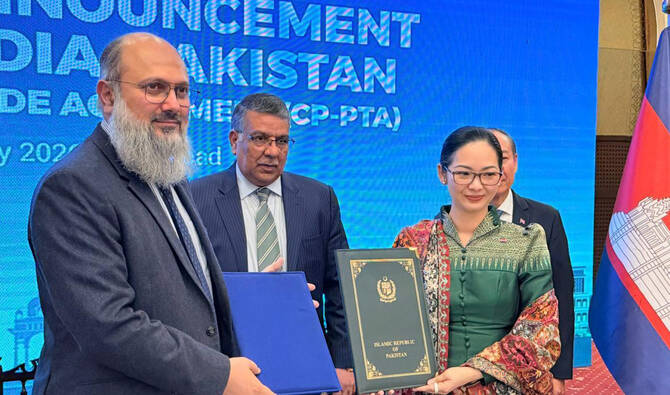
Pakistan’s Commerce Minister Jam Kamal Khan (left) and Cambodia’s Minister of Commerce Cham Nimul (right) exchange a Memorandum of Understanding to promote bilateral trade in Islamabad, Pakistan, on February 11, 2026. (Commerce Ministry)
Short Url
Updated 11 February 2026
Follow

Pakistan, Cambodia agree to promote bilateral trade, enhance business networking

  • Cambodia, Pakistan hold second session of Joint Trade Committee in Islamabad to promote trade, investment
  • Pakistan commerce minister reaffirms commitment to advance discussions for preferential trade agreement

KARACHI: The Trade Promotion Organizations of Pakistan and Cambodia on Wednesday signed an agreement to promote bilateral trade, enhance business networking and exchange information between the two countries, Pakistan’s commerce ministry said. 

The agreement was signed between both sides as Pakistan’s Commerce Minister Jam Kamal Khan co-chaired the second Pakistan-Cambodia Joint Trade Committee (JTC) meeting in Islamabad with his counterpart in Cambodia, Cham Nimul. 

The meeting took place as Islamabad intensifies efforts to diversify export markets beyond traditional Middle Eastern and Western destinations, while strengthening engagement within the Association of Southeast Asian Nations (ASEAN).

“The meeting concluded with the signing of the Joint Statement by the Co-Chairs, followed by the witnessing of the signing of the agreement between the Trade Promotion Organizations of Pakistan and Cambodia — a step aimed at enhancing information exchange, business networking, and trade promotion initiatives,” the Pakistani commerce ministry said in a statement. 

Khan stressed that the JTC serves as an effective platform to review progress, address challenges and identify new avenues for cooperation between both sides. 

He reaffirmed Pakistan’s commitment to advancing discussions toward a Preferential Trade Agreement to enhance market access and diversify trade baskets.

The Pakistani side highlighted export potential in rice, pharmaceuticals, textiles, and agricultural products, while Cambodia identified opportunities in cassava, cashew nuts, footwear, and rubber products, the commerce ministry said.

“Both sides agreed to facilitate direct engagement between their business communities to translate these complementarities into concrete trade flows,” the statement added. 

Pakistan’s Board of Investment presented opportunities in energy, IT, tourism and infrastructure, positioning the country as “a gateway to Central Asia,” the ministry said.

Cambodia outlined the advantages under its new investment law and special economic zones, proposing that their country could serve as a strategic production base for Pakistani enterprises seeking access to ASEAN and Regional Comprehensive Economic Partnership countries. 

The two sides also agreed to advance cooperation in agriculture, aviation, IT, AI, cybersecurity, labor and vocational training. 

“The Second Pakistan–Cambodia Joint Trade Committee marked a significant milestone in deepening bilateral economic engagement, laying a clear roadmap for enhanced trade, investment, and institutional collaboration between the two friendly nations,” the commerce ministry said. 


Pakistan says Afghanistan operation targeting only militants

Updated 09 March 2026
Follow

Pakistan says Afghanistan operation targeting only militants

  • Both countries claim to have inflicted heavy battlefield losses on the other since the clashes began on Feb. 26
  • Islamabad has been bombing areas it says harbor ‘militant targets’ in Afghanistan, an allegation Kabul has denied

ISLAMABAD: Pakistan’s Information Minister Ataullah Tarar has said that no civilian areas were targeted in the ongoing Afghanistan operation and Pakistani strikes were solely aimed at militant infrastructure and support networks, his office said on Monday.

The statement came after the Afghan Taliban government and the United Nations mission in Kabul accused Pakistan of targeting civilian areas during the ongoing operation, “Ghazab Lil Haq,” or the “Wrath for Truth.”

Clashes between the countries began on Feb. 26, when Afghan forces launched an attack on Pakistani military along their shared border in retaliation for Pakistan’s earlier airstrikes on what Islamabad said were militant camps inside Afghanistan.
In a conversation with foreign media correspondents, Tarar said that Pakistan was taking action inside Afghanistan based on “accurate” intelligence information.

“Pakistan has not targeted any civilian area in Afghanistan,” he was quoted as saying by his ministry. “Pakistan is only targeting the infrastructure of terrorists and their support system.”

The minister denied reports of civilian deaths, saying the UN agency was “completely dependent on the Taliban government” for information. The UN rights chief said Friday that 56 Afghan civilians had been killed, nearly half of them children, since the hostilities began.

Tarar also dismissed as “just propaganda” the claims made by an Afghan defense ministry spokesperson about inflicting battlefield losses on Pakistan. Tarar said on Sunday that 583 Afghan Taliban fighters had so far been killed in Pakistani strikes, a claim difficult to verify independently.

Islamabad has long accused Kabul of sheltering militant groups, including the Pakistani Taliban, or the Tehreek-e-Taliban Pakistan, and facilitating attacks against Pakistan. Afghanistan denies the allegations and says Islamabad’s security challenges are an internal matter.

Afghanistan has called for dialogue to resolve the conflict. Pakistan, however, has rejected talks, saying the operation will continue until its objectives are met.

“There is a nexus between the Afghan Taliban government and several terrorist organizations operating from Afghan soil,” Tarar added.