

Asian activists ready to set sail with largest-ever Gaza aid flotilla

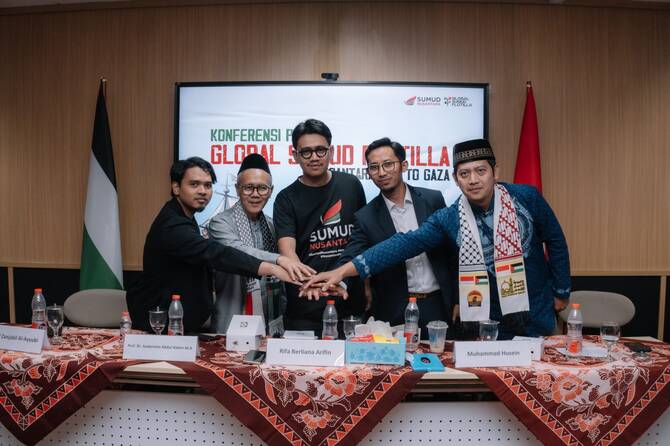
Rifa Berliana Arifin, Indonesia country director for the Sumud Nusantara initiative, center, poses for a group photo at a press conference on Indonesia's participation in the Global Sumud Flotilla on Aug. 15, 2025. (AWG)
Short Url
Updated 23 August 2025
Follow

Asian activists ready to set sail with largest-ever Gaza aid flotilla

  • First convoy of boats will set sail from Spanish ports for the Gaza strip on Aug. 31
  • Activists from 10 Asian nations, including Indonesia, Philippines are taking part 

JAKARTA/MANILA: Asian activists are preparing to set sail with the Global Sumud Flotilla, an international fleet from 44 countries aiming to reach Gaza by sea to break Israel’s blockade of food and medical aid. 

They have banded together under the Sumud Nusantara initiative, a coalition of activists from Indonesia, Malaysia, the Philippines, Maldives, Bangladesh, Bhutan, Thailand, Sri Lanka, Nepal and Pakistan, to join the global flotilla movement that will begin launching convoys from Aug. 31. 

Sumud Nusantara is part of the GSF, a coordinated, nonviolent fleet comprising mostly small vessels carrying humanitarian aid, which will first leave Spanish ports for the Gaza strip, followed by more convoys from Tunisia and other countries in early September.

The international coalition is set to become the largest coordinated civilian maritime mission ever undertaken to Gaza. 

“This movement comes at a very crucial time, as we know how things are in Gaza with the lack of food entering the strip that they are not only suffering from the impacts of war but also from starvation,” Indonesian journalist Nurhadis told Arab News ahead of his trip. 

“Israel is using starvation as a weapon to wipe out Palestinians in Gaza. This is why we continue to state that what Israel is doing is genocide.” 

Since October 2023, Israel has killed more than 62,000 Palestinians and injured over 157,000 more. As Tel Aviv continued to systematically obstruct food and aid from entering the enclave, a UN-backed global hunger monitor — the Integrated Food Security Phase Classification — declared famine in Gaza on Friday, estimating that more than 514,000 people are suffering from it. 

Nurhadis is part of a group of activists from across Indonesia joining the GSF, which aims to “break Israel’s illegal blockade and draw attention to international complicity in the face of the ongoing genocide against the Palestinian people.” 

“We continue to try through this Global Sumud Flotilla action, hoping that the entire world, whether it’s governments or the people and other members of society, will pressure Israel to open its blockade in Palestine,” he said. 

“This is just beyond the threshold of humanity. Israel is not treating Palestinians in Gaza as human beings and the world must not keep silent. This is what we are trying to highlight with this global convoy.” 

The GSF is a people-powered movement that aims to help end the genocide in Gaza, said Rifa Berliana Arifin, Indonesia country director for the Sumud Nusantara initiative and executive committee member of Jakarta-based Aqsa Working Group.  

“Indonesia is participating because this is a huge movement. A movement that aspires to resolve and end the blockade through non-traditional means. We’ve seen how ineffective diplomatic, political approaches have been, because the genocide in Gaza has yet to end. This people-power movement is aimed at putting an end to that,” Arifin told Arab News. 

“This is a non-violent mission … Even though they are headed to Gaza, they are boarding boats that have no weapons … They are simply bringing themselves … for the world to see.” 

As the Sumud Nusantara initiative is led by Malaysia, activists are gathering this weekend in Kuala Lumpur, where a ceremonial send-off for the regional convoy is scheduled to take place on Sunday, led by Malaysian Prime Minister Anwar Ibrahim. 

One of them is Philippine activist Drieza Lininding, leader of civil society group Moro Consensus Group, who is hoping that the Global Sumud Flotilla will inspire others in the Catholic-majority nation to show their support for Palestine. 

“We are appealing to all our Filipino brothers and sisters, Muslims or Christians, to support the Palestinian cause because this issue is not only about religion, but also about humanity. Gaza has now become the moral compass of the world,” he told Arab News. 

“Everybody is seeing the genocide and the starvation happening in Gaza, and you don’t need to be a Muslim to side with the Palestinians. It is very clear: if you want to be on the right side of history, support all programs and activities to free Palestine … It is very important that as Filipinos we show our solidarity.” 


Afghanistan launches retaliatory attacks on Pakistan as tensions escalate

Updated 5 sec ago
Follow

Afghanistan launches retaliatory attacks on Pakistan as tensions escalate

  • At least 66 Afghans have been killed by Pakistan’s strikes, Afghan authorities say
  • Afghanistan has called for dialogue while Pakistan ruled out any talks with Kabul 

KABUL: Afghanistan has launched new attacks on Pakistan’s military bases, the Afghan defense ministry said on Saturday, as cross-border clashes escalated between the neighbors after months of tension. 

The latest flare-up erupted after Pakistan’s airstrikes on Afghan territory last weekend triggered a retaliatory offensive from Afghanistan along the border on Thursday. 

The two countries have engaged in tit-for-tat attacks since, marking the most serious development in ongoing tensions between the two countries, which agreed to a ceasefire last October following a week of deadly clashes. 

Afghanistan’s Air Force has “once again launched airstrikes on Pakistani military bases” in Miranshah and Spinwam, the Afghan Ministry of National Defense said on X on Saturday, claiming that the strikes caused “severe damage and heavy casualties.”

“These successful operations were conducted in response to repeated aerial aggressions by the Pakistani military regime,” the ministry said. 

Afghan forces also launched similar strikes against military targets in Islamabad and Abbottabad on Friday, which the ministry said was in retaliation of aerial attacks by Pakistani forces in Kabul, Kandahar and Paktia.

At least 66 Afghan civilians, mostly women and children, have been killed in Pakistani strikes, with another 59 others wounded, according to Hamdullah Fitrat, deputy spokesman for the Afghan government. 

Pakistan has maintained that it is targeting only military targets to avoid any civilian casualties, in compliance with international law. 

Pakistani officials said its forces have killed more than 330 Afghan fighters and targeted 37 military locations across Afghanistan.

Zabihullah Mujahid, chief spokesperson for the Afghan government, earlier called for talks to resolve the crisis. 

“We have always emphasized peaceful resolution, and now too we want the issue to be resolved through dialogue,” he said on Friday. 

However, Pakistan has ruled out any talks with Kabul. 

“There won’t be any talks, there is nothing to talk about. There’s no negotiation. Terrorism from Afghanistan has to end,” Mosharraf Zaidi, spokesperson for Pakistan’s prime minister, said on Friday. 

Pakistan is accusing the Afghan Taliban of sheltering fighters from the banned Tehreek-e-Taliban Pakistan and allowing them to stage cross-border attacks — a charge Afghanistan denies, saying it does not allow its territory to be used against other countries. 

As international calls for mediation grow amid the escalating hostility, Afghans across the country are growing fearful of the violence. 

“Everyone heard the jets. This is the first time since the withdrawal of US invaders that we have heard such a horrible noise and news of damage. It is not good for us,” said Kandahar resident Shahid Zamari. 

“We had forgotten the US war and its bad impact on us, on our families, on our children. And now this has come upon us again — by Pakistan, and in the holy month of Ramadan.” 

When the strikes hit Kabul at around 1:30 a.m. on Friday, Saleema Wardak moved quickly to wake up her six children and escape outside, assuming the strong jolt that shook her house was an earthquake. 

“While standing in the yard, my husband told me it was not an earthquake but an explosion. Then we heard the crazy sounds of planes, and shooting from the mountains against the planes,” she told Arab News. 

“We hid inside, worried another bomb would fall on us. People say Pakistan is targeting civilians on purpose to increase pressure on the Taliban. So we hid … The world is unjust … They do not value the blood of the poor.” 

For Sabawoon, a 23-year-old student from eastern Kunar province’s Asadabad city, the coming days are filled with uncertainties. 

“What to do? Where to go? We have to stay and find our way to survive,” he told Arab News. “God willing, nothing bad will happen to us. If they are bombing us, what can we do?”