
MINA: The Grand Mosque is undergoing intensive operational preparations to manage pilgrims’ movement during Tawaf Al-Wada, the farewell circumambulation around the Kaaba, which marks the conclusion of Hajj for most of this year’s 1.71 million pilgrims.
In Islamic jurisprudence, pilgrims who perform the stoning ritual on the second day of Tashreeq may proceed to the Grand Mosque to perform the final tawaf under the option known as Ta’ajul, or hastened Hajj, provided they leave Mina before sunset on the 12th of Dhul Hijjah; otherwise, they must remain in Mina for the third day of Tashreeq.
The preparations form part of efforts to facilitate pilgrims’ movement and manage crowds efficiently within the Grand Mosque and its courtyards, ensuring smooth flow and the safety of worshippers as they conclude their spiritual journey, according to the General Authority for the Care of the Two Holy Mosques.
The authority added that its field teams were deployed across corridors, courtyards, and entrances to guide crowds toward designated tawaf routes, providing real-time assistance and responding to inquiries, thereby helping regulate crowd flow and reduce waiting times to reach the tawaf and sa’i areas.
It added that the routes to these two areas had been equipped with multilingual guidance signage, supported by on-the-ground guidance teams that facilitated movement, particularly amid the increasing number of departing pilgrims.
“This enhances operational efficiency and improves comfort and organization levels,” the authority added.
The authority said cleaning and sanitization operations were continuing round the clock inside the Grand Mosque and its courtyards, adding that they were carried out by specialized field teams working to prepare prayer areas and walkways and maintain site readiness for peak crowd density during Tawaf Al-Wada.
The authority added: “As part of supporting services, the authority has provided multiple Zamzam water distribution points and drinking stations across key locations inside the Grand Mosque, in addition to electric and manual wheelchair services for the elderly, persons with disabilities, and those in need of assistance.”
It said that these efforts aimed at ensuring that everyone could perform their rituals with ease and peace of mind.
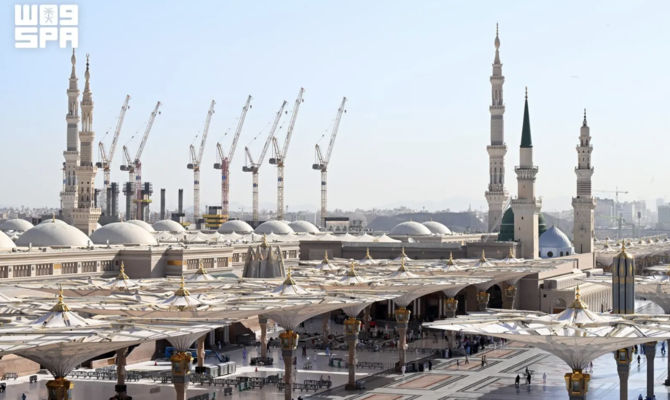
As for the Prophet’s Mosque, the authority said it had completed preparations to receive pilgrims arriving to visit the mosque after completing Hajj rituals, as reported by the Saudi Press Agency.
This coincided with the arrival of the first groups of pilgrims departing early on the evening of the 12th of Dhul Hijjah — corresponding to May 29 — via buses and the Haramain High Speed Railway.
The operational plan focuses on preparing the Prophet’s Mosque and all facilities to receive visitors and worshippers in a safe and well-equipped environment. Preparations have included opening 141 gates in the men’s and women’s sections.
“Entry movement is also being organized through 100 pathways supervised by specialists in guidance and crowd organization,” the SPA added.
The authority said that preparations included laying more than 25,000 carpets in the Prophet’s Mosque and its courtyards. Copies of the Holy Qur’an and translations of its meanings in several languages have also been provided.
The authority has enhanced guidance and orientation services and prepared dedicated services for elderly visitors and persons with disabilities, through wheelchair and electric-cart distribution points. Some 194 escalators and elevators have helped to serve worshippers.
Additional efforts have included increasing Zamzam water services through the distribution of more than 10,000 water containers across the Prophet’s Mosque and its courtyards. Drinking stations, shaded areas, and carpeted courtyards have also been prepared to accommodate worshippers and visitors during peak times.