

Pakistan’s finance chief says 15% of citizens in digital assets, urges adoption of ‘new economy’

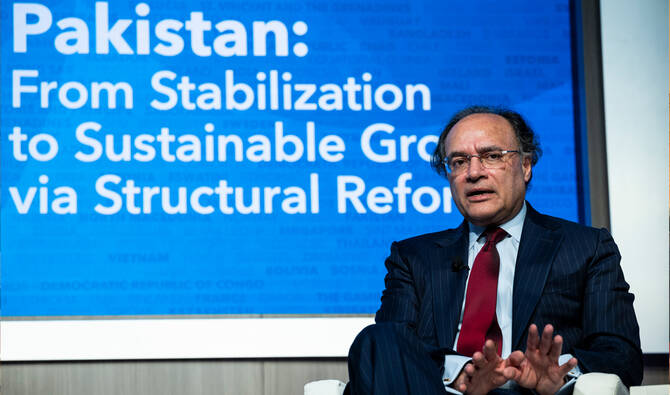
Pakistan’s Minister for Finance and Revenue Muhammad Aurangzeb speaks during a discussion on Pakistan, during the International Monetary Fund and World Bank Group 2024 Annual Meetings, in Washington, DC on October 22, 2024. (Sipa USA via Reuters/File)
Short Url
Updated 23 August 2025
Follow

Pakistan’s finance chief says 15% of citizens in digital assets, urges adoption of ‘new economy’

  • Muhammad Aurangzeb says government drafting virtual assets bill, to be reviewed by parliament
  • He says Pakistan Virtual Asset Regulatory Authority set to hold inaugural meeting on August 25

ISLAMABAD: Federal Minister for Finance and Revenue Muhammad Aurangzeb said on Saturday the country could not ignore the rapid growth of digital assets, pointing out that about 15 percent of citizens were already involved in the sector, prompting the government to work on a regulatory framework for virtual investment.

The minister’s remarks came at the Leadership Summit on Blockchain and Digital Assets in Islamabad, where he highlighted the need to harness emerging technologies to align Pakistan’s economy with global trends.

He said the government’s role was to provide a regulatory framework and enabling environment, while the private sector and youth were expected to drive innovation.

“When you see 20 to 25 million citizens of this country participating in this activity in one form, shape or the other … you cannot ignore that,” he said in his address to the conference.

He added the realization that “10 to 15 percent of the citizens of this country” were investing in virtual assets led to the genesis of the discussion on cryptocurrency in Pakistan.

Aurangzeb said the government had already established the Pakistan Crypto Council and the Pakistan Virtual Asset Regulatory Authority, whose inaugural meeting is scheduled on Monday, August 25.

A draft bill on digital investment and virtual assets is also being submitted to the Senate Standing Committee on Finance and will soon be moved to the National Assembly for approval.

The Pakistani finance chief described the expansion of digital assets as part of Pakistan’s entry into the “new economy,” stressing the importance of transparency, clear rules and learning from international models.

“I’m very clear that the private sector has to lead this country, and the government just needs to provide the ecosystem,” he added.

Aurangzeb noted it was vital for Pakistan to accelerate its economic journey by embracing new global trends, though he also maintained that “we must go into this with our eyes and ears open.”


Pakistan launches final nationwide polio drive of 2025 to vaccinate 45 million children

Updated 4 sec ago
Follow

Pakistan launches final nationwide polio drive of 2025 to vaccinate 45 million children

  • Campaign comes as Pakistan records 30 polio cases this year, one of only two countries where virus is endemic
  • Health minister urges parents to welcome vaccinators as insecurity, misinformation hinder eradication efforts

ISLAMABAD: Pakistan on Thursday launched its final polio vaccination campaign of the year, with Health Minister Mustafa Kamal administering drops to children under five as part of a nationwide effort to reach 45 million children, the country’s polio program said.

The Dec. 15–21 drive is part of Pakistan’s decades-long struggle to eliminate wild poliovirus. Pakistan and neighboring Afghanistan are the only two countries where the virus remains endemic, keeping global eradication efforts at risk.

Pakistan has reported 30 polio cases so far this year. The incurable and highly infectious virus can cause lifelong paralysis and can only be prevented through repeated oral vaccinations and routine immunization, health officials say.

“I want to take this opportunity to speak directly to parents and caregivers. When our polio vaccinator knocks at your door, I urge you to welcome them in and ensure that every child under five in your house receives two drops of this essential vaccine,” the polio program quoted Health Minister Kamal as saying.

“I also urge you to advocate for vaccination in your families and communities and create a welcoming environment for our vaccinators.”

The new campaign comes days after Pakistan conducted a nationwide measles, rubella and polio vaccination drive from Nov. 17–29, which targeted 22.9 million children across 89 high-risk districts.

Pakistan recorded 74 polio cases in 2024, a steep rise from six in 2023 and just one in 2021, underscoring the volatility of eradication efforts in a country where misinformation, vaccine hesitancy and political instability have repeatedly disrupted progress.

Violence has also hampered the program. Polio teams and their security escorts have been attacked frequently by militants and religious hard-liners in parts of northwestern Khyber Pakhtunkhwa and southwestern Balochistan. Officials say continued security threats, coupled with natural disasters such as recent flooding, pose major obstacles to reaching every child.

Pakistan has drastically reduced polio prevalence since the 1990s, when annual cases exceeded 20,000. By 2018, the number had fallen to eight. But health authorities warn that without consistent access to children, particularly in high-risk, underserved region, eradication will remain out of reach.