
WASHINGTON/KYIV: US President Donald Trump renewed a threat to impose sanctions on Russia on Friday if there is no progress toward a peaceful settlement in Ukraine in two weeks, showing frustration at Moscow a week after his meeting with Russian President Vladimir Putin in Alaska.
“I’m going to make a decision as to what we do and it’s going to be, it’s going to be a very important decision, and that’s whether or not it’s massive sanctions or massive tariffs or both, or we do nothing and say it’s your fight,” Trump said.
He was unhappy about Russia’s deadly strike on a factory in Ukraine this week, he said.
“I’m not happy about it, and I’m not happy about anything having to do with that war,” Trump told reporters at the White House.
Ukrainian President Volodymyr Zelensky, meanwhile, said on Friday that Russia was doing everything it could to prevent a meeting between him and Putin, while Russia’s foreign minister said the agenda for such a meeting was not ready.
Zelensky has repeatedly called for Putin to meet him, saying it is the only way to negotiate an end to the war.
Trump had said he had begun the arrangements for a Putin-Zelensky meeting after a call with the Russian leader on Monday that followed their Alaska meeting on August 15.
Zelensky accused Russia of stalling.
“The meeting is one of the components of how to end the war,” he said on Friday at a press conference in Kyiv with NATO Secretary General Mark Rutte. “And since they don’t want to end it, they will look for space to (avoid it).”
Russian Foreign Minister Sergei Lavrov told NBC there was no agenda for such a summit.
“Putin is ready to meet with Zelensky when the agenda would be ready for a summit. And this agenda is not ready at all,” he said.
The statement echoed Moscow’s established rhetoric about a leaders’ meeting being impossible unless certain conditions were met.
Asked for his response to Lavrov’s comments and what the next steps are, Trump told reporters earlier on Friday: “Well, we’ll see. We’re going to see if Putin and Zelensky will be working together. It’s like oil and vinegar a little bit.”
‘He may be coming’
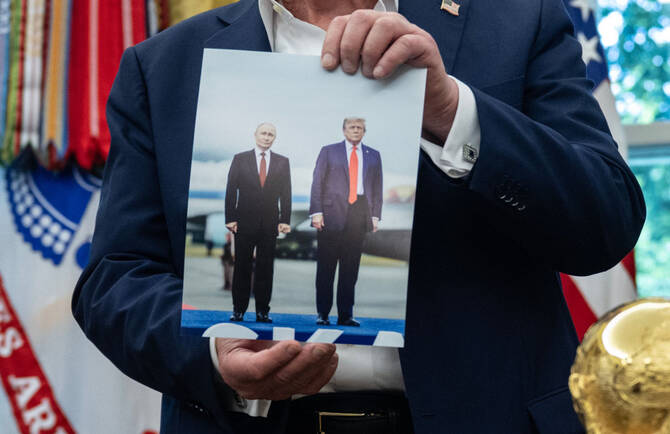
Trump had taken sanctions off the table in preparation for his summit in Anchorage with Putin. But at the same White House event where he mentioned possible sanctions, he showed a photograph of his meeting with Putin on the red carpet in Alaska, saying Putin wanted to attend the World Cup 2026 soccer tournament in the United States.
“I’m going to sign this for him. But I was sent one, and I thought you would like to see it, it’s a man named Vladimir Putin, who I believe will be coming, depending on what happens. He may be coming, and he may not, depending on what happens,” Trump said.
Trump’s comments did not address the fact that Russia was banned from international competitions such as the World Cup after the 2022 invasion of Ukraine and has not taken part in qualification for the 2026 tournament, which will be hosted by the US, Canada and Mexico.
During a visit to a nuclear research center on Friday, Putin said Trump’s leadership qualities would help restore US-Russia relations.
“With the arrival of President Trump, I think that a light at the end of the tunnel has finally loomed. And now we had a very good, meaningful and frank meeting in Alaska,” Putin said.
Thousands of Ukrainian civilians have been killed in the full-scale invasion of Ukraine that Russia launched in 2022. Analysts estimate that more than a million soldiers on both sides have been killed or wounded and fighting is continuing unabated, with both sides also attacking energy facilities.
Russia has maintained its longstanding demand for Ukraine to give up land it still holds in two eastern regions while proposing to freeze the front line in two more southerly regions Moscow claims fully as its own and possibly hand back small pieces of other Ukrainian territory it controls.
Zelensky meanwhile has dropped his demand for a lengthy ceasefire as a prerequisite for a leaders’ meeting, although he has previously said Ukraine cannot negotiate under the barrel of a gun.
At the press conference with Rutte, Zelensky said they had discussed security guarantees for Ukraine. He said the guarantees ought to be similar to NATO’s Article 5, which considers an attack on one member of the alliance as an attack against all.
Rutte said NATO allies and Ukraine are working together to ensure security guarantees are strong enough that Russia will never try to attack again.
“Robust security guarantees will be essential, and this is what we are now working on to define,” he said.