

China says upcoming SCO summit will provide stability, counter ‘hegemonism’

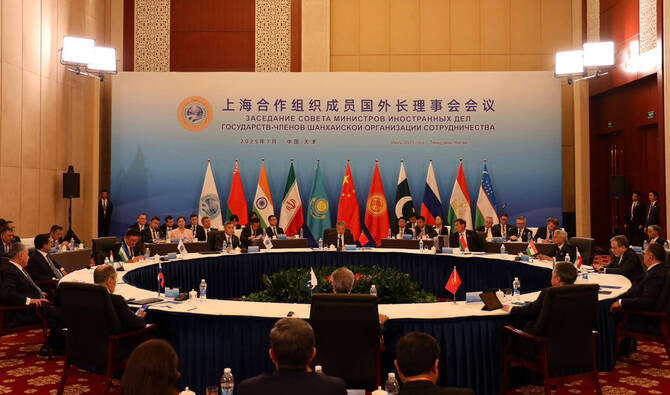
This handout photo shows the Shanghai Cooperation Organization Foreign Ministers meeting in Tianjin, China on July 15, 2025. (Handout/SCO/File)
Short Url
Updated 22 August 2025
Follow

China says upcoming SCO summit will provide stability, counter ‘hegemonism’

  • China has long sought to present the Shanghai Cooperation Organization as a counterweight to Western-led power blocs
  • Over 20 leaders including India, Pakistan PMs as well as Russia’s president will attend the summit from Aug. 31 till Sept. 1

BEIJING: China slammed “hegemonism and power politics” on Friday as it touted an upcoming summit it is hosting for more than 20 world leaders as promoting stability and peace.

The Shanghai Cooperation Organization summit will be held in the northern city of Tianjin from August 31 to September 1, days before a huge military parade in the nearby capital Beijing to mark 80 years since the end of World War II.

China has long sought to present the SCO as a counterweight to Western-led power blocs and has pushed for greater collaboration between its 10 members.

More than 20 foreign leaders including Indian Prime Minister Narendra Modi and Russian President Vladimir Putin will attend the regional security bloc’s largest meeting since it was founded, China’s Assistant Foreign Minister Liu Bin said Friday.

Top politicians from member states or guest countries such as Belarus, Iran, Kazakhstan, Pakistan, Turkiye and Vietnam are also among those taking part.

Chinese President Xi Jinping will deliver keynote speeches at the event — also attended by heads of international organizations such as UN Secretary-General Antonio Guterres.

Through the summit, China hopes “to stimulate momentum for cooperation...(and) with the stability and resilience of the SCO, respond to the uncertain and unpredictable factors in the international environment,” Liu told reporters at a briefing.

“In today’s world, outdated mindsets of hegemonism and power politics still have influence, with certain countries attempting to prioritize their own interests above others, seriously threatening world peace and stability,” he added in a veiled reference to the United States.

“The more complex and turbulent the international situation becomes, the more countries need to strengthen solidarity and cooperation to promote common development.”

Xi said in July that the SCO “has successfully explored a path of regional cooperation that aligns with the trends of the times and meets the needs of all parties, setting a model for a new type of international relations.”


Pakistan combing for perpetrators after deadly Balochistan attacks

Updated 5 sec ago
Follow

Pakistan combing for perpetrators after deadly Balochistan attacks

  • Pakistan has been battling a Baloch separatist insurgency for decades, with frequent armed attacks on security forces, foreign nationals and non-locals
  • Militants stormed banks, jails, police stations and military installations, killing 31 civilians and 17 security personnel, the Balochistan chief minister says

QUETTA: Pakistan forces were hunting on Sunday for the separatists behind a string of coordinated attacks in restive Balochistan province, with the government vowing to retaliate after more than 190 people were killed in two days.

Around a dozen sites remained sealed off, with troops combing the area a day after militants stormed banks, jails, police stations and military installations, killing at least 31 civilians and 17 security personnel, according to the chief minister of Balochistan province.

At least 145 attackers were also killed, he added, while an official told AFP that a deputy district commissioner had been abducted.

That figure includes more than 40 militants that security forces said were killed on Friday.

Mobile internet service across the province has been jammed for more than 24 hours, while road traffic is disrupted and train services suspended.

After being rocked by explosions, typically bustling Quetta lay quiet on Sunday, with major roads and businesses deserted, and people staying indoors out of fear.

Shattered metal fragments and mangled vehicles litter some roads.

"Anyone who leaves home has no certainty of returning safe and sound. There is constant fear over whether they will come back unharmed," Hamdullah, a 39-year-old shopkeeper who goes by one name, told AFP in Quetta.

The chief minister, Sarfraz Bugti, told a press conference in Quetta that all the districts under attack were cleared on Sunday.

"We are chasing them, we will not let them go so easily," he said.

"Our blood is not that cheap. We will chase them until their hideouts."

The Baloch Liberation Army (BLA), the province's most active militant separatist group, claimed responsibility for the attacks in a statement sent to AFP.

The group, which the United States has designated a terrorist organisation, said it had targeted military installations as well as police and civil administration officials in gun attacks and suicide bombings.

Interior Minister Mohsin Naqvi, who flew to Quetta late Saturday to join funerals, claimed without offering any evidence that the attackers were supported by India.

"We will not spare a single terrorist involved in these incidents," he said.

In a press conference on Sunday, Pakistan Defence Minister Khawaja Asif likewise claimed the attackers enjoyed links to India and pledged to "completely eliminate these terrorists".

India denied any involvement.

"We categorically reject the baseless allegations made by Pakistan, which are nothing but its usual tactics to deflect attention from its own internal failings," said foreign ministry spokesman Randhir Jaiswal on Sunday.

'BROAD DAYLIGHT'

Pakistan has been battling a Baloch separatist insurgency for decades, with frequent armed attacks on security forces, foreign nationals and non-local Pakistanis in the mineral-rich province bordering Afghanistan and Iran.

Saturday's attacks came a day after the military said it killed 41 insurgents in two separate operations in the province.

The insurgents released a video showing group leader Bashir Zaib leading armed units on motorcycles during the attack.

Another clip claimed to show the abducted senior official from Nushki district.

In another district, militants freed at least 30 inmates from a district jail, while seizing firearms and ammunition. They also ransacked a police station and took ammunition with them.

"It was one of the most audacious attacks in the region in recent years, as unlike other attacks, it took place in broad daylight," Abdul Basit at the S. Rajaratnam School of International Studies in Singapore told AFP.

"It is alarming that militants, with coordinated manpower and strategic acumen, have now reached the provincial capital," he added.

Several of the BLA's videos featured women insurgents, while Defence Minister Asif said at least one of the suicide bombers was a young woman.

"They continue to showcase women strategically in high-visibility attacks," Basit said.

Pakistan's poorest province and largest by landmass, Balochistan lags behind the rest of the country in almost every index, including education, employment and economic development.

Baloch separatists accuse Pakistan's government of exploiting the province's natural gas and abundant mineral resources, without benefiting the local population. The government denies this.

The BLA has intensified attacks on Pakistanis from other provinces working in the region in recent years, as well as foreign energy firms.

Last year, the separatists attacked a train with 450 passengers on board, sparking a deadly two-day siege.