

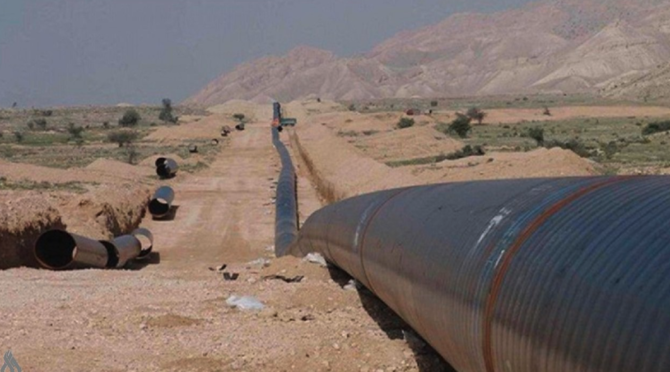

JEDDAH: Iraq is proposing a new oil pipeline to Syria’s Baniyas port while seeking to boost flows to Turkiye’s Ceyhan terminal to 650,000 barrels per day, as part of a broader push to rehabilitate infrastructure and strengthen supply flexibility.
Bassem Mohammed Khudair, the country’s deputy minister of oil, told the Iraqi News Agency that the existing line is inoperable and a study is underway to build a new facility, while modernizing the Basra line and developing branches toward Jordan and Baniyas.
He noted that, before the current conflict, export capacity stood at around 200,000 bpd, with 50,000 barrels allocated for domestic use, adding that the target is to raise regional output to 400,000 bpd, which, combined with 250,000 barrels from the North Oil Co., could bring total exports to about 650,000 bpd, depending on production growth.
Iraqi oil production has slumped amid the ongoing regional conflict, with output from southern oilfields falling roughly 80 percent to around 800,000 bpd. Storage tanks are reaching critical levels, and exports via the Strait of Hormuz remain blocked, according to three Iraqi energy officials who spoke to Reuters.
Earlier this month, production from the same fields had already declined by about 70 percent to 1.3 million bpd.
“The main pipeline has previously suffered sabotage and has not yet reached its full export capacity. It is currently undergoing rehabilitation and inspection,” INA reported, citing Khudair.
He added that the project “will require significant investment for the pipeline, intermediate stations, and storage facilities.”
The deputy minister said that one of the pumping stations has been restored, allowing an initial capacity of about 350,000 bpd, and said work is underway on a second station in partnership with the Engineering Equipment Co., which “could increase export capacity to around 500,000 barrels per day.”
Khudair also highlighted ongoing coordination with the Kurdistan region to increase production from fields within its territory, noting that the contracts are between the regional authorities and foreign companies and “are not” under the ministry’s control.
Iraq has two main oil pipelines: one in the Kurdistan region, established in 2014 with a design capacity of 900,000 bpd, and the main Kirkuk-Fishkhabur pipeline under the ministry’s control, with a design capacity of around 1.5 million bpd.
Khudair underscored the strategic importance of the Syria project, noting that it will enhance supply flexibility between southern and northern regions and enable southern crude to bypass potential disruptions at the Strait of Hormuz.
He added that the pipeline is being manufactured by an Iraqi company in the south using imported materials and is being constructed in line with international specifications.
Khudair said the ministry will invite companies to compete for the pipeline construction to ensure efficient implementation.
He added that the plan includes developing and rehabilitating the southern export system, enhancing the northern route via Ceyhan toward Baniyas, and, if necessary, pursuing the Aqaba project, adding that tanker-based pipelines to Turkiye, Jordan, and Syria can be considered, according to INA.
“This is part of the plan, and following the outbreak of this war, we are currently in the process of announcing opportunities to shipping companies and buyers through SOMO (State Organization for Marketing of Oil), which is responsible for crude oil exports,” Khudair said.


