BOGOTA: A car bomb and a separate attack on a police helicopter in Colombia killed at least 17 people Thursday, according to authorities. President Gustavo Petro attributed both attacks to dissidents of the defunct Revolutionary Armed Forces of Colombia, commonly known as FARC.
At least 12 police officers died in the attack on a helicopter that according to authorities was transporting personnel to an area in Antioquia in northern Colombia, to eradicate coca leaf crops, the raw material for cocaine. Petro had reported initially eight officers killed, but Antioquia Gov. Andrés Julián said four others died later and three remain injured.
The Antioquia governor had said on X that a drone attacked the helicopter as it flew over coca leaf crops. Colombian Defense Minister Pedro Sánchez said preliminary information indicates the attack caused a fire in the aircraft.
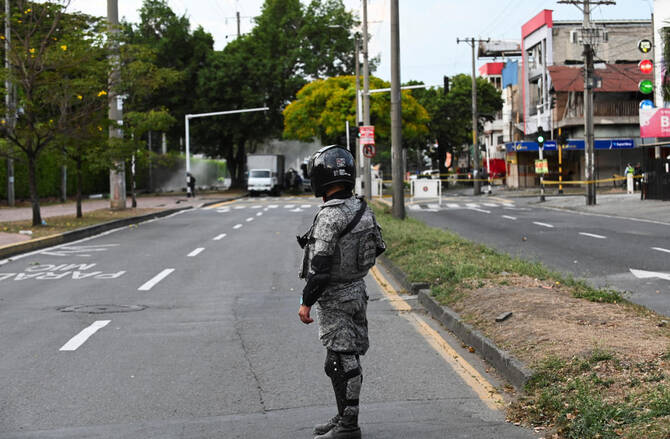
Meanwhile, authorities in the southwest city of Cali reported that a vehicle loaded with explosives detonated near a military aviation school, killing five people and injuring more than 30. The Colombian air force did not immediately provide additional details of the explosion.
Petro initially blamed the Gulf Clan, the country’s largest active drug cartel, for the attack on the helicopter. He said the aircraft was targeted in retaliation for a cocaine seizure that allegedly belonged to the group.
The president said an alleged member of the dissident group was arrested in the area of the explosion.
FARC dissidents, who rejected a peace agreement with the government in 2016, and members of the Gulf Clan both operate in Antioquia.
Coca leaf cultivation is on the rise in Colombia. The area under cultivation reached a record 253,000 hectares in 2023, according to the latest report available from the UN Office on Drugs and Crime.


![]()


Car bomb and attack on a helicopter in Colombia kill at least 17, including police officers
Short Url
https://arab.news/wedrp
Car bomb and attack on a helicopter in Colombia kill at least 17, including police officers
- The Antioquia governor had said on X that a drone attacked the helicopter as it flew over coca leaf crops
- At least 12 police officers died in the attack on a helicopter that according to authorities was transporting personnel to an area in Antioquia in northern Colombia


UN rights chief appeals for $400 million as crises mount and funding shrinks
- The UN office is appealing for $100 million less than last year, after a significant scale back of its work in some areas
- Volker Turk’s office undertook less than half the number of human rights monitoring missions compared to 2024
GENEVA: UN human rights chief Volker Turk appealed for $400 million on Thursday to address mounting human rights needs in countries such as Sudan and Myanmar, after donor funding cuts drastically reduced the work of his office and left it in “survival mode.”
The UN office is appealing for $100 million less than last year, after a significant scale back of its work in some areas due to a fall in contributions from countries including the US and Europe.
“We are currently in survival mode, delivering under strain,” Turk told delegates in a speech in Geneva, urging countries to step up support.
In the last year, Turk’s office raised alarm about human rights violations in Gaza, Sudan, the Democratic Republic of the Congo, Ukraine, and Myanmar, among others.
However, due to slashes in funding, Turk’s office undertook less than half the number of human rights monitoring missions compared to 2024, and reduced its presence in 17 countries, he said. Last year it received $90 million less in funding than it needed, which resulted in 300 job cuts, directly impacting the office’s work, Turk said in December.
“We cannot afford a human rights system in crisis,” he stated.
Turk listed examples of the impacts of cuts, noting the Myanmar program was cut by more than 60 percent in the last year, limiting its ability to gather evidence.
A UN probe into possible war crimes in the Democratic Republic of the Congo is also struggling to become fully operational due to limited funding, while work to prevent gender-based violence and protect the rights of LGBTIQ+ people globally has been cut up to 75 percent, the office said.
“This means more hate speech and attacks, and fewer laws to stop them,” Turk stated.
The UN human rights office is responsible for investigating rights violations. Its work contributes to UN Security Council deliberations and is widely used by international courts, according to the office.
The UN office is appealing for $100 million less than last year, after a significant scale back of its work in some areas due to a fall in contributions from countries including the US and Europe.
“We are currently in survival mode, delivering under strain,” Turk told delegates in a speech in Geneva, urging countries to step up support.
In the last year, Turk’s office raised alarm about human rights violations in Gaza, Sudan, the Democratic Republic of the Congo, Ukraine, and Myanmar, among others.
However, due to slashes in funding, Turk’s office undertook less than half the number of human rights monitoring missions compared to 2024, and reduced its presence in 17 countries, he said. Last year it received $90 million less in funding than it needed, which resulted in 300 job cuts, directly impacting the office’s work, Turk said in December.
“We cannot afford a human rights system in crisis,” he stated.
Turk listed examples of the impacts of cuts, noting the Myanmar program was cut by more than 60 percent in the last year, limiting its ability to gather evidence.
A UN probe into possible war crimes in the Democratic Republic of the Congo is also struggling to become fully operational due to limited funding, while work to prevent gender-based violence and protect the rights of LGBTIQ+ people globally has been cut up to 75 percent, the office said.
“This means more hate speech and attacks, and fewer laws to stop them,” Turk stated.
The UN human rights office is responsible for investigating rights violations. Its work contributes to UN Security Council deliberations and is widely used by international courts, according to the office.
Latest updates


Recommended


© 2026 SAUDI RESEARCH & PUBLISHING COMPANY, All Rights Reserved And subject to Terms of Use Agreement.