

Colombia presidential hopeful dies after June rally shooting

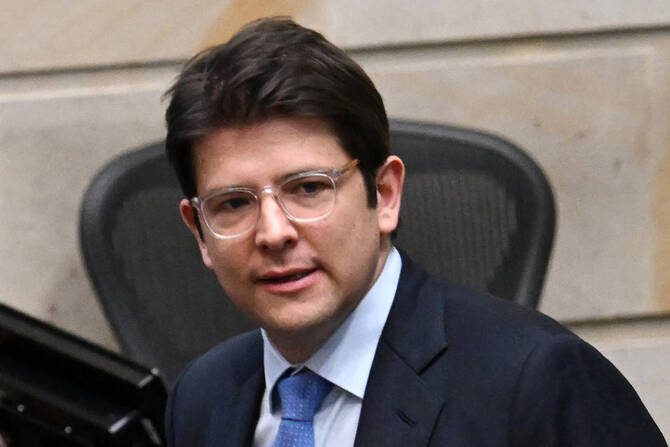
Colombian presidential candidate Miguel Uribe died two months after being shot in the head at a campaign event, his wife announced, Aug. 11, 2025. (File/AFP)
Short Url
Updated 11 August 2025
Follow

Colombia presidential hopeful dies after June rally shooting

  • Miguel Uribe, 39, was a conservative senator and a grandson of former president Julio Cesar Turbay (1978-1982)
  • Authorities have arrested six suspects linked to the attack and the alleged mastermind, Elder Jose Arteaga Hernandez, alias “El Costeno”

BOGOTA: Colombian presidential candidate Miguel Uribe has died two months after being shot at a campaign rally, his family said Monday, as the attack rekindled fears of a return to the nation’s violent past.

The 39-year-old conservative senator, a grandson of former president Julio Cesar Turbay (1978-1982), was shot in the head and leg on June 7 at a rally in the capital Bogota.

Despite signs of progress in recent weeks, his doctors on Saturday announced he had suffered a new brain hemorrhage.

“Rest in peace, love of my life,” his wife Maria Claudia Tarazona wrote Monday morning in a post on Instagram.

“Thank you for a life full of love.”

Authorities have arrested six suspects linked to the attack, including the alleged shooter, a 15-year-old boy captured at the scene by Uribe’s bodyguards.

Following a nationwide manhunt, police announced the arrest of an alleged mastermind behind the attack, Elder Jose Arteaga Hernandez, alias “El Costeno.”

Police have also pointed to a dissident group of the defunct FARC guerrilla group as being behind the assassination.

The attack on Uribe, a leading candidate ahead of the 2026 presidential election, has reopened old wounds in a country wracked by violence.

His own mother, journalist Diana Turbay, was killed in a botched 1991 police operation to free her from cocaine kingpin Pablo Escobar’s Medellin cartel.

Four presidential candidates were assassinated during the worst phase of violence in the 1980s and 1990s under Escobar, who terrorized citizens of Bogota, Medellin and elsewhere with a campaign of bombings.
 

Sad day for Colombia

“Today is a sad day for the country,” Colombian Vice President Francia Marquez said on social media.

“Violence cannot continue to mark our destiny. Democracy is not built with bullets or blood, it is built with respect, with dialogue.”

Uribe has been a strong critic of Colombia’s first left-wing president, Gustavo Petro, who has sought in vain to make peace with the country’s various remaining armed groups.

He announced in October that he would seek to succeed the term-limited Petro in the May 2026 presidential election.

Uribe was elected to Bogota’s city council at age 26, later becoming its youngest-ever chairperson and then the mayor’s right-hand man.

In 2019, he unsuccessfully ran for mayor of Bogota, but three years later, he was elected a senator — receiving the most votes of any candidate in the country.

He took a seat with the conservative Democratic Center party, founded by former president Alvaro Uribe, no relation.

“Evil destroys everything, they killed hope. May Miguel’s struggle be a light that illuminates Colombia’s rightful path,” former president Uribe wrote on X.

In recent months, Petro, a former left-wing guerrilla, has been accused of dialing up the political temperature by labelling his right-wing opponents “Nazis.”

US Secretary of State Marco Rubio, a frequent critic of the leftist Petro government, demanded justice following the announcement of Uribe’s death.

“The United States stands in solidarity with his family, the Colombian people, both in mourning and demanding justice for those responsible,” Rubio said.

Uribe leaves behind a young son and three teenage daughters of his wife, whom he had taken in as his own.


Modi starts Mideast-Africa tour as India-Oman free-trade pact nears completion

Updated 15 December 2025
Follow

Modi starts Mideast-Africa tour as India-Oman free-trade pact nears completion

  • Oman’s Shoura Council approved the trade deal’s draft last week
  • Modi begins trip in Amman, heading to Addis Ababa and Muscat

NEW DELHI: Prime Minister Narendra Modi left New Delhi on Monday for a tour covering Jordan, Oman and Ethiopia, as his government looks to strengthen partnerships with West Asia and Africa and finalize a free-trade deal with Muscat.

Modi’s four-day trip will start in Amman, at the invitation of King Abdullah.

“I am sure this visit will boost bilateral linkages between our nations,” Modi said on social media upon his arrival in Jordan, where he was received by Prime Minister Jafar Hassan.

On Tuesday, he is scheduled to arrive in Addis Ababa for his first state visit to Ethiopia. A day later, he will be in Muscat, where the Shoura Council last week approved the draft Comprehensive Economic Partnership Agreement with India.

“If it is signed during this visit, it will significantly deepen the economic ties between India and Oman. And it will open up a new chapter in the history of India-Oman trade and commercial relationship,” Ministry of External Affairs Secretary Arun Chatterjee told reporters ahead of Modi’s departure.

He said Modi would be accompanied by a high-level delegation for his second visit to Oman, after his last trip in February 2018. It also follows the visit of Oman’s Sultan Haitham bin Tariq to India in December 2023.

Free-trade negotiations between India and Oman began in November 2023, with the first round in New Delhi and the second in Muscat.

When the talks concluded in March 2024, Oman sought revisions on market-access terms and the final signature was postponed.

Announcements of the deal’s possible finalization have been made in the past few months by India’s Commerce and Industry Minister Piyush Goyal and the Omani ambassador to New Delhi, Issa Saleh Al-Shibani.

It would be its second with a GCC country after a 2022 trade deal with the UAE, as India has been trying to reach a similar agreement with the whole bloc.

“The framework is expected to be the same as the UAE’s, that is, a Comprehensive Economic Partnership Agreement. This is significant given that the progress on India-GCC FTA has been slow and non-consequential so far,” said Muddassir Quamar, associate professor at the School of International Studies, Jawaharlal Nehru University.

While Oman is one of Delhi’s smaller GCC trading partners — trailing behind the UAE and Saudi Arabia, with bilateral trade about $10 billion — it remains strategically important, particularly in energy and logistics.

“The FTA is likely to give a boost to India-Oman economic and trade relations, especially of goods and services. (It is) important given India has worked to enhance its trade and economic relations with the Gulf countries that are (among) the most dynamic and fast-expanding global economies,” Quamar told Arab News.

“It is also important because there is immense potential for Indian businesses and industries to partner with their Gulf and Omani partners in contributing to the diversification and economic growth plans.”