


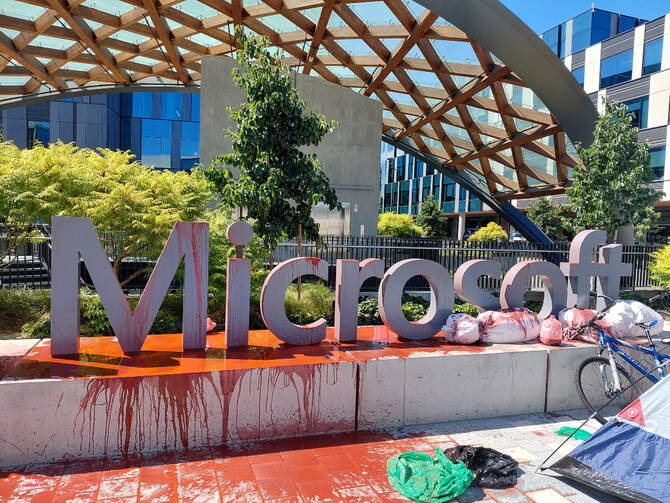

WASHINGTON: Police arrested 18 people on Wednesday during the second day of pro-Palestinian protests led by current and former Microsoft employees at the tech giant’s headquarters in Redmond, Washington.
The arrests came a day after officers dismantled an encampment set up by the worker-led campaign group “No Azure for Apartheid,” which is demanding Microsoft end its ties with the Israeli military amid reports that the company’s technology has been used to facilitate mass surveillance of Palestinians in Gaza and the West Bank, and assist in selecting bombing targets during the war on Gaza.
Redmond police said they arrested 18 demonstators who “resisted and became aggressive” as officers tried to disperse the protests at Microsoft’s campus.
“A few protesters had poured paint over the Microsoft sign and on the ground. Others had blocked a pedestrian bridge and were using stolen tables and chairs from vendors to form a barrier,” Redmond police department said in a post on X.
18 arrested for various charges during a protest at Microsoft Campus
Redmond police are at the scene of a demonstration at the Microsoft campus. On Aug 20, around 12:15 p.m., Redmond officers were dispatched to a large gathering of protestors in the Microsoft courtyard.… pic.twitter.com/L4jzjsdxkT
— RedmondWaPD (@RedmondWaPD) August 20, 2025
In a statement to Arab News, Microsoft accused the returning protesters of “vandalism and property damage,” a day after 35 demonstrators had cleared the site following police orders that such activities were not permitted on private property.
“They also disrupted, harassed, and took tables and tents from local small businesses at a lunchtime farmer’s market for employees,” a Microsoft spokesperson told Arab News.
Demonstrators were arrested on multiple charges, including “trespassing, malicious mischief, resisting arrest, and obstruction,” as investigations are underway, the police department said, adding that no injuries were reported at the scene.
Organizers of the “No Azure for Apartheid” group told Arab News that those arrested included current and former Microsoft workers as well as Seattle community members.
They said protesters returned for the second day in a row “to escalate and force an end to the genocide powered by Microsoft technology.”
“Instead of listening to the (group’s) demands and ending its role in the daily massacre of Palestinians, Microsoft chose to militarize its campus,” the group said in a statement to Arab News. They accused the tech giant of enabling Israel’s military campaign and starvation in Gaza, as well as assisting the displacement of Palestinians in the West Bank.
The group noted that the demonstrations aimed to “demand Microsoft stop exploiting our labor to build technology that murders Palestinians.”
Microsoft has reiterated its pledge to conduct “a thorough and independent review of new allegations” raised earlier this month in a Guardian media investigation, which reported that Israel used the tech giant’s Azure cloud services to record millions of daily phone calls made by Palestinians in the West Bank and Gaza.
“Microsoft will continue to do the hard work needed to uphold its human rights standards in the Middle East, while supporting and taking clear steps to address unlawful actions that damage property, disrupt business or that threaten and harm others,” the company’s spokesperson told Arab News.
On Friday, the tech giant said that it hired law firm Covington & Burling LLP to conduct the review on Israel’s commercial agreements with Microsoft and will make the findings public once the review is complete.


