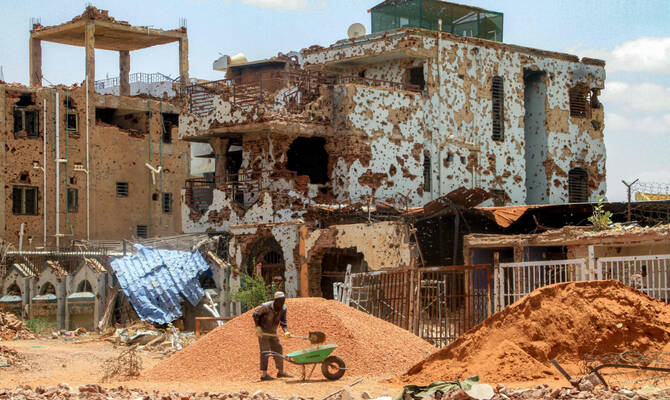
KHARTOUM: On the streets of Sudan’s capital Khartoum, builders clear rubble from houses pockmarked with bullet holes, haul away fallen trees and repair broken power lines, in the city’s first reconstruction effort since war began over two years ago.
Fighting between Sudan’s army and the paramilitary Rapid Support Forces (RSF), which broke out in April 2023, has left the capital battered and hollowed out.
But reconstruction — led by government agencies and youth-led volunteer groups — has finally begun to repair hospitals, schools and water and power networks.
“We are working to restore the state’s infrastructure,” volunteer Mostafa Awad said.
Once a thriving metropolis of nine million people, Khartoum’s skyline is now a jagged silhouette of collapsed buildings.
Electrical poles lean precariously or lie snapped on the ground in the streets. Cars, stripped for parts, sit burnt-out and abandoned, their tires melted into the asphalt.
AFP correspondents saw entire residential blocks standing with their exterior walls ripped away in the fighting.
Danger remains within the soot-stained buildings as authorities slowly work to clear tens of thousands of unexploded bombs left behind by fighters.
The UN warns Khartoum is “heavily contaminated by unexploded ordnance,” and this month said land mines have been discovered across the capital.
Sudan’s war has killed tens of thousands, displaced 13 million and plunged the nation into the world’s worst hunger and displacement crisis.
Until the army pushed the RSF out of Khartoum in March, the capital — where four million alone were displaced by fighting — was a battlefield.
Before they left, paramilitary fighters stripped infrastructure bare, looting everything from medical equipment and water pumps to copper wiring.
“Normally in a war zone, you see massive destruction... but you hardly ever see what happened in Khartoum,” the UN’s resident and humanitarian coordinator Luca Renda said.
“All the cables have been taken away from homes, all the pipes have been destroyed,” he told AFP, describing systematic looting of both small and large-scale items.
Today, power and water systems remain among the city’s greatest challenges.
The head of east Khartoum’s electricity department, Mohamed Al-Bashir, described “massive damage” in the capital’s main transformer stations.
“Some power stations were completely destroyed,” he told AFP, explaining the RSF had “specifically targeted transformer oil and copper cables.”
Vast swathes of Khartoum are without electricity, and with no reliable water supply, a cholera outbreak gripped the city this summer.
Health officials reported up to 1,500 new cases a day in June, according to the UN.
On his first visit to Khartoum last month, Sudan’s prime minister pledged a wide-scale recovery effort.
“Khartoum will return as a proud national capital,” Kamil Idris said.
Even as war rages on elsewhere in the country, the government has begun planning its return from its wartime capital Port Sudan.
On Tuesday, it announced central Khartoum — the devastated business and government district where some of the fiercest battles took place — would be evacuated and redesigned.
The UN estimates the rehabilitation of the capital’s essential facilities to cost around $350 million, while the full rebuilding of Khartoum “will take years and several billion dollars,” Renda told AFP.
Hundreds have rolled up their sleeves to start the long and arduous rebuilding work, but obstacles remain.
“We faced challenges such as the lack of raw materials, especially infrastructure tools, sanitation (supplies) and iron,” said Mohamed El Ser, a construction worker.
“Still, the market is relatively starting to recover,” he told AFP.
In downtown Khartoum, a worker, his hands coated in mud, stacks bricks beside a crumbling building.
AFP correspondents accompanied workers carefully refitting pipes into what once was a family home, while nearby others lifted slabs of concrete and mangled metal into wheelbarrows.
On one road that had been a front line, a man repaired a downed streetlight while others dragged a felled tree onto a flatbed truck.
The UN expects up to two million people to make their way back to Khartoum by the end of the year.
Those who have already returned, estimated to be in the tens of thousands, say life is still difficult, but there’s reason for hope.
“Honestly, there is an improvement in living conditions,” said Ali Mohamed, who recently returned.
“There is more stability now, and real services are beginning to come back, like water, electricity and even basic medical care.”


![]()

Sudanese lay first bricks to rebuild war-torn Khartoum
Short Url
https://arab.news/523df
Sudanese lay first bricks to rebuild war-torn Khartoum
- Danger remains within the soot-stained buildings as authorities slowly work to clear tens of thousands of unexploded bombs left behind by fighters


Latest updates


© 2026 SAUDI RESEARCH & PUBLISHING COMPANY, All Rights Reserved And subject to Terms of Use Agreement.