Sudan’s Burhan shakes up army, tightens control

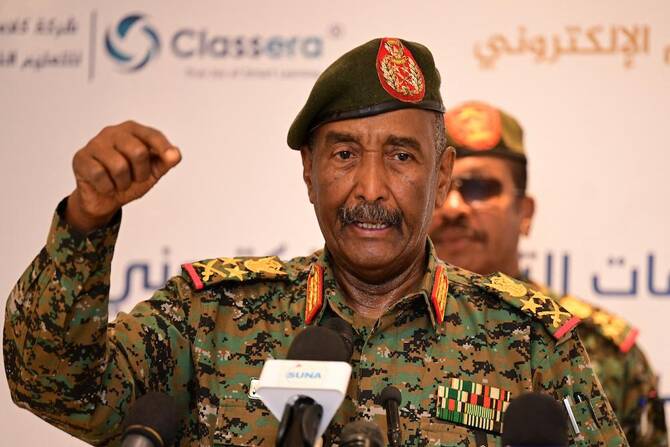
One of General Abdel Fattah Al-Burhan’s decrees brought all the other armed groups fighting alongside the army under his control. (AFP)
Short Url
Updated 19 August 2025
Follow

Sudan’s Burhan shakes up army, tightens control

  • Sudan’s army is fighting a more than two-year civil war with the paramilitary Rapid Support Forces
  • General Abdel Fattah Al-Burhan makes new appointments to the Joint Chiefs of Staff

CAIRO: Sudan’s army chief appointed a raft of new senior officers on Monday in a reshuffle that strengthened his hold on the military as he consolidates control of central and eastern regions and fights fierce battles in the west.
Sudan’s army, which controls the government, is fighting a more than two-year civil war with the paramilitary Rapid Support Forces, its former partners in power, that has created the world’s largest humanitarian crisis.
General Abdel Fattah Al-Burhan made new appointments to the Joint Chiefs of Staff a day after announcing the retirement of several long-serving officers, some of whom have gained a measure of fame over the past two years.
Burhan, who serves as Sudan’s internationally recognized head of state, kept the chairman of the Joint Chiefs of Staff, General Mohamed Othman Al-Hussein, but appointed a new inspector general and a new head of the air force.
Another decree from Burhan on Sunday brought all the other armed groups fighting alongside the army – including former Darfur rebels, Islamist brigades, civilians who joined the war effort and tribal militias – under his control.
Sudanese politicians praised the decision, saying it would prevent the development of other centers of power in the military, and potentially the future formation of other parallel forces like the RSF.
The RSF has its roots in Arab militias armed by the military in the early 2000s to fight in Darfur. It was allowed to develop parallel structures and supply lines.
The reshuffle comes a week after Burhan met US senior Africa adviser Massad Boulos in Switzerland, where issues including a transition to civilian rule were discussed, government sources said.
The war erupted in April 2023 when the army and the RSF clashed over plans to integrate their forces.
The RSF made quick gains in central Sudan, including the capital Khartoum, but the army pushed them westward this year, leading to an intensification in fighting in Al-Fashir in Darfur.


Syria welcomes US House vote to end ‘Caesar Act’ sanctions

Updated 10 sec ago
Follow

Syria welcomes US House vote to end ‘Caesar Act’ sanctions

  • Representatives back defense bill that includes provisions to scrap wide-ranging sanctions imposed on former leader Bashar Assad
  • Syria’s new government says vote is ‘pivotal moment’ for country as it attempts to rebuild its economy

LONDON: A vote by the US House of Representatives in favor of ending tough sanctions on Syria was welcomed by Damascus on Thursday as a “pivotal moment.”

The “Caesar Act” sanctions regime was imposed in 2020 against former President Bashar Assad’s government over the human-rights abuses carried out during the civil war.

The move to repeal the sanctions, seen as a crucial step for the Syrian Arab Republic’s economic recovery, is contained in a wide-ranging defense bill that the lower house of Congress backed on Thursday.

The Syrian Foreign Ministry said the vote “paves the way for a broader economic recovery and the return of opportunities long denied to Syrians.”

The ministry described it as a first step toward improving trade flows, and increasing the availability of essential goods, and medical supplies.

The National Defense Authorization Act, or NDAA, will now pass to the US Senate where a vote is expected to be held by the end of the year.

Assad was forced from power a year ago after a rapid military campaign by opposition forces brought the 13-year conflict to an end.

The new president, Ahmad Al-Sharaa, who led the offensive, has made ending Syria’s isolation a priority as he attempts to rebuild the country’s shattered economy.

President Donald Trump said in May that he planned to lift all sanctions on Syria and many have already been removed or suspended.

The Caesar Act, which imposed the toughest restrictions on trade and investment in Syria, requires Congressional approval to be overturned.

Along with repealing the act, the bill requires the White House to provide regular reports confirming that Syria’s government is fighting Daesh militants and upholding religious and ethnic minority rights, Reuters reported.

Syria’s foreign minister, Asaad Al-Shaibani, said the step toward repealing the Caesar Act was a “triumph for justice but also a recognition of the strength and resilience of the Syrian people.”

He said it reflected the success of Syrian diplomacy with the US.

Al-Sharaa has held talks with Trump three times, including an initial meeting in Riyadh in May on the sidelines of a US-GCC summit.

The Syrian president traveled to Washington in September where he was hosted at the White House. Speaking after the meeting, Trump said the US would do “everything we can to make Syria successful.”

During the visit, Syria confirmed that it would join the global coalition against Daesh.

Removing international sanctions on Syria would allow foreign investment to flow into the country, where the cost of rebuilding is estimated to be more than $200 billion.

Syrian Central Bank Gov. Abdulkader Husrieh told Reuters recently that the repeal of US sanctions was “a miracle” and that the economy was growing faster than expected.

The Caesar Act targeted individuals, companies and institutions linked to Assad, and sanctioned foreign entities from funding them.

The legislation was named after a code name given to a Syrian military photographer who smuggled thousands of photos documenting torture and war crimes by the Syrian regime out of the country.