

Karachi braces for fresh rains after deadly deluge kills eight, cripples city

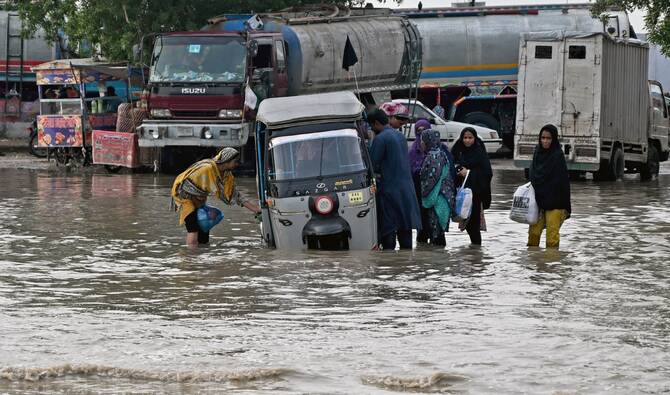
Passengers disembark from an auto rickshaw that got stranded on a flooded road after heavy monsoon rains in Karachi on August 20, 2025. (AFP)
Short Url
Updated 20 August 2025
Follow

Karachi braces for fresh rains after deadly deluge kills eight, cripples city

  • Nearly 400 dead in northern Pakistan since mid-August as monsoon toll rises past 700
  • Authorities declare public holiday in Karachi amid warnings of renewed urban flooding

KARACHI: Pakistan’s commercial capital Karachi is bracing for another spell of heavy rain today, according to a meteorological official on Wednesday, as the city is still reeling from downpour a day earlier that killed eight people and submerged major thoroughfares, leaving citizens stranded for hours.

The downpour in Karachi occurred at a time when Pakistan is witnessing an intense monsoon season that has already ravaged several areas, particularly in the country’s north, where cloudburst-triggered deluges have killed nearly 400 people since August 15.

In total, over 700 Pakistanis, including 175 children, have died in this year’s monsoon season, which began on June 26, according to the National Disaster Management Authority (NDMA).

The situation has raised fears of a repeat of the catastrophic 2022 floods that submerged a third of Pakistan and killed more than 1,700 people, as well as causing $30 billion in economic losses.

“Heavy rainfall is expected in Karachi during the first half of the day, which could trigger flooding similar to yesterday,” Ameer Hyder, Director of the Met Office Karachi, told Arab News.

He added the city recorded up to 163.4 millimeters (mm) of rain on Tuesday.

“If today’s downpour reaches the same intensity or goes above it, it may again lead to flood-like conditions,” he said.

The situation has prompted the local administration to declare a public holiday on Wednesday due to the threat of urban flooding.

Dr. Summayia Syed, a police surgeon in the city, said eight bodies were brought to different hospitals in Karachi after yesterday’s downpour, adding that a large number of citizens also were injured in rain-related incidents.

“Eight bodies have been brought to Jinnah Post Graduate Medical Center, Abbasi Shaheed Hospital, and Civil Hospital Karachi since the rain started yesterday,” she told Arab News, adding most deaths were caused by wall collapses and electrocution.

CITY PARALYZED

On Wednesday morning, water remained in several parts of the city, with vehicles still stranded along roadside stretches.

However, Karachi Mayor Murtaza Wahab said most major roads had been cleared by morning.

“Although there is still water near the airport, which was the worst affected area yesterday, the road is now motorable,” Wahab told Arab News, urging residents to stay indoors.

He cautioned that roads could be submerged again if heavy rain returned.

“We have been clearing the roads and will continue efforts today,” he said, attributing the flooding to unusually heavy downpours in a city where the drainage system can handle only 40mm of water.

Karachi, a city of more than 20 million with dilapidated infrastructure, has often seen even moderate rains trigger flooding in parts of the city, threatening residents’ lives and causing hours-long power outages.

Wahab said there were several civic agencies that collected revenue but were not seen on the ground.

Karachi has faced repeated bouts of urban flooding in recent years.

In July-August 2009, the heaviest rains in three decades killed at least 26 people and damaged infrastructure. Torrential downpours in August 2017 left 23 dead and large parts of the city paralyzed, while heavy rains in

2019 killed 11, mostly from electrocution and collapsing structures.

The following year brought the worst flooding in nearly a century, with record-breaking rainfall in August 2020 killing more than 40 and cutting power to many neighborhoods for days.

In July 2022, intense monsoon showers again submerged parts of the city, killing at least 14 in early July and several more later that month.


Pakistan Supreme Court halts trial of prominent lawyer over alleged anti-military tweets

Updated 57 min 11 sec ago
Follow

Pakistan Supreme Court halts trial of prominent lawyer over alleged anti-military tweets

  • Top court orders lower court to pause proceedings after lawyers allege due-process breaches
  • Mazari-Hazir, husband face charges under cybercrime law that carry up to 14 years in prison

ISLAMABAD: Pakistan’s Supreme Court on Thursday halted the cybercrime trial of prominent human rights lawyer Imaan Mazari-Hazir and her husband, Hadi Ali Chattha, after their lawyers argued that a lower court had recorded witness testimony in their absence, violating due-process rules.

Mazari-Hazir, one of Pakistan’s most outspoken civil liberties lawyers, and Chattha are being prosecuted under the Prevention of Electronic Crimes Act (PECA) over posts on X that authorities say incited ethnic divisions and portrayed the military as involved in “terrorism.” Both reject the allegations. If convicted under the relevant PECA provision, they face a prison term of up to 14 years.

The case has drawn broad attention in Pakistan’s legal community because Mazari-Hazir, who has been repeatedly detained over her criticism of the security establishment, argues that the trial court ignored basic procedural guarantees despite her medical leave request. The case also comes as Pakistan faces sustained scrutiny over the use of PECA against activists, journalists and political dissenters, with lawyers arguing that lower courts often move ahead without meeting minimum fair-trial standards.

The couple’s lawyer, Riasat Ali Azad, said his clients filed a petition in the Supreme Court because the lower court had moved ahead improperly.

“Today, the Supreme Court of Pakistan has stayed the lower court proceedings, the trial court proceedings and has said that the [Islamabad] High Court should decide our pending revision petition for which a date has already been fixed,” he told reporters.

Azad said the violation was clear under Pakistan’s Code of Criminal Procedure, which requires evidence to be recorded in the presence of the accused.

“Yet, on that very day, evidence of four witnesses was recorded in their absence, and a state counsel was appointed to conduct cross-examination on their behalf,” he said. “All these things are against the right to a fair trial under Articles 10 and 10-A.”

A three-judge bench led by Justice Muhammad Hashim Khan Kakar ordered the trial court to pause proceedings and instructed the Islamabad High Court to hear the couple’s pending criminal revision petition first.

The trial had been scheduled to resume on Dec.15, but the Supreme Court’s stay now freezes proceedings before both the additional sessions judge and the special PECA court. 

The Islamabad High Court is expected to hear the criminal revision petition next week.

Chattha, who is also a lawyer, said the SC ruling underscored the need for procedural safeguards.

“It is a victory for the constitution and the law,” he said, arguing that the trial court had ignored their request to re-record witness statements in their presence.