

Pakistan launches cashless Ramadan market in Islamabad to promote digital payments

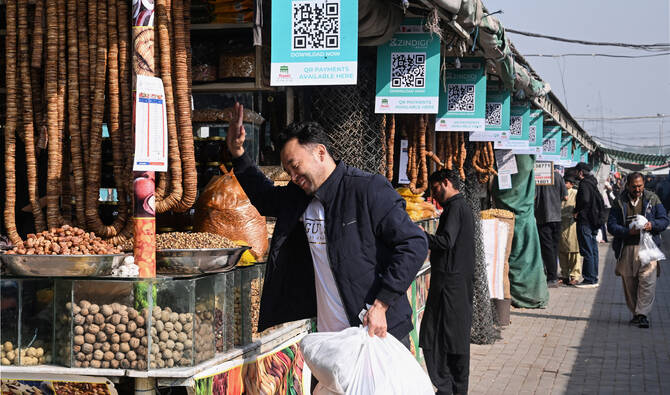
A customer reacts as digital cashless payment QR (quick response) codes are displayed at a market in Islamabad on November 25, 2025. (AFP/ file)
Short Url
Updated 18 February 2026
Follow

Pakistan launches cashless Ramadan market in Islamabad to promote digital payments

  • Pilot market allows shoppers to buy subsidized food using digital payments
  • Initiative aims to improve transparency and public relief during Ramadan

KARACHI: Pakistan has launched a cashless subsidized Ramadan food market in the capital Islamabad, the interior ministry said on Wednesday, introducing digital payments for essential goods as authorities try to improve transparency and affordability during the Muslim holy month.

The facility in the G-6 Aabpara area allows citizens to purchase vegetables, fruit and staple food items at regulated prices without cash, part of a broader push toward digitizing subsidy delivery.

Ramadan bazaars, which are temporary and often state-supported markets, are set up across Pakistan each year to limit price spikes as demand rises during fasting hours and evening meals.

Ramadan is likely to start on Feb. 19 in Pakistan. 

“The objective is to provide the public affordable and quality items. No negligence in public relief will be tolerated,” the interior ministry said in a statement.

Officials said the market will operate daily from 9 a.m. to 4 p.m. and includes private vendors under monitoring mechanisms to ensure goods are sold according to wholesale market rates.

Authorities also instructed administrators to strengthen cleanliness, security and complaint-handling systems and ensure price lists are prominently displayed.

Pakistan last year launched its first-ever cashless weekly market in Islamabad, but slow Internet speeds and patchy phone connectivity have hampered adoption among vendors and shoppers. 

The government plans to turn Islamabad into Pakistan’s first fully cashless city, using QR-code payments to formalize retail transactions, reduce tax evasion and improve documentation in one of South Asia’s most informally run economies.

Pakistan relies heavily on cash, enabling widespread tax evasion and limiting financial transparency. Economists say expanding digital payments can raise government revenues, curb corruption, and make marketplaces safer for customers and traders.

Pakistan has increasingly experimented with targeted subsidies and digital systems to manage food affordability during Ramadan, when consumption rises sharply and lower-income households face pressure after years of high inflation.

Last week, Prime Minister Shehbaz Sharif launched a Rs38 billion ($136 million) Ramadan relief package, pledging direct digital cash transfers of Rs13,000 ($47) each to 12.1 million low-income families across Pakistan.

The government will distribute the relief package through bank accounts and regulated mobile wallet platforms, fully replacing the previous utility store-based subsidy model with a digital payment mechanism overseen by the State Bank of Pakistan.


Islamabad dismisses claims about paying up to 8 percent interest on foreign loans as ‘misleading’

Updated 22 February 2026
Follow

Islamabad dismisses claims about paying up to 8 percent interest on foreign loans as ‘misleading’

  • Pakistan has long relied on external loans to help bridge persistent gaps in public finances and foreign exchange reserves
  • Pakistan’s total external debt, liabilities stand at $138 billion at an overall average cost of around 4 percent, ministry says

KARACHI: Pakistan’s finance ministry on Sunday dismissed as “misleading” claims that the country is paying up to 8 percent interest on external loans, saying the overall average cost of external public debt is approximately 4 percent.

Pakistan has long relied on external loans to help bridge persistent gaps in public finances and foreign exchange reserves, driven largely by a narrow tax base, chronic trade deficits, rising debt-servicing costs and repeated balance-of-payments pressures.

Over the decades, successive governments have turned to multilateral and bilateral lenders, including the International Monetary Fund, the World Bank and the Asian Development Bank, to support budgetary needs and shore up foreign exchange reserves.

The finance ministry on Sunday issued a clarification in response to a “recent press commentary” regarding the country’s external debt position and associated interest payments, and said the figures required contextual explanation to ensure accurate understanding of Pakistan’s external debt profile.

“Pakistan’s total external debt and liabilities currently stand at $138 billion. This figure, however, encompasses a broad range of obligations, including public and publicly guaranteed debt, debt of Public Sector Enterprises (both guaranteed and non-guaranteed), bank borrowings, private-sector external debt, and intercompany liabilities to direct investors. It is therefore important to distinguish this aggregate figure from External Public (Government) Debt, which amounts to approximately $92 billion,” it said.

“Of the total External Public Debt, nearly 75 percent comprises concessional and long-term financing obtained from multilateral institutions (excluding the IMF) and bilateral development partners. Only about 7 percent of this debt consists of commercial loans, while another 7 percent relates to long-term Eurobonds. In light of this composition, the claim that Pakistan is paying interest on external loans ‘up to 8 percent’ is misleading.

The overall average cost of External Public Debt is approximately 4 percent, reflecting the predominantly concessional nature of the borrowing portfolio.”

With respect to interest payments, public external debt interest outflows increased from $1.99 billion in Fiscal Year (FY) 2022 to $3.59 billion in FY2025, representing an increase of 80.4 percent, not 84 percent as reported. In absolute terms, interest payments rose by $1.60 billion over this period, not $1.67 billion, it said.

According to the State Bank of Pakistan’s records, Pakistan’s total debt servicing payments to specific creditors during the period under reference were as follows: the IMF received $1.50 billion, of which $580 million constituted interest; Naya Pakistan Certificates payments totaled $1.56 billion, including $94 million in interest; the Asian Development Bank received $1.54 billion, including $615 million in interest; the World Bank received $1.25 billion, including $419 million in interest; and external commercial loans amounted to nearly $3 billion, of which $327 million represented interest payments.

“While interest payments have increased in absolute terms, this rise cannot be attributed solely to an expansion in the debt stock,” the ministry said. “Although the overall debt stock has increased slightly since FY2022, the additional inflows have primarily originated from concessional multilateral sources and the IMF’s Extended Fund Facility (EFF) under the ongoing IMF-supported program.”

Pakistan secured a $7 billion IMF bailout in Sept. 2024 as part of Prime Minister Shehbaz Sharif’s efforts to stabilize the South Asian economy that narrowly averted a default in 2023. The government has since been making efforts to boost trade and bring in foreign investment to consolidate recovery.

“It is also important to note that the increase in interest payments reflects prevailing global interest rate dynamics. In response to the inflation surge of 2021–22, the US Federal Reserve raised the federal funds rate from 0.75-1.00 percent in May 2022 to 5.25–5.50 percent by July 2023. Although rates have since moderated to around 3.75 percent, they remain significantly higher than 2022 levels,” the finance ministry said.

“The government remains committed to prudent debt management, transparency, and the continued strengthening of Pakistan’s macroeconomic stability,” it added.