

Australia lashes Netanyahu over ‘weak’ leader outburst

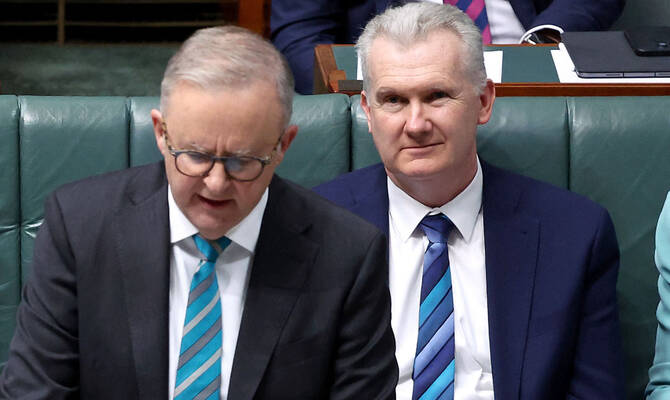
This picture taken on June 27, 2024 shows Australian Home Affairs Minister Tony Burke (R) listening to Australian Prime Minister Anthony Albanese speaking at the House of Representatives at Parliament House in Canberra. Australia lashed Israeli leader Benjamin Netanyahu on August 20, 2025 after he said the country's prime minister was weak. (AFP)
Short Url
Updated 20 August 2025
Follow

Australia lashes Netanyahu over ‘weak’ leader outburst

  • Netanyahu was infuriated when Australia declared it would recognize Palestinian statehood next month, following similar pledges from France, Canada and the United Kingdom

SYDNEY: Australia lashed Israeli leader Benjamin Netanyahu on Wednesday after he said the country’s prime minister was weak, with a top minister saying strength was more than “how many people you can blow up.”
For decades, Australia has considered itself a close friend of Israel, but the relationship has swiftly unraveled since Canberra announced last week it would recognize a Palestinian state.
Netanyahu drastically escalated a war of words on Tuesday night, calling his Australian counterpart Anthony Albanese a “weak politician who betrayed Israel.”
Australian Home Affairs Minister Tony Burke said Wednesday it was the sign of a frustrated leader “lashing out.”
“Strength is not measured by how many people you can blow up or how many children you can leave hungry,” Burke told national broadcaster ABC.
“What we’ve seen with some of the actions they are taking is a continued isolation of Israel from the world, and that is not in their interests either.”

Australian Prime Minister Anthony Albanese said on Wednesday that he treats leaders of other countries with respect after Netanyahu attacked him.
“I don’t take these things personally, I engage with people diplomatically. He has had similar things to say about other leaders,” Albanese said during a media briefing.

Albanese told reporters that he had informed Netanyahu about Australia’s decision to support a Palestinian state before his center-left government formally announced the plan.
“At that time, I gave Prime Minister Netanyahu a clear indication of my view and Australia’s view going forward but also a clear indication of the direction in which we were headed,” Albanese said.
“I gave him the opportunity to outline what political solution there was and gave him that opportunity.”

Through the 1950s, Australia was a refuge for Jews fleeing the horrors of the Holocaust.
The city of Melbourne at one point housed, per capita, the largest population of Holocaust survivors anywhere outside of Israel.
Netanyahu was infuriated when Australia declared it would recognize Palestinian statehood next month, following similar pledges from France, Canada and the United Kingdom.
In the space of nine days since that decision, relations between Australia and Israel have plummeted.
Australia on Monday canceled the visa of far-right Israeli politician Simcha Rothman — a member of Netanyahu’s governing coalition — saying his planned speaking tour would “spread division.”
The tit-for-tat continued on Tuesday, when Israel retaliated by revoking visas held by Canberra’s diplomatic representatives to the Palestinian Authority.
Then came Netanyahu’s social media outburst. “History will remember Albanese for what he is: A weak politician who betrayed Israel and abandoned Australia’s Jews,” he said on X.
Israel finds itself increasingly isolated as it continues to wage war in Gaza, a conflict triggered by the October 2023 attack by Palestinian militant group Hamas.
UN-backed experts have warned of widespread famine unfolding in the territory, where Israel has severely restricted the entry of humanitarian aid.
New Zealand Prime Minister Christopher Luxon said last week that Netanyahu had “lost the plot.”
Relations between Australia and Israel started fraying late last year following a spate of anti-Semitic attacks in Sydney and Melbourne.
Netanyahu accused the Australian government of harboring “anti-Israel sentiment” after a synagogue was firebombed in December.

With Agencies 


India says accomplice of Delhi car blast ‘suicide bomber’ arrested

Updated 2 sec ago
Follow

India says accomplice of Delhi car blast ‘suicide bomber’ arrested

NEW DELHI: Indian authorities said on Sunday that a deadly car blast in New Delhi earlier this week was an attack carried out by a “suicide bomber,” announcing the arrest of an accomplice.
The National Investigation Agency (NIA), the country’s counter-terrorism law enforcement body, said the alleged attacker and the second suspect were both from Indian-administered Kashmir, where police have carried out sweeping raids in recent days.
Announcing “a breakthrough” in the investigation, the NIA said in a statement it had arrested Amir Rashid Ali, “in whose name the car involved in the attack was registered.”
He had “conspired with the alleged suicide bomber, Umar Un Nabi, to unleash the terror attack,” it added, without specifying any possible motive.
Nabi, a resident of Kashmir, was an assistant professor in general medicine at a university in the northern state of Haryana, according to the counter-terrorism agency, which said it had seized a vehicle belonging to him.
Ali had come to Delhi to “facilitate the purchase of the car which was eventually used as a vehicle-borne Improvised Explosive Device (IED) to trigger the blast,” the NIA said.
The explosion on Monday took place near a busy metro station close to the landmark Red Fort in the capital’s Old Delhi quarter, where the prime minister delivers the annual Independence Day address.
A hospital official has said the blast killed 12 people. It was unclear whether the toll included Nabi.
The NIA’s statement said the attack “claimed 10 innocent lives and left 32 others injured.”
Prime Minister Narendra Modi has called the attack a “conspiracy,” and his government vowed to bring the “perpetrators, their collaborators and their sponsors” to justice.
It was the most significant security incident since April 22, when 26 mainly Hindu civilians were killed at the tourist site of Pahalgam in Indian-administered Kashmir, triggering clashes with Pakistan.
Kashmir has been divided between India and Pakistan since their independence from British rule in 1947, and both claim the Himalayan territory in full. Tensions remain high between New Delhi and Islamabad.
On Friday, nine people were killed when confiscated explosives blew up at a police station in Indian-administered Kashmir, in what authorities said was an accident.
Local media reported that a militant organization had claimed responsibility for it, which police dismissed.
The explosives had been recovered from Haryana state just before the powerful car blast in Delhi, according to the police.
Indian media have widely connected the Delhi blast with a string of arrests just hours prior.
Police said those arrested were linked with Jaish-e-Mohammed (JeM), a Pakistan-based and Al-Qaeda-linked group, as well as a Kashmiri offshoot linked to it.
The group that claimed the police station blast is considered close to JeM.