BEIRUT: Lebanese President Joseph Aoun on Tuesday warned against ending the United Nations peacekeepers’ mandate in the country’s south, after the UN Security Council began debating extending their mission.
The annual mandate renewal this year comes after Lebanese authorities, under heavy US pressure, have committed to disarming Hezbollah by year end, following a November ceasefire deal that sought to halt more than a year of hostilities between the Iran-backed group and Israel.
Israel and the United States, which wields a veto on the Security Council, have reportedly opposed the renewal.
“Any timetable for the mandate of UNIFIL that is different from the actual needs will negatively impact the situation in the south, which still suffers from Israeli occupation,” Aoun told force commander Diodato Abagnara, according to a presidency statement.
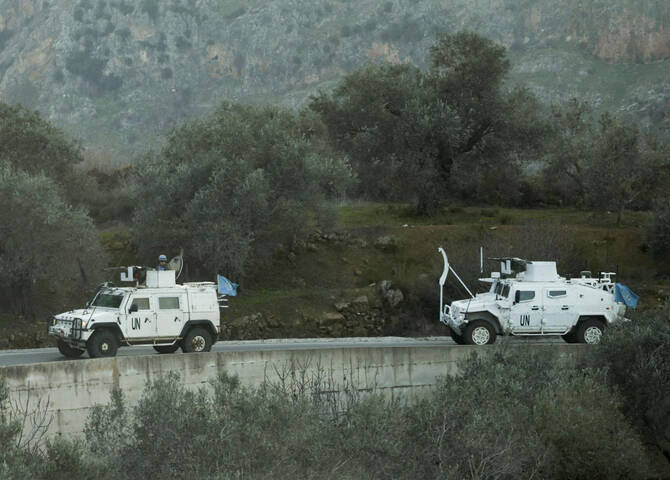
The UN Interim Force in Lebanon has been deployed since 1978 to separate Israel and Lebanon and counts some 10,000 personnel from around 50 countries.
The Security Council on Monday began debating a resolution drafted by France to extend the force for a year with the ultimate aim of withdrawing it.
Aoun said Beirut “has begun contacts with Security Council member states, and brotherly and friendly countries, to ensure the extension” of UNIFIL’s mandate.
He cited Lebanon’s need for the force to help “maintain security and stability in the south” and to support the army following the government’s decision to increase troop numbers there to 10,000 personnel.
Under the ceasefire, Hezbollah was to withdraw from near the Israeli border, while the Lebanese army was to bolster its deployment there.
Abagnara said on X that UNIFIL’s “close coordination” with the Lebanese army was “key to help restore stability.”
Last week, UNIFIL said that with its support, the army had deployed to more than 120 positions in the country’s south.
Despite the ceasefire, Israel has continued to strike Lebanon, saying it will do so until Hezbollah is disarmed. Israeli forces also occupy five areas of the south that it deems strategic.
The text of the draft resolution would extend UNIFIL’s mandate until August 31, 2026 but “indicates its intention to work on a withdrawal of UNIFIL.”
A vote of the 15-member Security Council is expected on August 25, before the force’s mandate expires at the end of the month.


Lebanon president urges extension of UN peacekeepers’ mandate
https://arab.news/wk7an
Lebanon president urges extension of UN peacekeepers’ mandate

- Israel and the United States, which wields a veto on the Security Council, have reportedly opposed the renewal
- UN Interim Force in Lebanon has been deployed since 1978 to separate Israel and Lebanon and counts some 10,000 personnel from around 50 countries


Lebanon approves release of former minister accused of corruption
- Salam is the only ex-minister to be arrested since the start of Lebanon’s economic crisis in 2019
- The official added that the bail was paid, with procedures ongoing to secure his release from prison
BEIRUT: Lebanon’s judiciary approved the release on bail of former economy minister Amin Salam on Tuesday after six months of detention over corruption linked to contracts deemed suspicious, a judicial official said.
Salam, who served in the cabinet of former prime minister Najib Mikati from 2021 to 2025, is the only ex-minister to be arrested since the start of Lebanon’s economic crisis in 2019.
The official, who requested anonymity, told AFP Lebanon’s judiciary “agreed to release former economy minister Amin Salam on bail of nine billion Lebanese pounds, equivalent to $100,000” and a travel ban.
The official added that the bail was paid, with procedures ongoing to secure his release from prison.
In June, another judicial official said Salam had been arrested in connection with alleged “falsification, embezzlement and suspicious contracts.”
Salam’s adviser Fadi Tamim was sentenced in 2023 to one year in prison for blackmail and personal enrichment at the expense of insurance companies.
The former minister’s brother Karim Salam was also arrested earlier this year in a “case of illicit enrichment, forgery and extortion of insurance companies,” committed “under cover of the minister himself,” the official said in June.
Many in Lebanon attribute the economic crisis to mismanagement and corruption that has plagued state institutions for decades.
President Joseph Aoun and Prime Minister Nawaf Salam, who both took office this year, have vowed to make the fight against endemic corruption a priority, as part of the reforms demanded by international donors.
Both have vowed to uphold the independence of the judiciary and prevent interference in its work, in a country plagued by official impunity.
In September, former central bank governor Riad Salameh, who faces numerous accusations including embezzlement, money laundering and tax evasion, was released after being detained for over a year by paying a record bail of more than $14 million.


