

Former central bank governor Riad Salameh’s case referred to financial prosecution

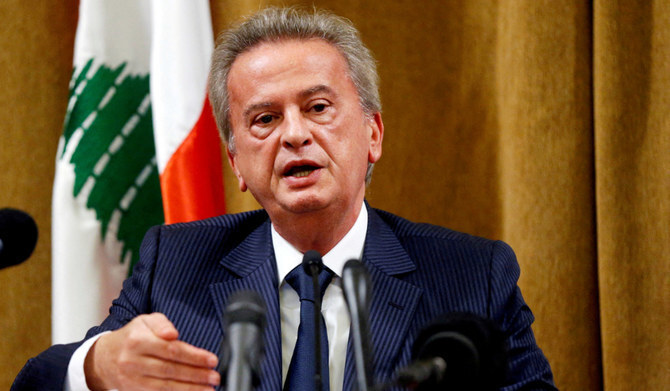
The judiciary in Lebanon is awaiting the findings of the financial public prosecutor regarding the investigation into the bank’s former governor Riad Salameh (pictured). (Reuters/File Photo)
Short Url
Updated 21 March 2025
Follow

Former central bank governor Riad Salameh’s case referred to financial prosecution

  • PM Nawaf Salam announces Lebanon’s shift to digital governance
  • Former economy minister banned from travel on suspicion of corruption

BEIRUT: Lebanese Prime Minister Nawaf Salam announced on Friday that the government was working on establishing an executive mechanism to transition Lebanon into a digital state.

Lebanon is focused on using all its resources and connections to leverage external expertise in order to pursue the government’s development goals, he stated during a meeting with a delegation of business leaders.

The Cabinet approved a mechanism for administrative appointments in state institutions on Thursday, which Salam described as “transparent and competitive.”

Media reports in Beirut on Friday characterized this mechanism as a “theoretical qualitative leap and a reformative advancement in the selection of public sector employees. However, the critical factor remains its successful implementation.”

The position of governor of Lebanon’s central bank, the Banque du Liban, is currently vacant as President Joseph Aoun and Prime Minister Salam have not yet reached an agreement on the most suitable candidate. In the meantime, the judiciary is awaiting the findings of the financial public prosecutor regarding the investigation into the bank’s former governor Riad Salameh.

Salameh has been in pretrial detention for the past seven months on charges of embezzling public funds.

A judicial source told Arab News that Investigative Judge Bilal Halawi had concluded the investigation into Salameh’s case after issuing two in absentia arrest warrants for Salameh’s advisers.

The case has now been referred to Financial Prosecutor Judge Ali Ibrahim for review in preparation for issuing an indictment.

There is no specific deadline for the financial prosecution to respond.

Salameh — along with two lawyers, Michel Tueini and Marwan Issa Khoury, who served as advisers at the central bank — is being prosecuted for allegedly embezzling over $40 million from the bank’s funds. It is claimed that this amount was transferred to Salameh’s account with the assistance of Tueini and Issa Khoury.

In the ongoing pursuit of corruption cases, Judge Jamal Hajjar, the public prosecutor at the Court of Cassation, has moved to ban former Economy Minister Amin Salam from traveling.

The decision was made based on a report from the National Economy, Industry, Trade, and Planning Committee.

It also included his advisers Karim Salam and Fadi Tamim, as well as financial auditor Elie Abboud.

On Thursday, MP Farid Boustany, the committee’s chairman, lodged a complaint with the Public Prosecutor’s Office against the former minister, his advisers, and Abboud as a signatory.

The complaint alleges “bribery, influence-peddling, blackmailing insurance companies, mismanagement of public funds, and money laundering.”

In response to these accusations, Salam denied the charges, claiming they were part of a “systematic campaign of personal or political targeting” against him and his team.

Salam served as the economy minister for less than four years in the Najib Mikati government.

A report from the Parliamentary Observatory determined that Salam “misused his authority over the Insurance Control Commission, which oversees the insurance sector, for personal benefit at the expense of public funds.”

A judicial source informed Arab News that the travel ban was a preliminary measure aimed at ensuring that the suspects are notified about their upcoming interrogations, scheduled to occur soon at the Palace of Justice in Beirut.

The National Economy Committee of Parliament prepared a dossier detailing “violations” by Salam during his time in office.

The committee had previously summoned him to discuss the oversight of insurance companies by the ministry.

Salam did not attend three sessions, leading the committee to refer the case to the public prosecutor at the Court of Cassation and the financial prosecution for further action.

In 2023, sources said suspicions arose after his adviser, Tamim, was accused of blackmailing insurance companies for hundreds of thousands of dollars to prevent the revocation of the company’s license.

“Tamim was arrested, and it later came to light that Minister Karim Salam, the brother of the minister, had pressured insurance companies to pay large sums for mandatory solvency studies through a firm owned by Tamim. These actions resulted in accusations of abuse of power and blackmail.

“The National Economy Committee uncovered evidence that former Minister Salam misused public funds, spending over $50,000 a month on his office and engaging in questionable contracts.”


Sweeping US defense bill passes Congress, including real of Syria sanctions

Updated 8 sec ago
Follow

Sweeping US defense bill passes Congress, including real of Syria sanctions

WASHINGTON: The US Senate voted overwhelmingly on Wednesday to advance a $901 billion bill setting policy for the Pentagon, sending the massive piece of legislation to the White House, which has said President Donald Trump will sign it into law. The fiscal 2026 National Defense Authorization Act, or NDAA, is a compromise between separate measures passed earlier this year in the House of Representatives and Senate. It authorizes a record $901 billion in annual military spending, with a 4 percent pay raise for the troops. It also authorizes reforms to the system for acquiring military equipment and includes efforts to boost competitiveness with US archrivals China and Russia.
The Senate backed the bill by 77 to 20, with strong support from both parties. Two of the “no” votes were from Republican senators Mike Lee and Rand Paul.
“This will be the 65th year in a row, the 65th consecutive year, that Congress has come together across the aisle and across two chambers to send the president a bill designed to sustain and strengthen the national defense,” said Senator Roger Wicker of Mississippi, the Republican Senate Armed Services Committee chairman. The House passed the bill last week, by 312 to 112, also with broad bipartisan support. In a break with Trump, whose fellow Republicans hold majorities in both the House and Senate, this year’s NDAA includes several provisions to boost security in Europe, despite Trump’s release earlier this month of a National Security Strategy seen as friendly to Russia and a reassessment of the US relationship with Europe.
The fiscal 2026 NDAA provides $800 million for Ukraine — $400 million in each of the next two years — as part of the Ukraine Security Assistance Initiative, which pays US companies for weapons for Ukraine’s military.
It also authorizes the Baltic Security Initiative and provides $175 million to support Latvia, Lithuania and Estonia’s defense. And it limits the Department of Defense’s ability to drop the number of US forces in Europe to fewer than 76,000 and bars the US European Commander from giving up the title of NATO Supreme Commander.

WINS FOR BOTH PARTIES
Members of Congress take great pride in having passed the NDAA every year for more than six decades.
The measure’s record price tag is $8 billion more than Trump had requested. This month a handful of Republicans and Democrats called for the addition of a provision to strengthen military helicopter safety rules, following a fatal crash between an Army Black Hawk and an American Airlines passenger jet that killed 67 people.
Anger over that issue was not strong enough to derail the NDAA. Senate leaders have promised to address it in upcoming legislation. The NDAA also repeals the tough “Caesar” sanctions imposed on Syria under its former leader Bashar Assad. And it has a provision to withhold a chunk of Defense Secretary Pete Hegseth’s travel budget if he does not provide Congress with unedited videos of military strikes on boats in the southern Caribbean and eastern Pacific. The Trump administration has said the strikes are directed at Venezuelan drug-traffickers. The Senate vote came a day after Trump ordered a blockade of all sanctioned oil tankers entering and leaving Venezuela, his latest move to increase pressure on Venezuelan President Nicolas Maduro’s government.
It repeals the 1991 and 2002 Authorizations for the Use of Military Force (AUMFs) against Iraq, an attempt to reassert Congress’ role in deciding to send troops into combat.
During his first term, Trump said the 2002 AUMF provided legal authority for the 2020 killing in Iraq of senior Iranian military commander Qassem Soleimani.
The NDAA does not include funding to change the name of the Department of Defense to the Department of War, an idea championed by Trump but a change that cannot be formalized without congressional approval.
However, it includes some of the “culture war” efforts popular with politicians on the US right. One measure bars transgender women from participating in athletic programs designated for women at US military academies.
It also codifies into law executive orders by Trump ending diversity, equity and inclusion efforts at the Pentagon.