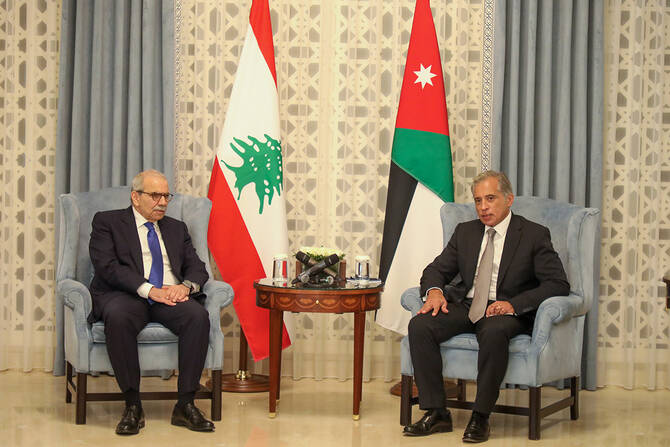
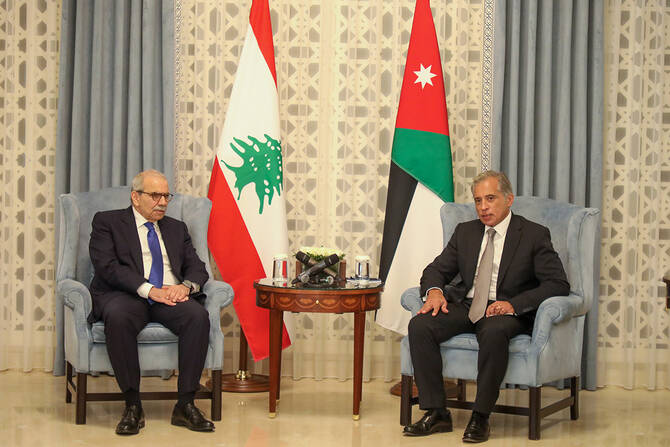
AMMAN: Jordanian Prime Minister Jafar Hassan and his Lebanese counterpart Nawaf Salam held talks in Amman on Tuesday, with both sides underscoring their rejection of Israel’s policies in Gaza and calling for intensified efforts to end the war in the enclave.
Hassan said the reality on the ground “does not reflect the illusion of a so-called Greater Israel, but rather an outcast, isolated Israel besieged regionally and internationally as a result of its policies of brutality and extremism,” he was quoted as saying by the Jordan News Agency.
He also cautioned against attempts to prolong the conflict under the pretext of such visions, stressing that the massacres taking place in Gaza and the West Bank “will not be forgiven by the peoples of the region and the world.”
He reiterated Jordan’s condemnation of the Israeli occupation of Lebanese territory, urging full implementation of the ceasefire agreement and an immediate halt to attacks on Lebanon.
He also underlined Jordan’s backing of Lebanon’s sovereignty, stability, and institutions, in line with the directives of King Abdullah II.
On Palestine, Hassan called for the opening of all crossings into Gaza to allow humanitarian aid to reach civilians, holding Israel legally and morally responsible for the collapse of relief efforts in the enclave.
He also mentioned Jordan’s commitment to modernization at home while supporting Lebanon and Syria to consolidate sovereignty, strengthen institutions, and reinforce internal resilience.
During a second round of talks at a lunch hosted by Hassan, the two premiers agreed to reconvene the Jordanian-Lebanese Joint Higher Committee this year after nearly a decade of suspension. The body will focus on enhancing cooperation in trade, transportation, and energy.
Salam expressed Lebanon’s appreciation for Jordan’s steadfast support under the leadership of King Abdullah, describing Amman’s positions as “historic and strategic,” the JNA reported.
He emphasized the importance of Jordan’s voice in regional and international forums, and reaffirmed Lebanon’s commitment to the Arab Peace Initiative and a two-state solution as the only viable path to resolving the Palestinian issue.
Earlier on Tuesday, King Abdullah met with Salam, accompanied by Crown Prince Hussein bin Abdullah.

King Abdullah met with Salam, accompanied by Crown Prince Hussein bin Abdullah. (Jordan News Agency)
The king affirmed Jordan’s full support for Lebanon in safeguarding its security and sovereignty, and highlighted the importance of expanding cooperation, particularly in economic sectors.
The meeting also covered developments in Syria, with the king reiterating Jordan’s support for Syria’s efforts to preserve its stability, sovereignty, and the safety of its citizens. On Gaza, King Abdullah once again called for an immediate ceasefire and increased aid to alleviate the humanitarian catastrophe.
He reaffirmed Jordan’s rejection of Israeli attempts to expand control in the West Bank and the wider region.