Pakistan expands pilgrim travel system for Iran, Iraq with licenses to 67 new operators

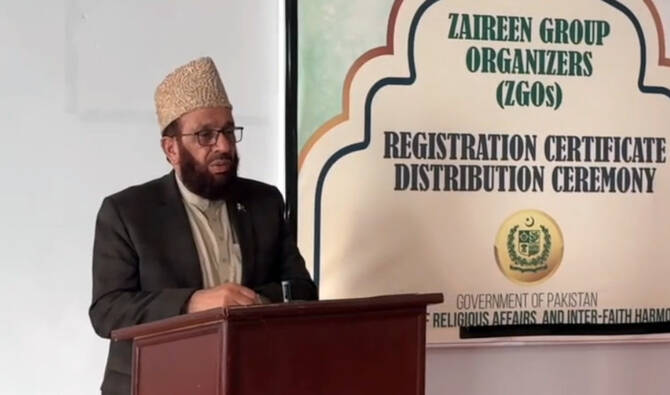
Federal Minister for Religious Affairs Sardar Muhammad Yousaf announces the award of licenses to pilgrimage companies in Islamabad, Pakistan, on December 16, 2025. (Screengrab/MORA)
Short Url
Updated 16 December 2025
Follow

Pakistan expands pilgrim travel system for Iran, Iraq with licenses to 67 new operators

  • New system requires all Iraq-Iran pilgrimages to be organized by licensed groups under state oversight
  • Long-running “Salar” model relied on informal caravan leaders, leading to overstays and missing pilgrims

ISLAMABAD: Pakistan has issued registration certificates to 67 additional licensed pilgrimage companies, expanding a tightly regulated travel system designed to curb overstays, undocumented migration and security risks linked to religious travel to Iran and Iraq, the ministry of religious affairs said on Tuesday.

The move is part of a broader overhaul of Pakistan’s pilgrim management framework after authorities confirmed that tens of thousands of Pakistani pilgrims had overstayed or gone missing abroad over the past decade, raising concerns with host governments and triggering diplomatic pressure on Islamabad to tighten oversight.

“The dream of safe travel for pilgrims to Iran and Iraq through better facilities and a transparent mechanism is set to be realized,” the religious affairs ministry said in a statement, quoting Federal Minister for Religious Affairs Sardar Muhammad Yousaf, who announced that 67 new Ziyarat Group Organizers had been registered.

Pakistan’s government has dismantled the decades-old “Salar” system, under which informal caravan leaders arranged pilgrimages with limited state oversight. The model was blamed for weak documentation, poor accountability and widespread overstays, particularly during peak pilgrimage seasons. 

Under the new framework, only licensed companies are allowed to organize pilgrimages, and they are held directly responsible for ensuring pilgrims return within approved timelines.

Authorities say pilgrimages to Iran and Iraq will be conducted exclusively under the new system from January 2026, marking a full transition to regulated travel. The religion ministry said it has now completed registration of 24 operators in the first phase and 67 more in the second, with remaining applicants urged to complete documentation to obtain licenses.

The religious affairs ministry said a digital management system is being developed with the National Information Technology Board to monitor pilgrim movements and operator compliance, while a licensed ferry operator has also secured approval to explore future sea travel options.

The overhaul has been accompanied by tighter coordination with host countries. Earlier this month, Pakistan and Iraq agreed to share verified pilgrim data and restrict entry to travelers cleared under the new system, following talks between interior ministers in Islamabad and Baghdad. Pakistan has also barred overland pilgrim travel for major religious events, citing security risks in its southwestern Balochistan province, meaning travel to Iran and Iraq is now limited to approved air routes.

Officials say the reforms are aimed at balancing facilitation with accountability, as tens of thousands of Pakistani pilgrims travel annually to key Shia shrines, including Karbala and Najaf in Iraq and Mashhad and Qom in Iran. Travel peaks during religious occasions such as Arbaeen, when millions of worshippers converge on Iraq, placing heavy logistical and security demands on regional authorities.

The government says the new system is intended to restore confidence among host countries while ensuring safer, more transparent travel for Pakistani pilgrims.


India and Pakistan set for World Cup blockbuster as boycott averted

Updated 14 February 2026
Follow

India and Pakistan set for World Cup blockbuster as boycott averted

  • With bilateral cricket a casualty of their relations, emotions run high whenever the neighbors meet in multi-team events
  • For Pakistan, opener Sahibzada Farhan has looked in fine form but Babar Azam’s strike rate continues to polarize ​opinion

India and Pakistan will clash in the Twenty20 World Cup in Colombo ​on Sunday, still feeling the aftershocks of a tumultuous fortnight in which Pakistan’s boycott threat — later reversed — nearly blew a hole in the tournament’s marquee fixture.

With bilateral cricket a casualty of their fraught relations, emotions run high whenever the bitter neighbors lock horns in multi-team events at neutral venues.

India’s strained relations with another neighbor, Bangladesh, have further tangled the geopolitics around the World Cup.

When Bangladesh were replaced by Scotland in the 20-team field for refusing to tour India over safety ‌concerns, the regional ‌chessboard shifted.

Pakistan decided to boycott the Group A ​contest ‌against ⁠India in ​solidarity ⁠with Bangladesh, jeopardizing a lucrative fixture that sits at the intersection of sport, commerce, and geopolitics.

Faced with the prospect of losing millions of dollars in evaporating advertising revenue, the broadcasters panicked. The governing International Cricket Council (ICC) held hectic behind-the-scenes parleys and eventually brokered a compromise to salvage the tournament’s most sought-after contest.

Strictly on cricketing merit, however, the rivalry has been one-sided.

Defending champions India have a 7-1 record against Pakistan in the ⁠tournament’s history and they underlined that dominance at last year’s ‌Asia Cup in the United Arab Emirates.

India beat ‌Pakistan three times in that single event, including a ​stormy final marred by provocative gestures ‌and snubbed handshakes.

Former India captain Rohit Sharma does not believe in the “favorites” tag, ‌especially when the arch-rivals clash.

“It’s such a funny game,” Rohit, who led India to the title in the T20 World Cup two years ago, recently said.

“You can’t just go and think that it’s a two-point victory for us. You just have to play good cricket ‌on that particular day to achieve those points.”

INDIA’S EDGE

Both teams have opened their World Cup campaigns with back-to-back wins, yet ⁠India still appear ⁠to hold a clear edge.

Opener Abhishek Sharma and spinner Varun Chakravarthy currently top the batting and bowling rankings respectively.

Abhishek is doubtful for the Pakistan match though as he continues to recover from a stomach infection that kept him out of their first two matches.

Ishan Kishan has reinvented himself as a top-order linchpin, skipper Suryakumar Yadav has regained form, while Rinku Singh has settled into the finisher’s role in India’s explosive lineup.

Mystery spinner Chakravarthy and the ever-crafty Jasprit Bumrah anchor the spin and pace units, while Hardik Pandya’s all-round spark is pivotal.

For Pakistan, opener Sahibzada Farhan has looked in fine form but Babar Azam’s strike rate continues to polarize ​opinion.

Captain Salman Agha will bank on ​spin-bowling all-rounder Saim Ayub, but the potential trump card is off-spinner Usman Tariq, whose slinging, side-arm action has intrigued opponents and fans alike.