

Pakistan launches third Chinese-built Hangor-class submarine amid deepening defense ties

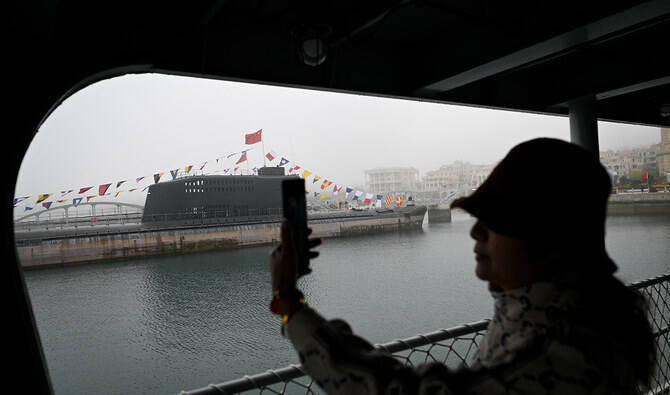
This picture taken during a media tour organised by the Chinese People's Liberation Army Navy (PLAN) to mark its 75th founding anniversary, shows a woman taking pictures of a submarine at the PLA Naval Museum in Qingdao, China's Shandong province on April 23, 2024. (AFP/File)
Short Url
Updated 15 August 2025
Follow

Pakistan launches third Chinese-built Hangor-class submarine amid deepening defense ties

  • The launch comes months after Pakistan’s brief but intense military standoff with India
  • Eight-submarine deal includes technology transfer, with four vessels to be built in Pakistan

KARACHI: Pakistan on Friday launched its third Hangor-class submarine in China, the navy said in a statement, in the latest sign of the country’s growing military ties with Beijing.

The launch comes months after Pakistan’s brief but intense military standoff with India, which saw the two nuclear-armed neighbors exchange air, missile, drone and artillery attacks.

In recent years, Islamabad has strengthened its defence collaboration with China, inducting state-of-the-art Chinese hardware across all three services, including Z-10ME attack helicopters earlier this month and JF-17 fighter jets jointly developed with Beijing.

The navy said the new vessel, equipped with modern sensors and weapons, will enhance its capabilities to safeguard national interests and contribute to a “secure and cooperative maritime environment.”

“Their cutting-edge weaponry and advanced sensors would be instrumental in sustaining regional power equilibrium and ensuring maritime stability,” Vice Admiral Abdul Samad, Deputy Chief of Naval Staff Project-2, said at the launch ceremony in Wuhan, according to a navy statement.

The launch took place at Wuchang Shipbuilding Industry Group’s Shuangliu Base and was attended by senior officials from both Pakistan and China, including representatives of China Shipbuilding & Offshore International Company Ltd (CSOC).

Samad commended the steady progress of the project, praised the work of Chinese shipbuilders and said the Hangor-class program would “bring a fresh dimension” to Pakistan-China naval cooperation.

The submarines are a new generation of diesel-electric attack vessels and equipped with advanced sensors and modern weapon systems to strengthen the country’s underwater warfare capabilities.

Pakistan signed a contract with CSOC to acquire eight Hangor-class submarines. Four are being built in China, while the remaining four will be produced in Pakistan at Karachi Shipyard & Engineering Works Limited under a transfer-of-technology program.

The first two submarines in the series were launched in 2024, with deliveries expected over the next several years.


Pakistan offers Kyrgyzstan Arabian Sea access as two states sign 15 cooperation accords

Updated 5 sec ago
Follow

Pakistan offers Kyrgyzstan Arabian Sea access as two states sign 15 cooperation accords

  • Pakistan and Kyrgyzstan sign MOUs spanning trade, energy, agriculture, ports, education, security cooperation
  • Kyrgyz president is on first visit to Pakistan in 20 years as both sides push connectivity and CASA-1000 power links

ISLAMABAD: Pakistan on Thursday offered Kyrgyzstan the shortest and most economical route to the Arabian Sea as the two countries signed 15 agreements and memoranda of understanding aimed at boosting cooperation across trade, energy, agriculture, education, customs data-sharing and port logistics.

The accords were signed during a visit to Islamabad by President Sadyr Zhaparov, the first by a Kyrgyz head of state to Pakistan in two decades, and part of Islamabad’s renewed push to link South Asia with landlocked Central Asian economies through ports, power corridors and transport routes.

For Pakistan, Kyrgyzstan offers access to hydropower through CASA-1000, a $1.2 billion regional electricity transmission project designed to carry surplus summer electricity from Kyrgyzstan and Tajikistan through Afghanistan into Pakistan. For Bishkek, Pakistan provides overland access to warm-water ports on the Arabian Sea, creating a shorter commercial route to global markets.

“President Asif Ali Zardari has reiterated Pakistan’s readiness to offer Kyrgyzstan the shortest and most economical route to the Arabian Sea,” Radio Pakistan reported after Zhaparov met the Pakistani president. 

The two leaders also discussed expanding direct flights to deepen business, tourism and people-to-people ties.

Zardari welcomed Kyrgyzstan’s completion of its segment of the CASA-1000 project and “reaffirmed Pakistan’s commitment to completing its part of the project, which is now at an advanced stage,” the state broadcaster said. 

Zhaparov thanked Islamabad for supporting Bishkek’s candidacy for a non-permanent UN Security Council seat and invited Zardari to visit Kyrgyzstan at a time of his convenience. Both sides expressed satisfaction with progress under the Quadrilateral Traffic in Transit Agreement, designed to facilitate road movement between Pakistan, Kyrgyzstan, Kazakhstan and China.

Earlier, both governments exchanged 15 sectoral cooperation documents covering commerce, mining, geosciences, power, agriculture, youth programs, the exchange of convicted persons, customs electronic data systems and a sister-city linkage between Islamabad and Bishkek.

According to APP, the MOUs were signed by ministers representing foreign affairs, commerce, economy, energy, power, railways, interior, culture, health and tourism. Agreements also covered cooperation between Pakistan’s Foreign Service Academy and the Diplomatic Academy of Kyrgyzstan, as well as collaboration between universities, youth ministries and cultural institutions.

“Our present mutual trade, comprising of about $15–16 million will be enhanced to $200 million in the next two years,” Prime Minister Shehbaz Sharif said after the agreements were signed, calling them “a framework for structured, result-oriented engagement and closer institutional linkages.”

Sharif said Pakistan was ready to serve as a maritime outlet for the landlocked Central Asian republic, offering access to Karachi, Port Qasim and Gwadar to help Kyrgyz goods reach regional and global markets.