


NEW DELHI: Prime Minister Narendra Modi announced on Friday the launch of a new “security shield” weapon system that will be expanded across India in the next decade, as the country marked 78 years of independence from British colonial rule.
Modi’s remarks came three months after India and Pakistan engaged in their worst fighting in decades. The clashes included air, drone and missile strikes, as well as artillery and small arms fire along their shared border and inside mainland areas of both countries.
India said it launched operations inside Pakistan on May 6 in response to an attack in Indian-administered Kashmir that killed 26 civilians in April. India described the incident as an act of terrorism orchestrated by Islamabad, a claim Pakistan has denied.
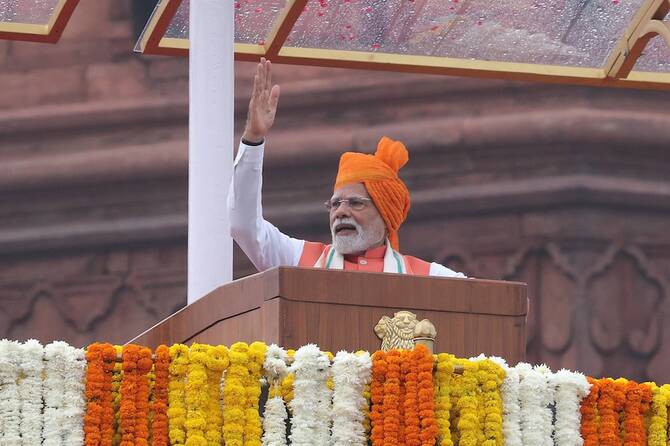
Addressing the country from New Delhi’s 17th-century, Mughal-era Red Fort on Friday, Modi said that India will be launching a new defense system called “Sudarshan Chakra.”
The prime minister said: “I pledge to take this work forward with great commitment for the security of the nation and the safety of citizens in the changing ways of warfare.”
He added: “This mission, ‘Sudarshan Chakra,’ a powerful weapon system, will not only neutralize the enemy’s attack but will also hit back at the enemy many times more.”
The new air defense initiative, inspired in part by systems like Israel’s Iron Dome, will create a multi-layered security shield across the country using homegrown technology. The government aims to have it fully in place by 2035.
“By 2035, all the important places of the nation, which include strategic as well as civilian areas, like hospitals, railways, any center of faith, will be given complete security cover through new platforms of technology,” Modi said.
“This security shield should keep expanding, every citizen of the country should feel safe. Whatever technology comes to attack us, our technology should prove to be better than that.”
Pakistan, which celebrates its Independence Day one day before India, announced in Prime Minister Shehbaz Sharif’s own speech on Thursday the creation of a new military branch, the Army Rocket Force Command, which will manage the country’s missile operations in conventional warfare. The move is part of a broader effort to boost combat readiness as tensions with India remain high.
Following the April attack, India said it has established a “new normal” that does not differentiate between “terrorists” and those who support terrorism.
“We will no longer tolerate these nuclear threats. The nuclear blackmail that has gone on for so long will no longer be endured,” Modi said.
“If our enemies continue this attempt in the future, our army will decide on its own terms, at the time of its choosing, in the manner it deems fit, and target the objectives it selects and we will act accordingly. We will give a fitting and crushing response.”
During his Friday speech, Modi hailed the Indian Army for reducing “terrorist headquarters” to dust under “Operation Sindoor.” Launched days after the attack in Kashmir, India said the operation had hit nine “terrorist infrastructure” sites in Pakistan.
“They reduced terrorist headquarters to dust and turned terrorist headquarters into ruins. Pakistan is still sleepless,” Modi said. “The devastation in Pakistan has been so huge that every day brings new revelations and fresh information.”
India has fought three wars with Pakistan since the 1947 partition of the Indian subcontinent, including two over control of the Kashmir region in the Himalayas, which they both rule in part but claim in full.
Modi also hinted that India will continue its unilateral suspension of the Indus Water Treaty with Pakistan, calling the agreement “unjust and one-sided.”
After the April attack, New Delhi had suspended the treaty that allows the sharing of the Indus River that runs about 2,897 km through South Asia and is a lifeline for both countries.
“India has now decided — blood and water will not flow together,” he said. “This agreement is unacceptable to us in the interest of our farmers, and in the interest of the nation.”
Islamabad previously said that any effort by India to stop or divert the water from flowing into Pakistan would be considered an “act of war.”


