

India signs critical minerals pact with Brazil as leaders meet in New Delhi

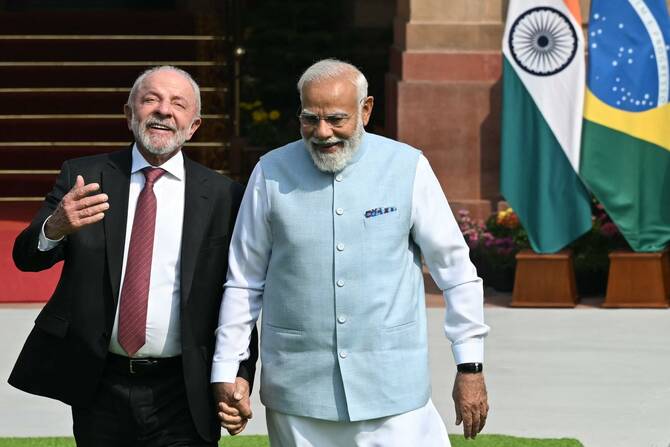
India’s Prime Minister Narendra Modi, right, holds hands with Brazil’s President Luiz Inacio Lula da Silva as they walk before their meeting at the Hyderabad House in New Delhi on Feb. 21, 2026. (AFP)
Short Url
Updated 21 February 2026
Follow

India signs critical minerals pact with Brazil as leaders meet in New Delhi

  • Brazil has one of world’s largest reserves of critical minerals, rare earths
  • India is committed to boost bilateral trade to $20 billion in five years, Modi says

NEW DELHI: India and Brazil moved to strengthen cooperation on critical minerals and rare earths with a new agreement on Saturday, following talks between Prime Minister Narendra Modi and President Luiz Inacio Lula da Silva in New Delhi.

Brazil has one of the world’s largest reserves of critical minerals and rare earths, which are essential for clean energy, modern electronics such as smartphones and fiber-optic cables, as well as advanced military technology.

Lula arrived in the Indian capital on Wednesday for the India AI Impact Summit 2026 and was accompanied by a delegation comprising more than a dozen ministers and business leaders.

“The agreement on critical minerals and rare earths is a major step toward building resilient supply chains,” Modi said during a joint press briefing.

The critical minerals cooperation is expected to boost technology transfer, exploration, research and development, while enabling India to benefit from the Brazilian experience in processing and recycling technologies, according to a statement issued by the Indian Ministry of External Affairs.

The India-Brazil deal comes a day after Delhi signed the Pax Silica Declaration, a US-led initiative aimed at securing the global supply chain for silicon-based technologies that are crucial for AI infrastructure.

Brazil offers India a potential alternative source of supply to reduce reliance on China, as Beijing’s grip on the supply of critical minerals required for high-end manufacturing and defense has been a growing concern for countries around the world.

“Increasing investment and cooperation in matters of renewable energy and critical minerals is at the core of the pioneering agreement that we have signed today,” Lula said.

India, the world’s most populous country, is also looking to strengthen its trade ties with Brazil.

“Brazil is India’s largest trade partner in Latin America. We are committed to taking our bilateral trade beyond $20 billion in the coming five years,” Modi said.

“Our nations will also work closely in areas such as technology, innovation, Digital Public Infrastructure, AI, semiconductors and more. This will benefit the people of our nation.”

India is Brazil’s 10th largest export market, with bilateral trade valued at more than $15 billion in 2025, showcasing a 25 percent growth from the previous year.

The Indian government has listed a total of 10 outcomes from Lula’s visit, including cooperation agreements in areas such as mining for steel supply chain, health and entrepreneurship.


Trump hikes US global tariff rate to 15 percent

Updated 2 sec ago
Follow

Trump hikes US global tariff rate to 15 percent

WASHINGTON: President Donald Trump raised the global duty on imports into the United States to 15 percent on Saturday, doubling down on his promise to maintain his aggressive tariff policy a day after the Supreme Court ruled much of it illegal.
Trump said on his Truth Social platform that after a thorough review of Friday’s “extraordinarily anti-American decision” by the court to rein in his tariff program, the administration was hiking the import levies “to the fully allowed, and legally tested, 15 percent level.”
Shortly after the court’s 6-3 ruling that rejected the president’s authority to impose tariffs under a 1977 economic emergency powers act, Trump had initially announced a new 10 percent global levy by invoking a different legal avenue.
At the same time, the Republican launched an extraordinary personal attack on the conservative justices who had sided with the majority, slamming their “disloyalty” and calling them “fools and lap dogs.”
The ruling was a stunning rebuke by the high court, which has largely sided with the president since he returned to office, and marked a major political setback in striking down Trump’s signature economic policy that has roiled the global trade order.
Saturday’s announcement is sure to provoke further uncertainty as Trump carries on with a trade war that he has used to cajole and punish countries, both friend and foe.
It is the latest move in a process that has seen a multitude of tariff levels for countries sending goods into the United States set and then altered or revoked by Trump’s team over the past year.
Several countries have said they are studying the Supreme Court ruling and Trump’s subsequent tariff announcements.
Brazil’s President Luiz Inacio Lula da Silva on Sunday urged Donald Trump to treat all countries equally.
“I want to tell the US President Donald Trump that we don’t want a new Cold War. We don’t want interference in any other country, we want all countries to be treated equally,” Lula told reporters in New Delhi.
German Chancellor Friedrich Merz said Saturday he would hold talks with European allies to formulate “a very clear European position” and joint response to Washington before he travels to the US capital in early March.
On the domestic front, Pennsylvania Governor Josh Shapiro, a Democrat, said on X it was time for Trump to “listen to the Supreme Court, end chaotic tariffs, and stop wreaking havoc on our farmers, small business owners, and families.”
The new duty by law is only temporary — allowable for 150 days. According to a White House fact sheet, exemptions remain for sectors that are under separate probes, including pharma, and goods entering the US under the US-Mexico-Canada agreement.
On Friday, the White House said US trading partners that reached separate tariff deals with Trump’s administration would also face the new global tariff.

- High court defeat -

Friday’s court ruling did not impact sector-specific duties Trump separately imposed on steel, aluminum and various other goods. Government probes still underway could lead to additional sectoral tariffs.
But it nevertheless marked Trump’s biggest defeat at the Supreme Court since returning to the White House 13 months ago. The court has generally expanded his power.
Trump heaped praise on the conservative justices who voted to uphold his authority to levy tariffs — Clarence Thomas, Samuel Alito and Brett Kavanaugh, a Trump nominee — thanking them “for their strength and wisdom, and love of our country.”
The president alleged the majority of six justices, including two nominated during his first term, had been “swayed by foreign interests.”
“I think that foreign interests are represented by people that I believe have undue influence,” he said.
Shares on Wall Street — a metric closely watched by Trump — rose modestly Friday after the decision, which had been expected.
Business groups largely cheered the ruling, with the National Retail Federation saying this “provides much-needed certainty” for companies.
In court arguments, the Trump administration said companies would receive refunds if the tariffs were deemed unlawful. But the Supreme Court’s ruling did not address the issue.
Trump said he expected years of litigation on whether to provide refunds. Kavanaugh noted the refund process could be a “mess.”