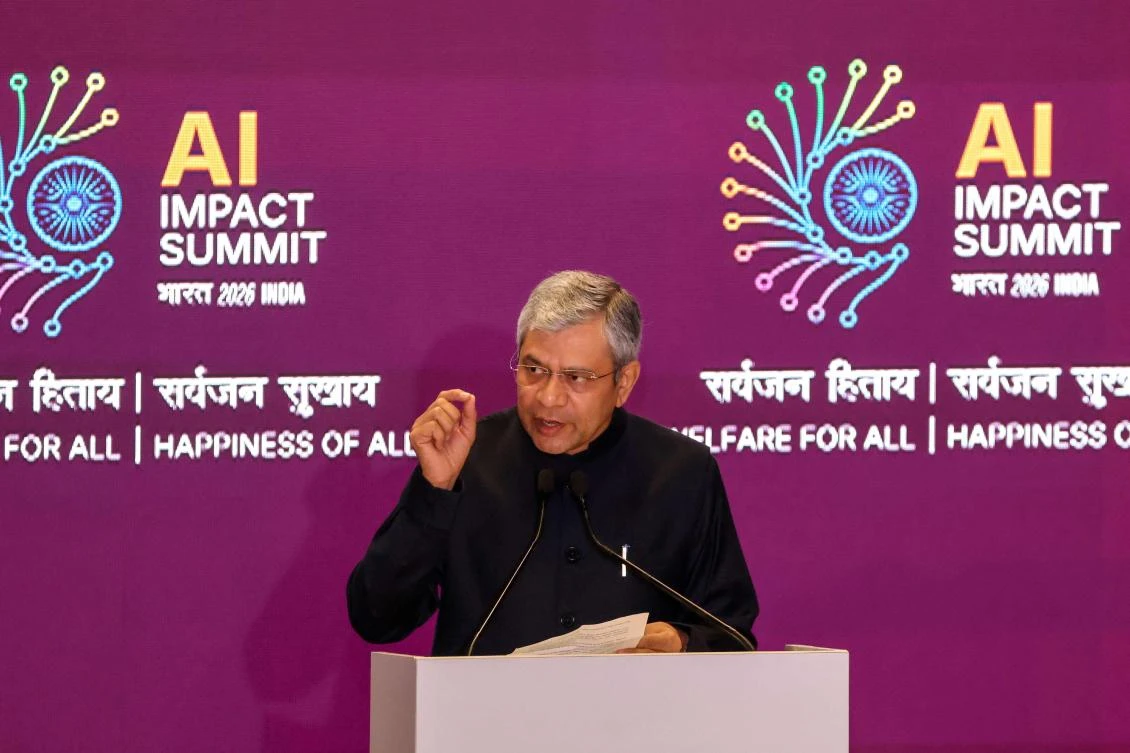
NEW DELHI: A summit statement on how the world should approach the promises and pitfalls of artificial intelligence was still not published Saturday afternoon, a day after it had been expected at global talks in New Delhi.
Dozens of national delegations, including leaders from France, Brazil and other countries, had gathered in the Indian capital this week to discuss the fast-developing technology.
On Friday, India’s IT minister Ashwini Vaishnaw said there was “huge consensus on the declaration,” the details of which he declined to provide.
He said the statement already had more than 70 signatories, but he hoped it would pass 80.
“We are just trying to maximize the number,” the minister said as the five-day AI Impact Summit drew to a close.
AFP contacted summit organizers and the IT ministry for comment on Saturday.
The summit, attended by tens of thousands of people including top tech CEOs, was the fourth annual international meeting to discuss the implications of generative AI, and the first hosted by a developing country.
Some visitors had complained of poor organization, including chaotic entry and exit points, at the vast summit and expo site.
Hot topics included the societal benefits of multilingual AI translation, the threat of job disruption and the heavy electricity consumption of data centers.
But analysts said that the summit’s broad focus, and vague promises made at its previous editions in France, South Korea and Britain, would make concrete commitments unlikely.
The United States, which did not sign last year’s AI summit statement, released its own bilateral declaration with India on Friday.
The two countries agreed to “pursue a global approach to AI that is unapologetically friendly to entrepreneurship and innovation.”
Also on Friday, White House technology adviser Michael Kratsios, head of the US delegation, warned against centralized control of generative AI.
“As the Trump Administration has now said many times: We totally reject global governance of AI,” he said.
Global AI summit in India still without final statement
https://arab.news/g29sy
Global AI summit in India still without final statement
Saudi ambassador becomes first foreign envoy to meet Bangladesh’s new PM
- Tarique Rahman took oath as PM last week after landslide election win
- Ambassador Abdullah bin Abiyah also meets Bangladesh’s new FM
Dhaka: Saudi Arabia’s ambassador to Dhaka became on Sunday the first foreign envoy to meet Bangladesh’s new Prime Minister Tarique Rahman since he assumed the country’s top office.
Rahman’s Bangladesh Nationalist Party made a landslide win in the Feb. 12 election, securing an absolute majority with 209 seats in the 300-seat parliament.
The son of former Prime Minister Khaleda Zia and former President and BNP founder Ziaur Rahman, he was sworn in as the prime minister last week.
The Saudi government congratulated Rahman on the day he took the oath of office, and the Kingdom’s Ambassador Abdullah bin Abiyah was received by the premier in the Bangladesh Secretariat, where he also met Bangladesh’s new foreign minister.
“Among the ambassadors stationed in Dhaka, this is the first ambassadorial visit with Prime Minister Tarique Rahman since he assumed office,” Saleh Shibli, the prime minister’s press secretary, told Arab News.
“The ambassador conveyed greetings and best wishes to Bangladesh’s prime minister from the king and crown prince of Saudi Arabia … They discussed bilateral matters and ways to strengthen the ties among Muslim countries.”
Rahman’s administration succeeded an interim government that oversaw preparations for the next election following the 2024 student-led uprising, which toppled former leader Sheikh Hasina and ended her Awami League party’s 15-year rule.
New Cabinet members were sworn in during the same ceremony as the prime minister last week.
Foreign Minister Khalilur Rahman is a former UN official who served as Bangladesh’s national security adviser during the interim government’s term.
He received Saudi Arabia’s ambassador after the envoy’s meeting with the prime minister.
“The foreign minister expressed appreciation for the Saudi leadership’s role in promoting peace and stability in the Middle East and across the Muslim Ummah. He also conveyed gratitude for hosting a large number of Bangladeshi workers in the Kingdom and underscored the significant potential for expanding cooperation across trade, investment, energy, and other priority sectors, leveraging the geostrategic positions of both countries,” the ministry said in a statement.
“The Saudi ambassador expressed his support to the present government and his intention to work with the government to enhance the current bilateral relationship to a comprehensive relationship.”
Around 3.5 million Bangladeshis live and work in Saudi Arabia. They have been joining the Saudi labor market since 1976, when work migration to the Kingdom was established during the rule of the new prime minister’s father.
Bangladeshis are the largest expat group in the Kingdom and the largest Bangladeshi community outside Bangladesh and send home more than $5 billion in remittances every year.