

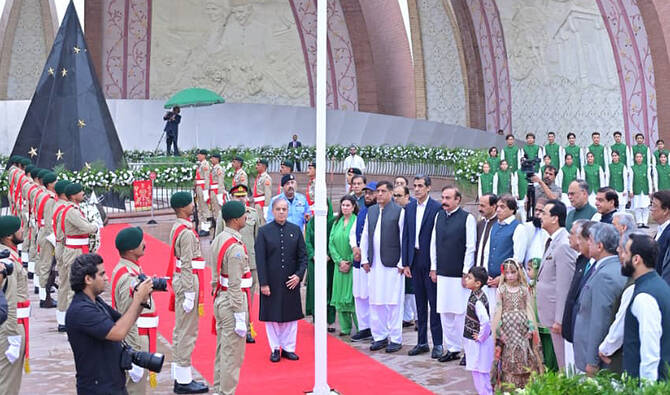

ISLAMABAD: Saudi Arabia, United Arab Emirates and other Arab countries on Thursday congratulated Pakistan on its 79th Independence Day, praising progress in bilateral relations and highlighting cooperation in trade, economic growth and regional peace.
Pakistan has strong religious, cultural, defense and economic relations with Arab Gulf countries, which are home to millions of Pakistani expatriates and serve as top sources of remittances to the South Asian country.
On Thursday, Aug. 14, when Pakistan marks its independence from British colonial rule in 1947, Saudi Arabia’s embassy in Islamabad extended its heartfelt felicitations to the South Asian nation.
“The Embassy of Saudi Arabia in Islamabad extends its sincere congratulations and best wishes to the brotherly Pakistani people on the occasion of Independence Day,” the Saudi embassy wrote on X.
“We pray to Allah Almighty to grant Pakistan lasting peace and stability.”
Hamad Obaid Al-Zaabi, the ambassador of the UAE, which is Pakistan’s second-largest source of foreign remittances after Saudi Arabia, praising progress in bilateral relations in recent years, highlighting cooperation in trade, economic growth and regional peace.
“As I enter my eighth year in this beautiful country, it is both an honor and a joy to join my Pakistani brothers and sisters in celebrating this cherished Independence Day,” Al-Zaabi said in a statement.
“Over the past year, our two nations have achieved notable milestones — advancing economic cooperation, expanding trade opportunities, and working side by side to promote peace, stability, and shared prosperity in our region.”
In a spectacular show of the bond between the two nations, Dubai’s iconic Burj Khalifa also lit up with Pakistan’s national flag on Thursday evening as the South Asian country marked its 79th Independence Day.
Sheikh Ahmad Abdullah Al-Ahmad Al-Sabah, the prime minister of Kuwait, also congratulated Pakistan President Asif Ali Zardari on his country’s Independence Day, the Kuwait News Agency reported.
“We congratulate the Islamic Republic of #Pakistan on the occasion of its Independence Day,” the Omani foreign ministry said in a post on X.
On Thursday, Pakistan’s civilian and military leaders marked the country’s 79th Independence Day by hailing what they described as a decisive victory against India in a brief military conflict earlier this year, using the anniversary to call for unity at home and reiterate support for disputed Kashmir.
The South Asian nation, which has fought three major wars with India since partition in 1947, said it had downed six Indian jets in fighting through missiles, drones and artillery that raged between May 6 and 10 before ending through US mediation. Officials have since framed the confrontation — which Islamabad has dubbed Marka-e-Haq, or “Battle of Truth” — as a moment of national resurgence.
“Pakistan’s great victory in Marka-e-Haq during the war imposed by India on 6-10th May 2025 has not only increased the significance of freedom, but has also enliven a new ambition and enthusiasm in the hearts of Pakistanis, which has amplified the joy and celebrations of the Independence Day,” Prime Minister Shehbaz Sharif said in a statement.
“The military capability, valour and faith of our brave soldiers and air warriors forced the enemy to kneel down … With same passion, we stand vigilant to defend and safeguard our national interests including water resources.”
Pakistan, carved out of British India in 1947, has seen repeated bouts of political turmoil, economic instability and tense relations with its neighbor in the decades since. This year’s Independence Day messages underscored how the May conflict has become a rallying point for its leaders to emphasize unity, resilience and renewed national confidence.
President Zardari also linked the country’s birth anniversary to the May conflict, while in a joint message, the chiefs of Pakistan’s army, navy and air force stressed that the “unbreakable bond between the Armed Forces and the people is the cornerstone of our collective strength,” pledging to safeguard Pakistan’s sovereignty and territorial integrity and uphold the constitution.


