

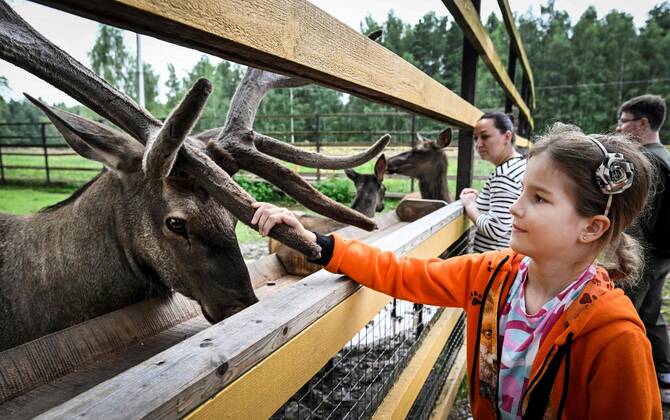

KOROLYOV: After getting fined for her environmental protest against a road being built through a national park near Moscow, Irina Kuriseva is back to check on the construction.
“We only want to defend nature,” the 62-year-old told AFP at the Losiny Ostrov (Elk Island) park, a 129-square-kilometer nature reserve with hundreds of species of wildlife including endangered birds.
With dissident voices in Russia almost totally silenced and as the country presses on with its massive military offensive in Ukraine, environmental activism has become highly risky.
“The authorities have become completely indifferent” and laws have been “softened” in favor of polluters and property developers, said one activist, speaking on condition of anonymity.
In the outskirts of Moscow, the issue has become particularly acute as developers continue to build new homes and residents commuting to the capital find themselves stuck in traffic jams for hours.
In Korolyov, a town of 200,000 people, the authorities decided to build a highway that passes through the national park to ease congestion and give access to a new housing development.
In July, Kuriseva and five other activists blocked machinery spreading asphalt in the forest.
They were arrested by police and fined, after spending a night at the police station.
“We were interrogated like criminals who had killed someone,” said Kuriseva, a local resident.
Russian law prohibits construction in national parks but local authorities got around it by arguing that the project consisted of “repairs” to an existing road.
Dmitry Trunin, an environmental defense lawyer with more than 25 years of experience, said this argument amounted to “falsification and fraud.”
“There was never a road there,” he said, explaining that there had only been an unpaved track used by forest rangers which then became just a path through the forest.
Kuriseva said that “asphalt powder” was placed on the path in an attempt to classify it as a road.
The highway is due to be completed by March 2026 at a cost of 5.4 million euros ($6.3 million), according to the regional transport ministry.
Mikhail Rogov, a 36-year-old engineer who also took part in the protest with Kuriseva, said the judge was “smiling” to the defendants in court.
“She told us: ‘If you don’t want any problems, sign these papers, pay your fines and you’re free’,” he said.
The judge, Maria Loktionova, had in 2023 sentenced another environmental activist, Alexander Bakhtin, to six years in prison for three posts on social media criticizing the Russian offensive in Ukraine.
Despite the crackdown on dissent, activists opposed to the highway have sought to appeal to President Vladimir Putin to help their cause.
In June, around a thousand people queued outside the presidential administration building in Moscow to submit their complaints.
Putin visited the national park in 2010 and fed a baby elk with a bottle, telling reporters that nature was “a gift from God” that must be “protected.”
The tone from the Kremlin is very different in 2025.
“This is a question for the regional authorities. Don’t get the president involved,” Kremlin spokesman Dmitry Peskov said in July when asked about the project by AFP.
Environmental protection “should not be a barrier to development and the comfort of the lives of citizens,” he said.
Trunin said it has become “harder and harder to defend the truth in court.”
“The power vertical takes decisions and law enforcement and monitoring bodies obey,” he said.


