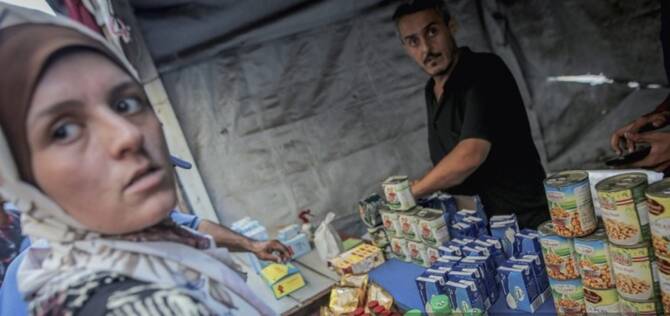

GAZA: Student Maha Ali was determined to become a journalist one day and report on events in Gaza. Now she and other students have just one ambition: finding food as hunger ravages the Palestinian enclave.
As war rages, she is living among the ruins of Islamic University, a once-bustling educational institution, which like most others in Gaza, has become a shelter for displaced people.
“We have been saying for a long time that we want to live, we want to get educated, we want to travel. Now, we are saying we want to eat,” honors student Ali, 26, said.
Ali is part of a generation of Gazans — from grade school through to university — who say they have been robbed of an education by nearly two years of Israeli air strikes, which have destroyed the enclave’s institutions.
More than 60,000 people have been killed in Israel’s response to Palestinian militant group Hamas’ October 7, 2023 attack on its southern communities, according to Gaza health authorities. Much of the enclave, which suffered from poverty and high unemployment even before the war, has been demolished.
Palestinian Minister of Education Amjad Barham accused Israel of carrying out a systematic destruction of schools and universities, saying 293 out of 307 schools were destroyed completely or partially.
“With this, the occupation wants to kill hope inside our sons and daughters,” he said.
There was no immediate comment from the Israeli military or foreign ministry.
Israel has accused Hamas and other militant groups of systematically embedding in civilian areas and structures, including schools, and using civilians as human shields.
Hamas rejects the allegations and along with Palestinians accuses Israel of indiscriminate strikes.
EXTENSIVE DESTRUCTION
The United Nations Office for the Coordination of Humanitarian Affairs said that according to the latest satellite-based damage assessment in July, 97 percent of educational facilities in Gaza have sustained some level of damage with 91 percent requiring major rehabilitation or complete reconstruction to become functional again.
“Restrictions by Israeli authorities continue to limit the entry of educational supplies into Gaza, undermining the scale and quality of interventions,” it said.
Those grim statistics paint a bleak future for Yasmine Al-Za’aneen, 19, sitting in a tent for the displaced sorting through books that have survived Israeli strikes and displacement.
She recalled how immersed she was in her studies, printing papers and finding an office and fitting it with lights.
“Because of the war, everything was stopped. I mean, everything I had built, everything I had done, just in seconds, it was gone,” she said.
There is no immediate hope for relief and a return to the classroom.
Mediators have failed to secure a ceasefire between Israel and Hamas, which triggered the conflict by killing 1,200 people and taking 251 hostage, according to Israeli tallies.
Instead, Israel plans a new Gaza offensive, which Prime Minister Benjamin Netanyahu said on Sunday he expected to complete “fairly quickly” as the UN Security Council heard new demands for an end to suffering in the Palestinian enclave.
So Saja Adwan, 19, an honors student of Gaza’s Azhar Institute who is living in a school turned shelter with her family of nine, recalled how the building where she once learned was bombed.
Under siege, her books and study materials are gone. To keep her mind occupied, she takes notes on the meagre educational papers she has left.
“All my memories were there, my ambitions, my goals. I was achieving a dream there. It was a life for me. When I used to go to the institute, I felt psychologically at ease,” she said.
“My studies were there, my life, my future where I would graduate from.”