Iran names moderate Larijani to head top security body

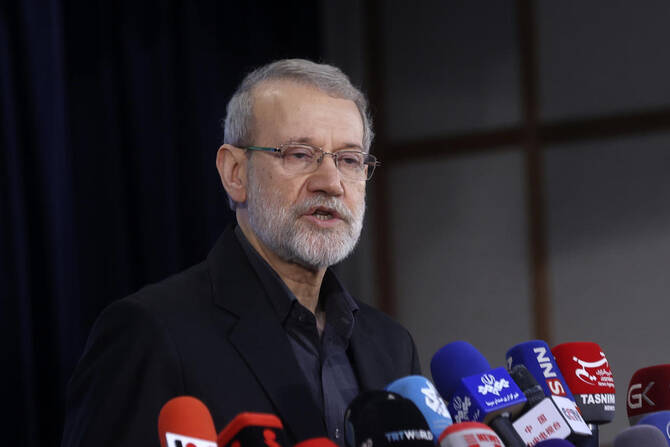
Former Iranian parliament speaker Ali Larijani speaks with the media. (File/AP)
Short Url
Updated 05 August 2025
Follow

Iran names moderate Larijani to head top security body

  • Ali Larijani was appointed secretary of the Supreme National Security Council in a decree by President Masoud Pezeshkian, IRNA reported
  • The security council is responsible for laying out Iran’s defense and security strategy, but its decisions must be approved by the country’s supreme leader

TEHRAN: Iran has appointed veteran politician Ali Larijani, considered a moderate on foreign policy, to lead the Islamic republic’s top security body, state media said Tuesday.
“Ali Larijani was appointed secretary of the Supreme National Security Council in a decree by President Masoud Pezeshkian,” official news agency IRNA reported.
Larijani, 68, who is seen as a moderate conservative in Iran, replaces Ali Akbar Ahmadian, a Revolutionary Guards general who was named to the position in May 2023.
His appointment comes after a 12-day war in June, launched by Israel and later joined by the United States, during which key Iranian nuclear and military sites were hit.
The security council is responsible for laying out Iran’s defense and security strategy, but its decisions must be approved by the country’s supreme leader, Ayatollah Ali Khamenei.
The secretary, as the most senior member of the council, oversees the implementation of its decisions.
A former member of the Islamic Revolutionary Guard Corps, Larijani has held several senior government positions over three decades.
Khamenei made him one of his advisers in May 2020.
The following year, Larijani’s presidential run was blocked by a government vetting body despite him being considered a leading candidate.
Starting in 2005, Larijani had led Iran’s nuclear policy but resigned after two years of negotiations with Western powers, citing “serious differences” with the president at the time, ultra-conservative Mahmoud Ahmadinejad.
As parliament speaker from 2008 to 2020, Larijani put his weight behind the 2015 nuclear agreement with world powers.
The son of a grand ayatollah, Larijani comes from an influential Shiite Muslim family with ties to the government, and holds a doctorate in philosophy.
Tehran and Washington had been engaged in negotiations aimed at reaching a new nuclear deal earlier this year, but the talks were derailed by the Israel-Iran war.
Israel said its offensive was aimed at preventing Iran from acquiring nuclear weapons, an ambition Tehran has consistently denied pursuing.


Israel fires mortar into Gaza residential area, wounding at least 10

Updated 12 sec ago
Follow

Israel fires mortar into Gaza residential area, wounding at least 10

  • The attack is the latest Israeli attack since the Oct. 10 ceasefire took effect
  • Palestinian health officials have reported over 370 deaths from Israeli fire since the truce
JERUSALEM: Israeli troops fired a mortar shell over the ceasefire line into a Palestinian residential area in the Gaza Strip, in the latest incident to rock the tenuous ceasefire with Hamas. Health officials said at least 10 people were wounded, and the army said it was investigating.
The military said the mortar was fired during an operation in the area of the “Yellow Line,” which was drawn in the ceasefire agreement and divides the Israeli-held majority of Gaza from the rest of the territory.
The military did not say what troops were doing or whether they had crossed the line. It said the mortar had veered from its intended target, which it did not specify.
Fadel Naeem, director of Al-Ahli Hospital, said the hospital received 10 people wounded in the strike on central Gaza City, some critically.
It was not the first time since the ceasefire took effect on Oct. 10 that Israeli fire has caused Palestinian casualties outside the Yellow Line. Palestinian health officials have reported over 370 deaths from Israeli fire since the truce.
Israel has said it has opened fire in response to Hamas violations, and says most of those killed have been Hamas militants. But an Israeli military official, speaking on condition of anonymity in line with military protocol, said the army is aware of a number of incidents where civilians were killed, including young children and a family traveling in a van.
Palestinians say civilians have been killed in some cases because the line is poorly marked. Israeli troops have been laying down yellow blocks to delineate it, but in some areas the blocks have not yet been placed.
Ceasefire’s next phase
The Israel-Hamas ceasefire is struggling to reach its next phase, with both sides accusing each other of violations. The first phase involved the exchange of hostages for Palestinian prisoners. The second is supposed to involve the deployment of an international stabilization force, a technocratic governing body for Gaza, the disarmament of Hamas and further Israeli troop withdrawals from the territory.
The remains of one hostage, Ran Gvili, are still in Gaza, and the militants appear to be struggling to find it. Israel is demanding the return of Gvili’s remains before moving to the second phase.
Hamas is calling for more international pressure on Israel to open key border crossings, cease deadly strikes and allow more aid into the strip. Recently released Israeli military figures suggest it hasn’t met the ceasefire stipulation of allowing 600 trucks of aid into Gaza a day, though Israel disputes that finding.
Humanitarian groups say the lack of aid has had harsh effects on most of Gaza’s residents. Food remains scarce as the territory struggles to bounce back from famine, which affected parts of Gaza during the war.
The toll of war
The vast majority of Gaza’s 2 million people have been displaced. Most live in vast tent camps or among the shells of damaged buildings.
The initial Hamas-led Oct. 7, 2023, attack on southern Israel killed around 1,200 people and took 251 hostages. Almost all hostages or their remains have been returned in ceasefires or other deals.
Israel’s two-year campaign in Gaza has killed more than 70,660 Palestinians, roughly half of them women and children, according to the territory’s Health Ministry, which does not distinguish between militants and civilians in its count. The ministry, which operates under the Hamas-run government, is staffed by medical professionals and maintains detailed records viewed as generally reliable by the international community.