


NEW YORK CITY: A comprehensive national plan to address the future of Hezbollah must be placed at the heart of efforts to stabilize Lebanon, the UN’s special coordinator for the country, Jeanine Hennis-Plasschaert, told the Security Council on Tuesday.
Describing it as an “urgent priority,” she stressed that any credible path forward must tackle not only the group’s weapons but also its financial networks and extensive social infrastructure, through a coordinated approach that involves all branches of the Lebanese state.
Relying on broader regional dynamics to resolve the deepening crisis in Lebanon would be misguided, she warned.
“Betting on a regional settlement to solve Lebanon’s problems would be a grave mistake,” she said, as she urged leaders to focus instead on immediate domestic initiatives.
Hennis-Plasschaert was briefing the council, alongside the UN’s under-secretary-general for peace operations, Jean-Pierre Lacroix, on the implementation of Security Council Resolution 1701, which ended the 2006 war between Israel and Hezbollah.
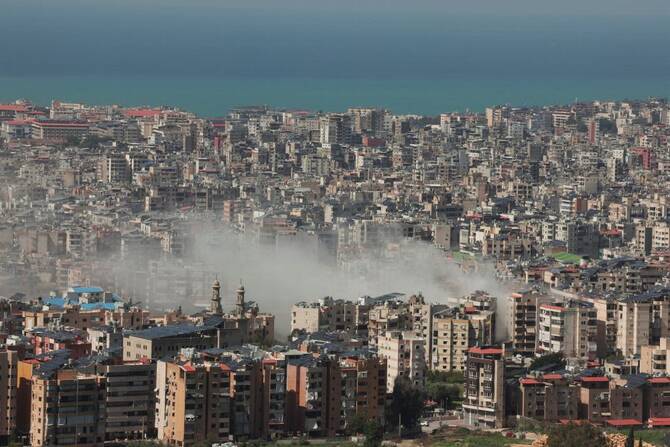
Early hopes that the country might avoid the current violence in the region amid the US-Israeli conflict with Iran were dashed when Hezbollah launched an attack against Israel on March 2, she said, triggering an Israeli military response that left thousands of people dead or injured and more a million displaced in the first two weeks.
“In doing so, it spread the embers that have now engulfed Lebanon in flames,” she added.
Calling for “swift and decisive action,” the UN envoy outlined several long-delayed priorities for Lebanon, including the development of a national security strategy, the launch of cross-party dialogue, and renewed efforts to improve socioeconomic conditions in the country, particularly among marginalized communities. She also highlighted the need to plan for the future of Hezbollah fighters.
Equally critical, Hennis-Plasschaert said, is the need to strengthen the Lebanese Armed Forces, which remains indispensable in the efforts to ensure the state holds a monopoly on possession of arms but is facing a severe gap between its mounting responsibilities and the availability of resources to address them.
“The harsh reality is that the Lebanese Armed Forces continue to face a colossal mismatch between the resources at hand and the tasks ahead,” she said, calling for significantly increased international support alongside stronger domestic fiscal prioritization.
With humanitarian, recovery and reconstruction needs also increasing rapidly, Hennis-Plasschaert emphasized the importance of scaling up international assistance. Such support, she said, is essential not only to meet urgent needs, but to prevent nonstate actors from once again stepping in to fill gaps left by the state.
She described the situation as “profoundly challenging, volatile and dangerous,” and cautioned that ongoing military action would not result in any lasting solutions.
She welcomed the fact that Lebanese authorities were open to holding direct talks with Israel, and pointed to what she described as a broad national desire for stability and state-building over continued conflict.
“Across all sects, confessions and political affiliations, there is a resounding readiness to abandon armed resistance for governance,” Hennis-Plasschaert said.
“There is a great desire to live in a stable country and region, as well as an enormous appetite to build a state that unites, rather than to maintain the weapons that divide.”


