BEIRUT: The leader of Lebanon’s Hezbollah warned Tuesday that if Israel intensifies its military operations against his group, the Iran-backed armed faction will resume firing missiles toward Israel.
Naim Kassem’s comments came as Lebanon’s Cabinet was meeting to discuss Hezbollah’s disarmament. Beirut is under US pressure to disarm the group that recently fought a 14-month war with Israel and was left gravely weakened, with many of its political and military leaders dead.
Since the war ended in November with a US-brokered ceasefire, Hezbollah officials have said the group will not discuss its disarmament until Israel withdraws from five hills it controls inside Lebanon and stops almost daily airstrikes that have killed or wounded hundreds of people, most of them Hezbollah members.
Israel has accused Hezbollah of trying to rebuild its military capabilities. Israel’s military has said the five locations in Lebanon provide vantage points or are located across from communities in northern Israel, where about 60,000 Israelis were displaced during the war.
Since the ceasefire, Hezbollah has claimed responsibility for one attack on a disputed area along the border.
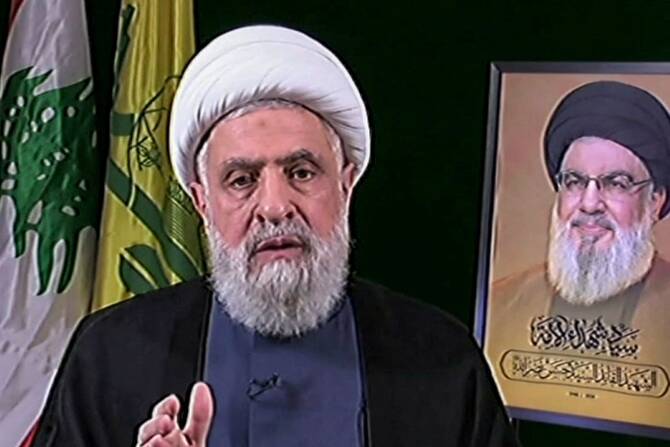
In a televised speech Tuesday, Kassem said Hezbollah rejects any timetable to hand over its weapons.
“Israel’s interest is not to widen the aggression because if they expand, the resistance will defend, the army will defend and the people will defend,” Kassem said. “This defense will lead to the fall of missiles inside Israel.”
Since the war ended, Hezbollah has withdrawn most of its fighters and weapons from the area along the border with Israel south of the Litani river.
Last week, Lebanese President Joseph Aoun reiterated calls for Hezbollah to give up its weapons, angering the group’s leadership.
The ceasefire agreement left vague how Hezbollah’s weapons and military facilities north of the Litani river should be treated, saying Lebanese authorities should dismantle unauthorized facilities starting with the area south of the river.
Hezbollah maintains the deal only covers the area south of the Litani, while Israel and the US say it mandates disarmament of the group throughout Lebanon.
Kassem said Hezbollah rejects a government vote over its weapons, saying such a decision should be unanimously backed by all Lebanese.
“No one can deprive Lebanon of its force to protect its sovereignty,” Kassem said.
Hezbollah’s weapons are a divisive issue among Lebanese, with some groups calling for its disarmament.
The Israel-Hezbollah war started a day after the Oct. 7, 2023, Hamas-led attack against Israel from Gaza. It left more than 4,000 people dead and caused damage worth $11 billion.

Hezbollah threatens to resume firing missiles at Israel if it intensifies operations in Lebanon
https://arab.news/b87kt
Hezbollah threatens to resume firing missiles at Israel if it intensifies operations in Lebanon
- Naim Kassem’s comments came as Lebanon’s Cabinet was meeting to discuss Hezbollah’s disarmament
- Hezbollah officials have said the group will not discuss its disarmament until Israel withdraws from five hills it controls inside Lebanon
US officials say Gaza stabilization force will not fight Hamas
- An American two-star general is under consideration to lead the ISF, but no decision has been made, officials said
NEW YORK: International troops could be deployed in the Gaza Strip as early as next month to form a UN-authorized stabilization force, two US officials said, but it remains unclear how Hamas will be disarmed.
Officials said the International Stabilization Force, or ISF, would not fight Hamas.
They said many countries have expressed interest in contributing, and US officials are currently working out the size of the ISF, its composition, housing, training, and rules of engagement.
There is a lot of quiet planning that’s going on behind the scenes right now for phase two of the peace deal.
Karoline Leavitt, White House spokesperson
An American two-star general is under consideration to lead the ISF, but no decision has been made, officials said.
Deployment of the force is a key part of the next phase of US President Donald Trump’s Gaza peace plan.
Under the first phase, a fragile ceasefire in the two-year war began on Oct.10, and Hamas released hostages, and Israel freed detained Palestinians.
“There is a lot of quiet planning that’s going on behind the scenes right now for phase two of the peace deal,” White House spokesperson Karoline Leavitt said.
“We want to ensure an enduring and lasting peace.”
Indonesia has said it is prepared to deploy up to 20,000 troops to take on health and construction-related tasks in Gaza.
“It is still in the planning and preparation stages,” said Rico Sirait, spokesperson of the Indonesian Defense Ministry.
“We are now preparing the organizational structure of the forces to be deployed.”
Israel still controls 53 percent of Gaza, while nearly all the 2 million people in the enclave live in the remaining Hamas-held area. The plan — which needs to be finalized by the so-called Board of Peace — is for the ISF to deploy in the area held by Israel, the US officials said.
Then, according to the Trump peace plan, as the ISF establishes control and stability, Israeli troops will gradually withdraw “based on standards, milestones, and timeframes linked to demilitarization.”
A UN Security Council resolution adopted on Nov. 17 authorized a Board of Peace and countries working with it to establish the ISF.
Trump said on Wednesday that an announcement on which world leaders will serve on the Board of Peace will be made early next year.
The Security Council authorized the ISF to work alongside newly trained and vetted Palestinian police to stabilize security “by ensuring the process of demilitarizing the Gaza Strip, including the destruction and prevention of rebuilding of the military, terror, and offensive infrastructure, as well as the permanent decommissioning of weapons from non-state armed groups.”
However, it remains unclear exactly how that would work.
US Ambassador to the UN Mike Waltz noted on Thursday that the Security Council authorized the ISF to demilitarize Gaza by all means necessary, which means the use of force.
“Obviously, that’ll be a conversation with each country,” he told Israel’s Channel 12, adding that discussions on rules of engagement were underway.
Hamas has said the issue of disarmament has not been discussed with them formally by the mediators — the US, Egypt, and Qatar — and the group’s stance remains that it will not disarm until a Palestinian state is established.
Israel’s Prime Minister Benjamin Netanyahu said in a speech on Sunday that the second phase would move toward demilitarization and disarmament.
“Now that raises a question: Our friends in America want to try and establish a multinational task force to do the job,” he said. “I told them I welcome it. Are volunteers here? Be my guest,” Netanyahu said.
“We know there are certain tasks that this force can perform ... but some things are beyond their abilities, and perhaps the main thing is beyond their abilities, but we will see about that,” he said.


