

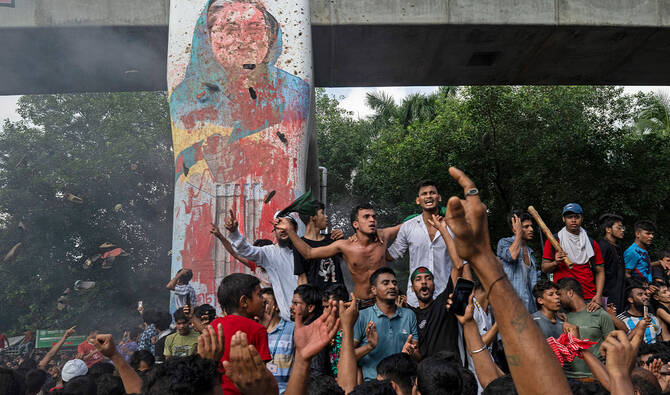

DHAKA: Abdur Rahman Tarif was talking to his sister Meherunnesa over the phone when the voice on the other end of the call suddenly fell silent.
In that moment, Tarif knew something bad had happened. He rushed home, dodging the exchange of fire between security forces and protesters on the streets of Dhaka. When he finally arrived, he discovered his parents tending to his bleeding sister.
A stray bullet had hit Meherunnesa’s chest while she was standing beside the window of her room, Tarif said. She was taken to a hospital where doctors declared her dead.
Meherunnesa, 23, was killed on Aug. 5 last year, the same day Bangladesh’s former Prime Minister Sheikh Hasina was forced to flee the country in a massive student-led uprising, which ended her 15-year rule. For much of Bangladesh, Hasina’s ouster was a moment of joy. Three days later, Nobel Peace Prize laureate Muhammad Yunus took over the country as head of an interim government, promising to restore order and hold a new election after necessary reforms.
A year on, Bangladesh is still reeling from that violence, and Hasina now faces trial for crimes against humanity in absentia, as she is in exile in India. But despite the bloodshed and lives lost, many say the prospect for a better Bangladesh with a liberal democracy, political tolerance and religious and communal harmony has remained a challenge.
“The hope of the thousands who braved lethal violence a year ago when they opposed Sheikh Hasina’s abusive rule to build a rights-respecting democracy remains unfulfilled,” said Meenakshi Ganguly, deputy Asia director at Human Rights Watch, a New York-based human rights group.
A YEAR LATER, CHANGE IS STALLED
Bangladesh’s anti-government movement exacted a heavy price. Hundreds of people, mostly students, were killed in violent protests. Angry demonstrators torched police stations and government buildings. Political opponents often clashed with each other, sometimes leading to gruesome killings.
Like many Bangladeshis, Tarif and his sister took part in the uprising, hoping for a broader political change, particularly after when one of their cousins was shot and killed by security forces.
“We could not stay home and wanted Sheikh Hasina to go,” 20-year-old Tarif said. “Ultimately we wanted a country without any discrimination and injustice.”
Today, his hopes lie shattered. “We wanted a change, but I am frustrated now,” he said.
After taking the reins, the Yunus-led administration formed 11 reform commissions, including a national consensus commission that is working with major political parties for future governments and the electoral process.
Bickering political parties have failed to reach a consensus on a timetable and process for elections. Mob violence, political attacks on rival parties and groups, and hostility to women’s rights and vulnerable minority groups by religious hard-liners have all surged.
Some of the fear and repression that marked Hasina’s rule, and abuses such as widespread enforced disappearances, appear to have ended, rights groups say. However, they accuse the new government of using arbitrary detention to target perceived political opponents, especially Hasina’s supporters, many of whom have been forced to go into hiding.
Hasina’s Awami League party, which remains banned, says more than two dozen of its supporters have died in custody over the last one year. The Yunus-led administration has announced a public holiday on Aug. 5 to mark Hasina’s ouster.
Human Rights Watch in a statement on July 30 said the interim government “is falling short in implementing its challenging human rights agenda.” It said violations against ethnic and other minority groups in some parts of Bangladesh have continued.
“The interim government appears stuck, juggling an unreformed security sector, sometimes violent religious hard-liners, and political groups that seem more focused on extracting vengeance on Hasina’s supporters than protecting Bangladeshis’ rights,” said Ganguly.
Yunus’ office routinely rejects these allegations.
YUNUS PROMISES APRIL ELECTION
Bangladesh also faces political uncertainty over a return to democratically held elections.
Yunus has been at loggerheads with the Bangladesh Nationalist Party, or BNP, now the main contender for power. The party headed by former Prime Minister Khaleda Zia has demanded elections either in December or February next year. Yunus has said they could be held in April.
The interim government has also cleared the way for religious parties, who were under severe pressure during Hasina’s regime, to rise, while the student leaders who spearheaded the uprising have formed a new political party. The students’ party demands that the constitution be rewritten, if needed entirely, and says it won’t allow the election without major reforms.
Meanwhile, many hard-liners have either fled prison or have been released, and the Jamaat-e-Islami, the country’s largest religious party, which has a controversial past, is now aspiring to a role in government. It often bitterly criticizes the BNP, equating it with Hasina’s Awami League, and recently held a massive rally in Dhaka as a show of power. Critics fear that greater influence of religious forces could fragment Bangladesh’s political landscape further.
“Any rise of Islamists demonstrates a future Bangladesh where radicalization could get a shape where so-called disciplined Islamist forces could work as a catalyst against liberal and moderate forces,” political analyst Nazmul Ahsan Kalimullah said.
Worries also remain over whether the government is ultimately capable of enacting reforms.
“People’s expectation was (that) Yunus government will be focused and solely geared toward reforming the electoral process.
But now it’s a missed opportunity for them,” Kalimullah said.
FRUSTRATION IS RISING
For some, not much has changed in the last year.
Meherunnesa’s father, Mosharraf Hossain, said the uprising was not for a mere change in government, but symbolized deeper frustrations. “We want a new Bangladesh … It’s been 54 years since independence, yet freedom was not achieved,” he said.
Tarif echoed his father’s remarks, adding that he was not happy with the current state of the country.
“I want to see the new Bangladesh as a place where I feel secure, where the law enforcement agencies will perform their duties properly, and no government will resort to enforced disappearances or killings like before. I want to have the right to speak freely,” he said.


